About Race of the Ancients
The race game of Ur, played four and a half thousand years ago. Throw four pyramid dice and run your seven pieces along twenty inlaid squares. Rosettes give another throw, and the shared middle lane is where pieces are knocked home. Climb a ladder of seven rivals, then test yourself on Trials cut from exactly solved endgames.
How to play
- Goal
- Bear all seven of your pieces off the board before your rival does.
- How it ends
- The first player to bear off seven pieces wins the match; a lost match simply ends, and you can play again.
- Record
- Each rival keeps your fastest win and your fewest turns to a win, and the ten best of each for everyone; each Trial keeps your fastest first solve and the best time for everyone.
- Press Throw. Each pyramid shows a marked tip or a plain one; the marked tips count, so a throw moves 0 to 4 squares. The pieces that can move that far glow: tap one to move it, or tap your waiting stack to bring a new piece on.
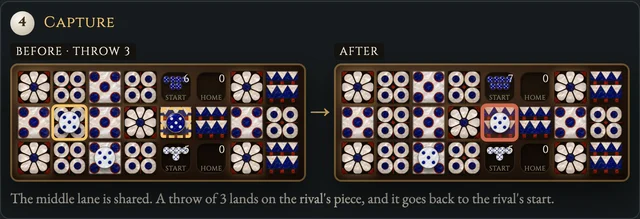
- Your first four squares and last two are your own. The eight squares in the middle are shared: land on a rival piece there and it goes back to its stack. A square never holds two of your own pieces.
- Land on a rosette and you throw again. The rosette in the middle of the shared lane is safe: nobody can be knocked off it. A piece leaves the board only with the exact throw. Bear all seven off first to win.
- Beat a rival to unlock the next. A Trial gives you a late position and fixed throws: find the best move at every choice and bring your last piece home.
Controls
| Input | Action |
|---|---|
| Throw · Space, Enter or T | Throw the four pyramid dice |
| Tap or click a glowing piece or your stack | Move that piece the thrown count |
| Arrows or Tab, then Enter | Choose a movable piece and move it |
| N · Restart | Start the match again |
| Escape | Menu, or leave the match |
Good to know
Finkel's reconstruction of the rules. Every rival is measured to beat the one below it in a thousand paired matches with the same throws. Every Trial's best moves are proved by an exact endgame solve and checked by a second, independent one. A match in progress, records, sound and motion settings persist.