About Sculpture Arena
Seven competitions on photographs of 2,896 public-domain sculptures, from prehistoric figurines, Egyptian and Greek statues and Chinese Buddhas to Michelangelo, Bernini, Canova, Rodin and the monuments of the early twentieth century. Every picture shows the named work itself or another cast of it by the same sculptor.
Play the 263 famous works, everything at once, one of seven eras or one part of the world. Titles, sculptors, dates and cities come from Wikidata (CC0) and are kept only when the photograph's own Commons record agrees; photographs from Wikimedia Commons, each credited.
How to play
- Goal
- Recognize the world’s sculptures from photographs and learn their names, sculptors, centuries and the cities that hold them.
- How it ends
- Finish ten questions or ten pairs, exhaust the sprint clock, or make one sprint mistake.
- Record
- Best score, highest Century Reserve or fastest Matching finish, with time and the player’s name.
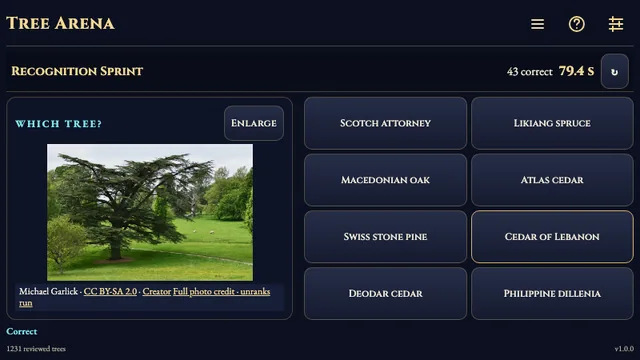
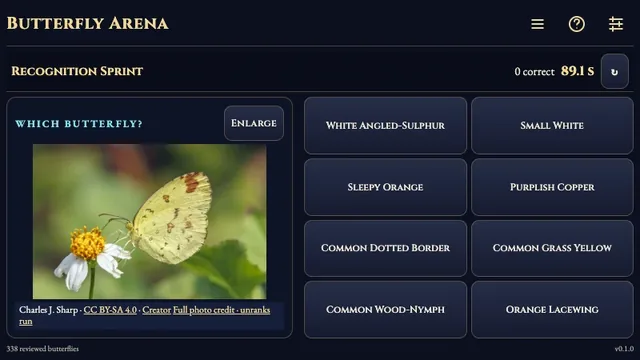
- Recognition Sprint: choose the pictured sculpture from eight titles, by the same sculptor where possible. You have 90 seconds and one wrong answer ends the run. Most correct answers wins; the time of the last one breaks ties.
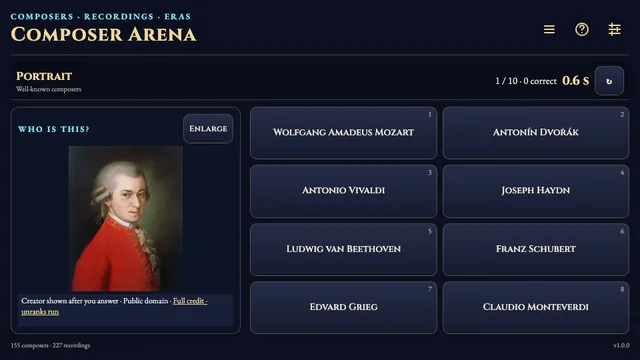
- Title Round: the same eight-title choice at your own pace, ten photographs, each answer revealed. Most correct answers wins, then time.
- Name Search: identify ten photographs. Type part of a title, an alias or the sculptor's name and pick from the list; close spellings are offered. Correct answers rank first, then faster time.
- Sculptor: choose the sculptor of ten named works from eight who worked within about a century of each other. Most correct answers wins, then time.
- Where It Stands: choose the city that holds each of ten named works from eight cities in eight countries. Most correct answers wins, then time.
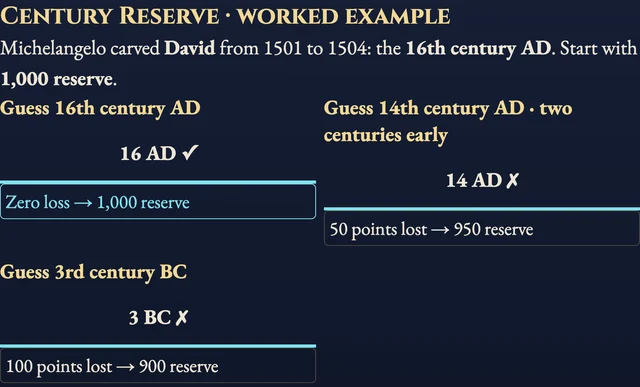
- Century Reserve: name the century in which each of ten works was made. You start with 1,000; the right century is free and each century off loses 25, up to 100 per work. Highest reserve wins, then time.
- Matching Table: select a photograph, then its title, or drag one onto its partner. Match all ten pairs. Each wrong pair adds three seconds; fastest adjusted finish wins.
Controls
| Input | Action |
|---|---|
| Tap / click | Choose titles, sculptors, cities and matching pairs |
| Drag | Drag either side of Matching Table onto its partner to make a pair |
| Type a title | Filter the Name Search list; Enter chooses a unique result |
| Century | Enter a century number and choose BC or AD; a number pad supports controllers |
| Enlarge | Inspect the photograph while the clock keeps running |
| 1–8 | Choose an answer in the pick-one competitions |
| Standard controller | D-pad navigates controls; A selects, Y opens Rules; in the Name Search list, left and right jump between first letters |
Tips
- Read the material and pose Marble contrapposto points to Greece, Rome or their Renaissance and Neoclassical heirs; bronze on a city pedestal is usually nineteenth-century.
- Count centuries carefully The 1500s are the 16th century, and there is no year zero: the 1st century BC is followed by the 1st century AD.
- Casts travel Rodin's Thinker and Burghers of Calais stand in many cities; Where It Stands offers only one city that holds a cast.
Good to know
Every photograph retains its creator, chosen licence, original title and source links. Creator credits appear beside the photograph; Full photo credit opens the complete attribution and sources. Opening full credits during a question, leaving the tab, restoring an unfinished run or a mid-run photo-loading interruption makes that attempt practice.
Watch how to play
Questions
Why are modern sculptures missing?
Only public-domain works are shown: the sculptor died before 1955, or, with no known sculptor, the work was made by 1850. Later works are still under copyright.
Why do fewer works appear in some competitions?
Sculptor is asked only when the photograph's own Commons record names that sculptor, Where It Stands only when the record names the city or the photo was taken within 25 km of it, and Century Reserve only when the making date is known.
Where do the facts come from?
Titles, sculptors, dates and locations come from Wikidata (CC0) and English Wikipedia; photographs from Wikimedia Commons.