About Five Dice
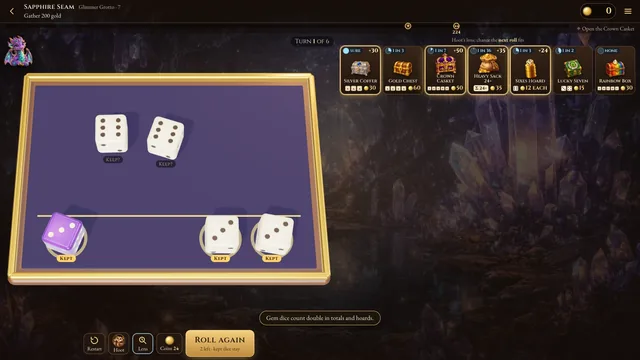
Roll five dice, keep the ones you want and choose where to write each turn’s points. A promising straight competes with a useful upper score, and every filled box narrows your next choice.
Play 100 numbered sealed cards. Each card gives everyone the same dice streams, so scores compare within that card. Finish all thirteen categories to keep your result.
How to play
- Goal
- Score as many points as you can.
- How it ends
- Fill all thirteen categories.
- Record
- Highest score on the same sealed card; first sitting only.
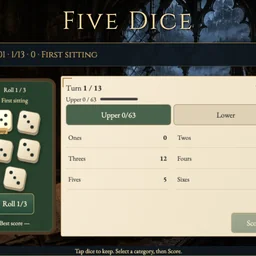
- Choose a sealed card. Roll all five dice to begin a turn.
- Tap dice to Keep them, then roll the others. You may roll up to three times per turn, or score after an earlier roll.
- Select an open category to see its current points, then press Score. Every category must be filled once, including a zero when necessary.
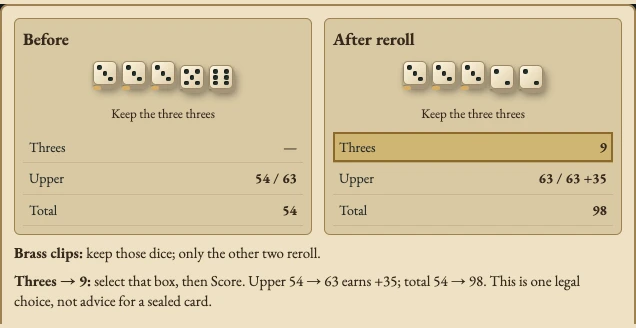
- Upper boxes count their matching faces. Reach 63 upper points for a 35-point bonus. Three or four of a kind and Chance count all dice; a Full House scores 25, a small straight 30, a large straight 40 and five of a kind 50.
- After the five-of-a-kind box is filled, another five of a kind must use its matching upper box if open. Otherwise choose a lower box, with fixed Joker scores for Full House and straights; if none remain, an upper box scores zero. Each later five of a kind adds 100 only when the original box scored 50.
- Complete thirteen turns. Higher scores rank first on that card’s Top 10; an equal score keeps the earlier result. Repeat, restarted and resumed games are Practice.
Controls
| Input | Action |
|---|---|
| Click or tap dice | Toggle Keep |
| Roll / Score | Roll unkept dice / commit the selected category |
| 1–5 / R | Toggle a die / roll |
| Arrow keys / Enter | Select a category / confirm the preview |
| Escape | Back or game menu |
Good to know
Progress and personal bests stay in this browser. Public scores use your first uninterrupted sitting on each card. Restart, navigation away and reload become Practice. There is no Undo. The 254.59 comparison is an optimal-play long-run average, not a target or this card’s best possible score.