About The Chronometer
An archivist’s brass instrument, a slip of history, and a year to place. Spend a reserve of years, measure ten guesses, or survive a tightening window of time and error.
Explore 3,000 researched historical events across cultures, discoveries and turning points. Every reveal includes a historical fact and its source. Keep your discoveries in a personal atlas, or take your time in the untimed Reading Room.
How to play
- Goal
- Place historical events as close as possible to their true year.
- How it ends
- Time Reserve ends when your reserve runs out; Ten Events ends after ten answers; Closing Window ends after three misses.
- Record
- Your longest Time Reserve and Closing Window runs and lowest Ten Events error, separately for each collection. Personal records stay on this device.
- Place each historical event as close as possible to its true year. Enter the digits, choose BCE or CE, and lock your answer. There is no year zero.
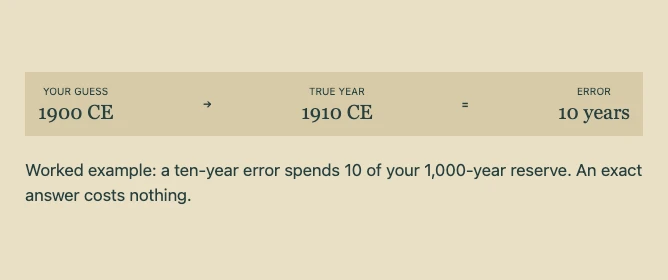
- Time Reserve starts with 1,000 years. Each year of error spends one year; exact answers cost nothing. Keep playing until the reserve is spent. Skipping or running out of time costs 250 years.
- Ten Events deals exactly ten questions. Your score is the sum of your year distances; lower is better. A skip or timeout adds 4,024 penalty-years.
- Closing Window gives three lives. Stay inside the shown error tolerance; every five successful answers narrows the window and eventually shortens the clock. A miss, skip or timeout costs one life.
- Timed questions begin at ten seconds. Reveals are untimed, and Reading Room removes the timer entirely. Discoveries and their sources collect in your atlas.
Controls
| Input | Action |
|---|---|
| Digits / number pad | Enter a year |
| BCE / CE · B / C | Choose the era |
| Enter / Lock year | Submit the year before time expires |
| Skip | Apply the shown mode penalty |
| Atlas | Read discovered facts and sources |
| Settings → Return to desk | Change mode or resume an expedition |
| R / ↻ | Start a fresh expedition after confirmation |
Good to know
The clock keeps running in menus, when you leave, and across reloads. Personal records and discoveries stay in this browser; a second tab plays without overwriting the first tab’s save. An archive update retains discoveries and starts fresh edition records. Uninterrupted attempts can enter the named Top 10 for each mode and collection; paused or resumed attempts retain personal results.