About Train Arena
Eight competitions on reviewed photographs of 3,293 locomotives, multiple units and high-speed trainsets, from steam engines to maglev. Name the train; search for it by name; pick the country it was built for, the company that built it, or what drives it; estimate its top speed and the year the first was built; or match photographs to names.
Play the famous trains, one of ten regions from Britain & Ireland to Japan, or a balanced mix. Classes and individual named engines stay distinct: Mallard is also an LNER Class A4, so a class and its own engines never count against each other. Every fact agrees between Wikidata and the train’s Wikipedia article.
How to play
- Goal
- Recognize the world’s locomotives and trainsets from photographs, and learn their names, countries, builders, top speeds, first build years and traction.
- How it ends
- Finish ten questions or ten pairs, exhaust the sprint clock, or make one sprint mistake.
- Record
- Best score, highest speed or year reserve, or fastest matching finish, with time and the player’s name.
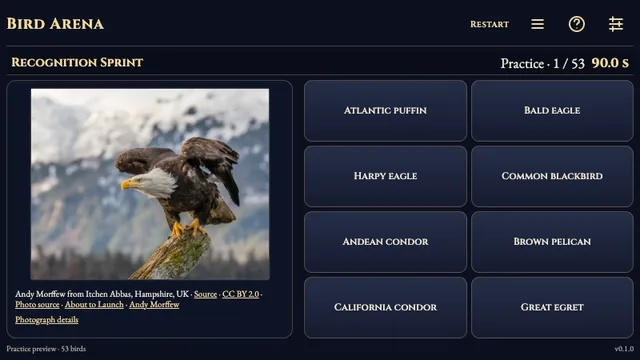
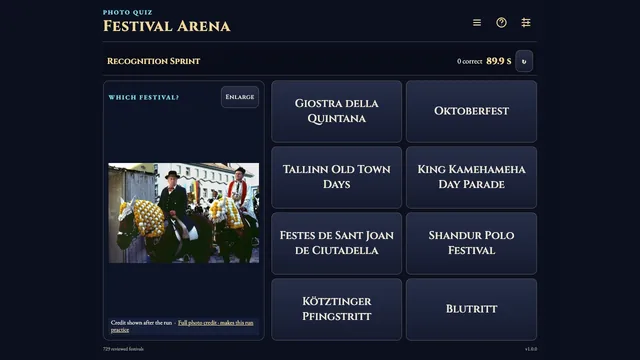
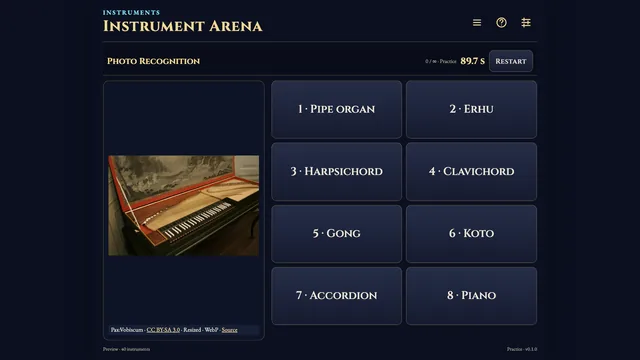
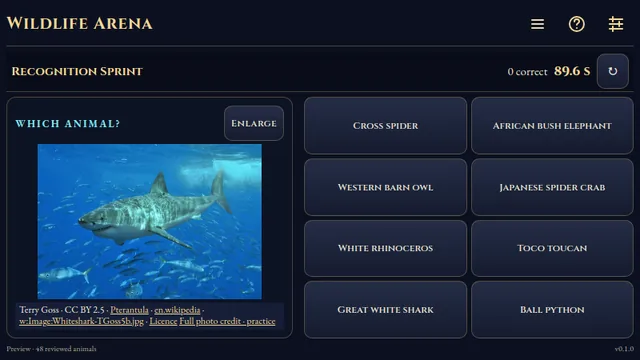
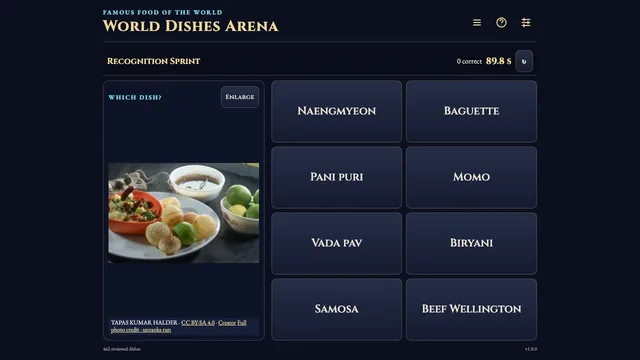
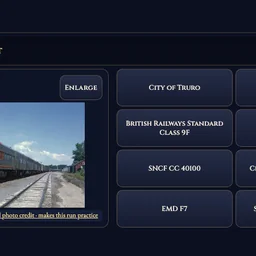
- Recognition Sprint: choose the pictured train from eight names. You have 90 seconds and one wrong answer ends the run. Most correct answers wins; the time of the last one breaks ties.
- Name Search: identify ten photographs. Type part of a name or another name and choose the exact train; a small typing slip still finds it. A named engine’s class, or a class’s named engine, also counts. Correct answers rank first, then faster time.
- Country: choose the country whose railways the train was built for, among the eight countries nearest it; trains whose name gives the country away are left out. Ten questions; a wrong answer scores nothing. Most correct answers wins, then the faster total time.
- Builder: choose the company that built the train from eight, mostly from the same country. Ten questions; most correct answers wins, then time.
- Traction: steam, diesel, electric or gas turbine. Ten questions; most correct answers wins, then time.
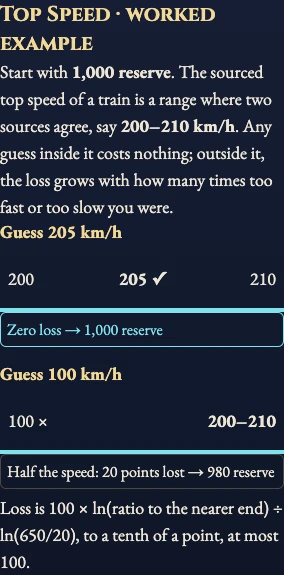
- Top Speed: estimate the design top speed in km/h. You start with 1,000. A guess inside the sourced range costs nothing; outside it you lose by how many times too fast or slow you were, on a logarithmic share of the 20–650 km/h range, at most 100 per guess. Highest reserve wins, then time.
- First Built: enter the year the first of the class (or the engine itself) was built. Inside the sourced range costs nothing; each year outside costs one point, at most 100. Highest reserve wins, then time.
- Matching Table: select a photograph, then its name, or drag one onto its partner. Match all ten pairs. Each wrong pair adds three seconds; fastest adjusted finish wins.
Controls
| Input | Action |
|---|---|
| Tap / click | Choose answers and matching pairs |
| Drag | Drag either side of the Matching Table onto its partner to make a pair |
| Type a train name | Filter the Name Search list; Enter chooses a unique result |
| Speed or year estimate | Enter a number; a number pad supports controllers |
| Enlarge | Inspect the photograph while the clock keeps running |
| 1–8 | Choose an answer in the pick-one competitions; Enter continues from a reveal |
| Standard controller | D-pad navigates controls; A selects, Y opens Rules |
Tips
- Read the front end Cab windows, headlights and the nose shape separate classes that share a livery.
- Count the wheels On steam engines the wheel arrangement (4-6-2, 2-8-8-4) narrows the class quickly.
- Think in log ratios In Top Speed, half the speed costs the same at 60 km/h as at 300 km/h; aim for the right order of magnitude first.
Good to know
Every photograph retains its creator, chosen licence, original title and source links; Full photo credit opens the complete attribution. Opening full credits during a question, leaving the tab, restoring an unfinished run or a mid-run photo-loading interruption makes that attempt practice.
Watch how to play
Questions
Why do fewer trains appear in Top Speed or First Built?
A train joins a competition only when Wikidata and its Wikipedia article agree on that fact; disagreements are held out rather than guessed.
Is a photo of Mallard a wrong answer for LNER Class A4?
No. A named engine and its own class are kin: they never appear as wrong answers for each other, never share a Matching Table, and Name Search accepts either. Family names such as TGV work the same way with their members.
Why is a famous train missing?
Every train needs a reviewed photograph with no readable name on it and a licence that allows reuse. A few famous engines, such as Novelty and Salamanca, have no such photograph yet.