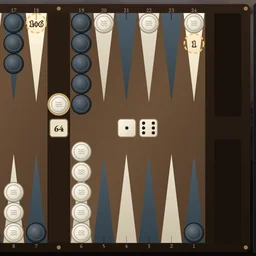
About Backgammon
Backgammon at the pilots' wayhouse in the Salt Coves, by the full rules: the opening roll, hitting and entering from the bar, bearing off, gammons and backgammons, and matches of 1, 3, 5 or 7 points with the doubling cube and the Crawford rule.
The dice you can check. From the first roll the table shows a seal, the fingerprint of a secret that fixes every die of the match. When the match ends the secret is shown, and anyone can recompute every roll from it. The dice ledger also counts both sides' luck: doubles and pips rolled against what to expect.
Seven keepers sit across from you, from Deckhand, who is just learning the board, to Pilot, who plays its best judgement every time. They share one judgement, a network trained here by playing itself, and each step up the ladder was measured in a thousand games on shared dice: the stronger keeper wins between two and three games in four. They see the board, never the dice to come, and after each of their plays Why? shows the plays they liked and their own estimate of each. Each keeper keeps your fastest win and your fewest plays to a win, for every match length.
The Trials are 120 bear-offs where one play wins most often, worked out exactly for every position and re-proved by an independent solver in every release. None of them falls to taking the most checkers off; in Slack water not even to the fewest expected rolls. Each keeps a public fastest first solve.
How to play
- Goal
- Bear all fifteen of your checkers off before the other side does.
- How it ends
- That wins the game (a gammon or backgammon scores more); the first to the match length wins the match. In a Trial, find the play that wins most often.
- Record
- Each Trial keeps the fastest first solve; each keeper keeps your fastest win and fewest plays for every match length.
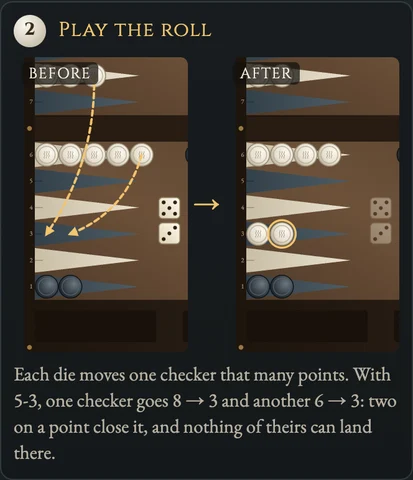
- Roll, then tap one of your checkers: the places it can land light up, marked with the die they use. Tap one. Done passes the dice; Undo takes a checker back until then.
- Play both dice if you can, the larger if only one fits. A double plays four times. A hit checker waits on the bar and must come in first.
- In matches of 3 points or more you may double before you roll. The other side takes and owns the cube, or passes and loses the game at the old stake.
- Trials: find the play that wins most often. A play that is not the best goes back and the clock keeps running; it started when the Trial opened.
- Two players: both sides on one device, the board turning to face whoever is to play.
Controls
| Click · Tap | Pick a checker, then where it lands |
|---|---|
| ← → ↑ ↓ | Walk the points in the direction of play |
| Enter · Space | Pick up or land a checker |
| R · D · U | Roll, double, undo a checker |
| Escape | Put a checker down, or leave the table |
All 120 Trials are re-proved by the release build's independent solver; the keepers' ladder is measured and committed. Every die of a match can be recomputed from the secret the ledger reveals. Matches in hand, your records and Trial times stay in this browser under morass.backgammon.v1; the fastest time on each Trial is public. No ads or analytics run inside the game.