How to play
- Goal
- Know the great composers: name who wrote a recording and which work it is, recognise their portraits, and place them in their era and in time.
- How it ends
- Ear Sprint ends when its 120 listening seconds run out or on the third mistake; every other competition ends after ten rounds, ten placements or ten pairs.
- Record
- Most correct answers, then fastest time; Birth Year keeps the most reserve, Matching the fastest time with penalties, each with the player’s name.
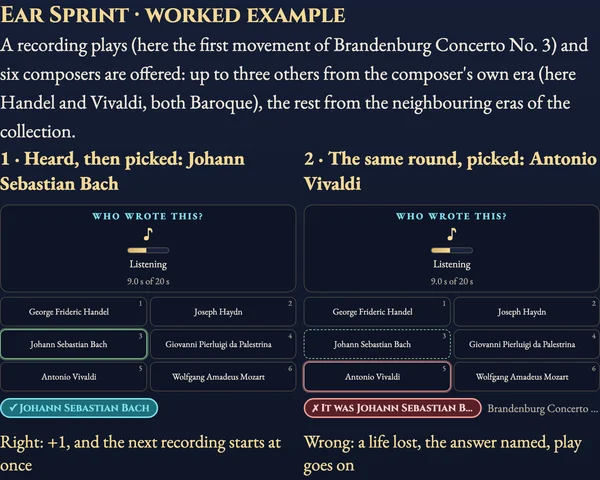
- Ear Sprint: a recording starts and six composer names show; answer as soon as you know. Most names come from the recording's own and the nearest eras. The 120-second clock runs only while a recording plays or a question is open, never while one loads, and you have three lives: a wrong answer names the right composer and play goes on until the third. Most correct answers wins, with the time of the last correct answer breaking ties. Replay starts the recording again and costs only time.
- Name the Work: ten recordings, six famous works by six different composers, never two with the same title. Titles leave out catalogue numbers that would name the composer (BWV, K.); an opus number tells apart works with the same name. The reveal names the composer, the work, the movement and the performers. Most correct answers wins, then the faster time; the clock pauses while each answer is revealed.
- Portrait: ten portraits, eight composer names, at most three others from the sitter's era. Most correct answers, then time.
- Era: ten composers; choose the era from those present in the collection: Medieval, Renaissance, Baroque, Classical, Romantic, or Late Romantic & Modern (main work after about 1890). An era is played only where two independent classifications agree, so composers they place differently, such as Beethoven and Schubert, never appear in Era.
- Birth Year: enter the year each of ten composers was born. You start with 1,000 reserve; an exact year costs nothing and every year off costs one point, at most 100 per guess. Bach was born in 1685, so 1700 costs 15 points. Highest reserve wins, with time breaking ties.
- Timeline: one composer starts a line with the earliest birth at the top. Place ten more, one at a time: select the gap where each belongs, then press it again or Place card. Equal birth years count as equal, so either side is right. A misplaced composer is refiled in its right place and play continues. Most correct placements wins, then the faster time.
- Matching Table: select a famous work, then its composer. Match all ten pairs. Each wrong pair adds three seconds; fastest adjusted finish wins.
Controls
| Tap / click | Choose an answer, a timeline gap or a matching pair; Start sound for the first recording |
|---|---|
| 1–6 · 1–8 | Choose an Ear Sprint or Name the Work answer (1–6), a Portrait answer (1–8) or an era |
| P | Replay the recording |
| Arrow keys · Enter | Move between timeline gaps or across the matching table, then answer; Enter continues from a reveal |
| Birth year | Type a year; a number pad supports controllers |
| R | Restart with a new run |
| Standard controller | D-pad moves between controls, A selects, X replays the recording, Y opens How to play, Start opens Settings |
Tips for Composer Arena
- Listen for the orchestra A harpsichord or a small string band points to the Baroque; a huge orchestra with brass and harp to the late Romantics.
- Birth-year anchors Bach and Handel 1685, Mozart 1756, Beethoven 1770, Chopin and Schumann 1810, Wagner and Verdi 1813, Tchaikovsky 1840, Debussy 1862.
- Start with Well-known Well-known composers plays only famous composers and recordings a typical listener knows; All composers adds the rarities.
Questions about this game
Why are only composers who died before 1956 in the game?
Their music is out of copyright in most of the world (life plus 70 years), and every played work was also published before 1931, so it is in the public domain in the United States too. Each recording carries its own free licence.
Why do some composers never appear in Era or Birth Year?
A fact is played only where two sources agree. Beethoven and Schubert are classical to some and romantic to others, and several early composers have disputed birth years, so they play in the other modes only.
Who performs the recordings?
Performers, licences and sources are listed under Recording credits after each run, never during one, because a file name or source page would give the composer away.
Recordings are 20-second excerpts of human performances from Wikimedia Commons, Musopen and the US Marine, Army, Navy and Air Force bands, each with its own public-domain or Creative Commons licence; band arrangements play only where the arrangement is free too. Portraits are public-domain paintings, engravings and photographs from Wikimedia Commons. Opening full credits during a question, leaving the tab or restoring an unfinished run makes that attempt practice. No ads, SDKs or analytics run in the game.
Watch how to play
About Composer Arena
Seven competitions on the great composers, from Hildegard of Bingen to Rachmaninoff. Hear twenty seconds of a real performance and name who wrote it before the 120-second clock runs out, name the famous work, recognise composers by their portraits, place them in their era, guess their birth year, file them on a timeline, or match ten works with their composers. Worldwide score, time and player name lead the main menu.
155 composers who were born before 1900 and died before 1956, with 227 recordings of human performances (public domain or Creative Commons, from Wikimedia Commons, Musopen and the US service bands) and 143 public-domain portraits, in five collections: All composers, Well-known composers, Baroque & earlier, Classical & Romantic, and Late Romantic & Modern. A fact is played only where two sources agree: birth years from Wikidata and the GND or Library of Congress authority (129 composers), eras from two independent classifications (135).