About Hanoi
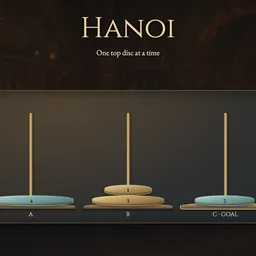
Move wooden discs between three towers, one top disc at a time. A larger disc can never rest on a smaller one. Clear a path for the largest discs, then rebuild the complete tower on the marked goal.
Explore 80 fixed studies with 3–6 discs. Each start has a proved minimum route. Undo a detour, test another plan and keep your first solve time separately from your fewest moves. Later towers develop the same recursive idea rather than adding new rules.
How to play
- Goal
- Move every disc onto the marked goal tower without putting a larger disc on a smaller one.
- How it ends
- A study ends when the complete tower reaches the goal, and you cannot lose.
- Record
- Your first solve time and your fewest moves are kept separately for each study.
- Choose a disc-count shelf, then a study. Opening it reveals the arrangement and starts its first clock. C is always the marked goal.
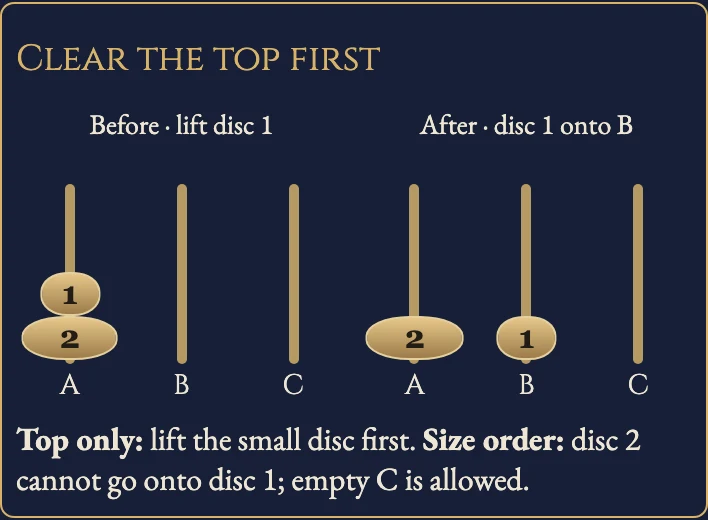
- Tap a source tower to lift its top disc, then tap a destination to move it. Empty towers accept any disc. A disc may rest only on a larger disc.
- Tap the source again or press Escape to cancel a lifted disc. Refused moves leave the arrangement and move count unchanged.
- Move every disc onto C, with the smallest at the top. A study ends on completion; there is no loss or move limit.
- Undo rewinds the current route and its move count; Redo restores it. Thinking and undone exploration still cost time. Restart restores the start without resetting the first clock.
- Your first completed time is kept. Practice preserves that time and can improve your fewest moves. The minimum shown during play is a target, not a hint.
Controls
| Input | Action |
|---|---|
| Tap a source, then a destination | Move its top disc |
| Tap the source again / Escape | Cancel the lifted disc |
| Arrow keys, then Enter or Space | Select and activate a tower |
| 1 / 2 / 3 | Activate A / B / C |
| Z or Backspace / Y | Undo / Redo |
| R | Request Restart |
| Escape | Close a panel or return to the chooser |
| Gamepad D-pad / A | Select and activate |
| Gamepad LB / RB | Undo / Redo |
| Gamepad B / Start | Cancel or go back / settings |
Tips
- Free the largest disc Before moving a large disc, work out where every smaller disc must wait. An empty tower is temporary workspace.
- Build from the base Once the largest disc reaches the goal, keep it there while transferring the smaller tower onto it.
- Think in smaller towers Moving a stack means moving its smaller top stack aside, moving its base, then rebuilding the top. The same idea works again at each size.
Good to know
Progress stays in this browser when storage is available. The first clock never pauses for menus, Restart or chooser visits. Reload keeps your route and Undo, but the resumed first time stays local; eligible moves may still rank. Settings control music, effects and reduced motion. No account is needed.
Watch how to play
Questions
Does Undo add a penalty move?
No. Moves count the route currently on the board. Undo removes its last transfer and Redo restores it. Time spent exploring still counts.
Can a larger disc go on an empty tower?
Yes. The size rule applies when another disc is already on that tower.
Can Practice improve my records?
Practice can improve your fewest moves, but it never replaces your first solve time. Time and moves may have different named holders.
How long are the studies?
The starts use 3–6 discs and have minimum routes from 7 to 63 moves. You can take more moves; there is no move limit.
Are all 80 studies different techniques?
No. They are distinct starting-route families within the 3–6-disc collection. Later studies reuse the same recursive transfer idea.