How to play
- Goal
- Shade cells into rectangles so every numbered region contains exactly its stated number of shaded cells.
- How it ends
- A chart finishes when every cell is marked dark or pale, all region counts agree and every connected dark block is rectangular; Undo and Erase allow corrections.
- Record
- Your first unassisted finish keeps your time for that chart; later plays are practice.
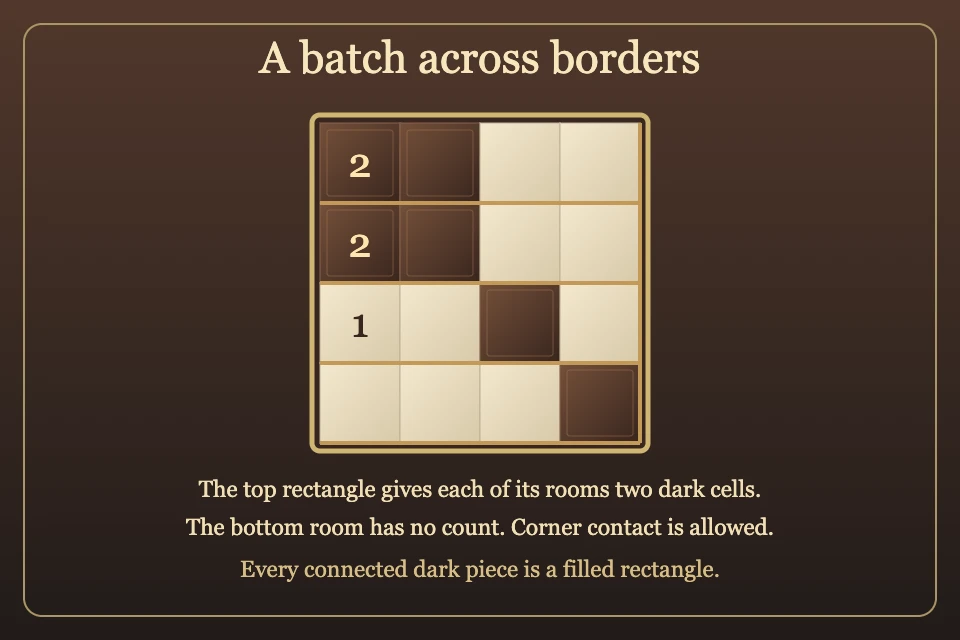
- Mark every cell Dark or Pale. Every numbered outlined room must contain exactly its stated number of dark cells. A room without a number has no count requirement.
- Every orthogonally connected group of dark cells must fill an axis-aligned rectangle, including squares, single cells and one-cell-wide strips.
- Rectangles may cross room borders and touch at corners. Two dark pieces touching along an edge join into one piece, which must still be rectangular.
- A room can contain parts of several dark rectangles. Numbered cells can be dark, and the pale cells have no connectivity or shape requirement.
- Choose Dark, Pale or Erase, then tap cells or paint a stroke. Inspect region highlights the selected room and reports its current dark count.
- Release commits a stroke as one Undo step. Escape, resize, pointer loss or a second finger cancels an unfinished stroke. Restart keeps the original clock; reload retains marks and Undo, and a resumed finish stays local.
Controls
| Mouse / touch | Choose a brush and tap or paint cells; Inspect region highlights the selected room and reports its count |
|---|---|
| Arrows + Enter / Space | Move the cursor and apply the brush |
| 1 / 2 / 3 | Choose Dark / Pale / Erase |
| Delete / Backspace | Erase the selected cell, including a numbered cell |
| Z / Y | Undo / Redo |
| R / Restart | Confirm clearing marks while keeping the first clock running |
| Escape | Cancel a stroke, close a dialog or return to the atlas |
| Controller | D-pad moves; A marks; X changes brush; Y erases; shoulders Undo/Redo; B cancels/back; Start settings; Back rules |
Tips for Chocona
- Start with zero rooms Every cell in a room numbered zero must be pale.
- Finish a rectangular corner Three dark corners of a 2 × 2 block require its fourth corner to be dark, even across a room border.
- Watch the room total When a numbered room has all its dark cells, every remaining cell in it must be pale.
- Keep corrections reversible Inspect region checks a selected room; Erase and Undo let you correct marks without restarting.
Questions about this game
Can a rectangle cross a room border?
Yes. Each room counts only the dark cells lying inside it.
Can two dark pieces touch?
They may touch diagonally. An edge contact joins them into one connected piece, which must be a rectangle.
What does an unnumbered room require?
No particular dark count. It may contain zero dark cells or parts of any valid rectangles.
Can I shade a numbered cell?
Yes. Its printed number remains the required count for the whole room.
Does every cell need a mark?
Yes. Dark and Pale are decisions; Erase leaves a cell undecided.
Can replay improve my first time?
No. The first saved finish stays unchanged; replay is practice.
All charts are open. Reload retains an unfinished first attempt, Undo and its original clock; resumed finishes stay local. Practice reopens fresh and preserves your first time.
Watch how to play
About Chocona
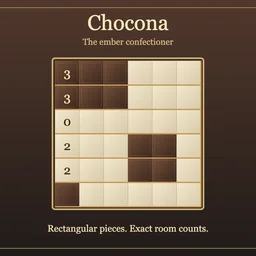
Form cocoa rectangles on the ember confectioner’s charts. Each outlined room counts its dark cells; a rectangle can reach across room borders.
All 160 original charts are open across four shelves: twenty 4×4, eighty 5×5 and sixty 6×6. Every chart has one answer and a complete bounded deduction proof.
Your first finish keeps its time for that chart. An uninterrupted verified first solve can claim the named fastest time; later plays are untimed practice.