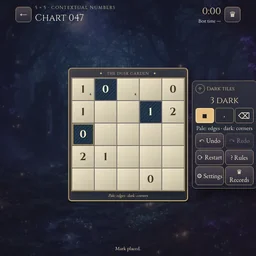
How to play
- Goal
- Shade isolated cells while keeping the pale floor connected and satisfying every contextual number.
- How it ends
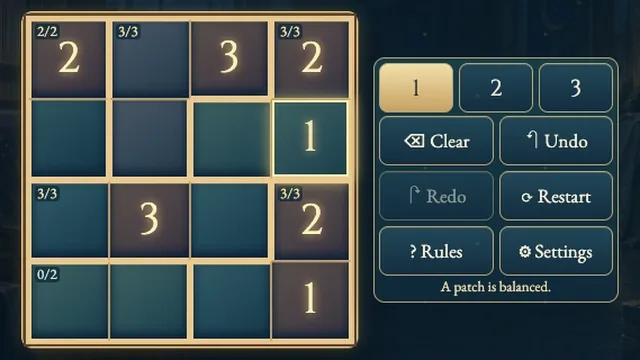
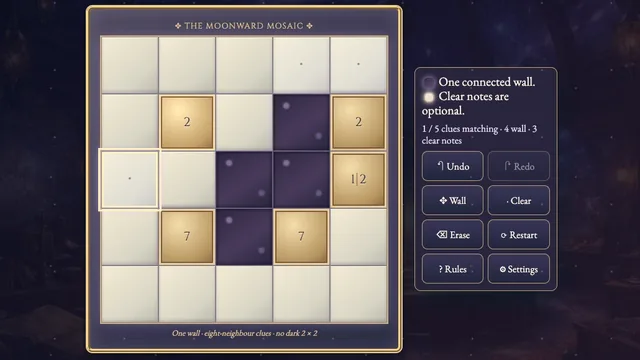
- The chart is won when dark cells share no edges, the pale floor is connected, and each pale number counts dark edge-neighbours while each dark number counts dark diagonal neighbours; Undo repairs marks.
- Record
- Your first unassisted solve of each chart is kept in this browser; verified solves under twenty-four hours compete for fastest-time records. Replays are practice.
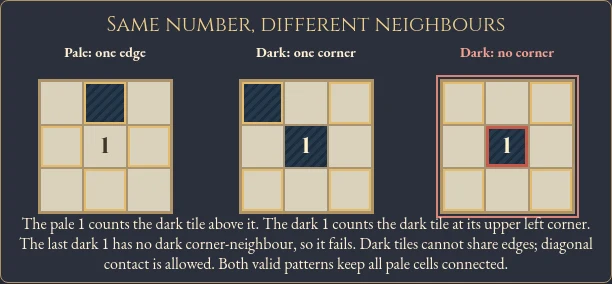
- Shade cells so no two dark cells share an edge. Diagonal dark contact is allowed. All remaining pale cells must form one connected floor through shared edges.
- A pale number counts dark cells immediately above, below, left and right. A dark number counts dark cells immediately at its four diagonal corners. Counts exclude the numbered cell itself.
- Numbered cells may be pale or dark. Choose Shade, Pale or Erase and tap or drag across cells. Pale notes are optional: a valid dark pattern completes the chart.
- Undo repairs marks. Restart clears marks after confirmation and keeps the original first clock running.
Controls
| Tap / drag | Paint cells with the selected ink |
|---|---|
| Arrows; Enter / Space | Move the cursor; paint the selected cell |
| 1 / 2; Delete / Backspace | Select Shade / Pale; erase the cursor cell |
| Z / Y; Undo / Redo | Withdraw or restore marks |
| Escape | Cancel a gesture, close a dialog or return to the atlas |
| Restart | Clear marks after confirmation; retain the first clock |
Tips for Context
- Start with zero Whether a zero is pale or dark, every edge-neighbour must be pale.
- Read the colour A shaded clue counts corners; a pale clue counts edges.
- Protect the floor A pale cell needs an edge-connected route to the rest of the pale floor.
Questions about this game
May numbered cells be shaded?
Yes. Shading changes their count from edge-neighbours to corner-neighbours.
May dark cells touch diagonally?
Yes. Only shared edges are forbidden.
Must I mark every pale cell?
No. Pale notes are optional; the valid dark pattern wins.
Does a clue count itself?
No. It counts only neighbouring dark cells.
Can replay improve my first time?
No. Your first completed time is retained; replay is untimed practice.
All charts are open. Progress saves in this browser; a reloaded attempt finishes locally on its original clock.
Watch how to play
About Context
Shade isolated tiles in a dusk garden. Each number changes its neighbourhood when shaded: pale counts dark cells beside it; dark counts dark cells at its corners.
All 160 original charts are open, from four by four to six by six. Every chart has one independently verified shaded pattern and a deduction proof from its public clues.
Your first completed time stays with each chart. An uninterrupted verified first solve under twenty-four hours on the game page can claim the named best; replay is untimed practice.