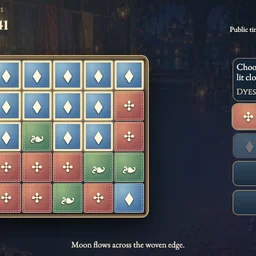
How to play
- Goal
- Flood the tapestry from its upper-left loom pin until every tile shares one dye.
- How it ends
- A chart is complete when the whole cloth joins the flooded region; there is no loss state, and the proved minimum is an optional challenge.
- Record
- The fastest first solve and the fewest dye changes for each chart are kept as separate public records, with their holders' names.
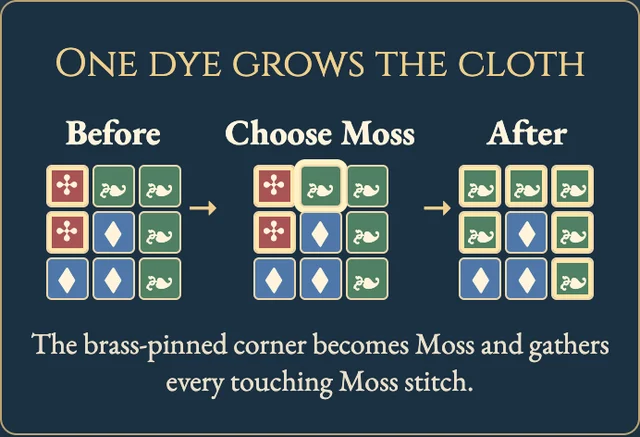
- Start at the lit upper-left corner. Tap a dye or an outside tile of that colour. Only the connected pinned cloth changes; every touching island of the new colour joins it. The goal is one colour across the whole cloth.
- The worked 3×3 sample shows the pinned Ember stitches before a change, the choice of Moss on the border, and the larger Moss region afterward. A dye with no touching tiles is unavailable and costs no move.
- Par is the exact fewest changes but is optional for completion. Undo removes a dye; Restart restores the chart without resetting its first-solve clock. A replay may improve your fewest dye count, while first-solve time stays sealed.
Controls
| Tap / click a dye | Recolour the pinned region and collect touching stitches |
|---|---|
| Tap / click an outside tile | Choose that tile’s dye |
| 1–4 | Choose Ember, Moss, Moon or Dusk |
| Arrow keys + Enter / Space | Focus and choose a board tile |
| Undo / Z | Remove the last dye change |
| Restart / R | Restore the cloth without resetting the clock |
| Escape | Close a panel or return to the atlas |
Every chart’s par and every legal final colour are independently proved. More than one finishing colour is valid. Saves use morass.dye-works.v1; sound and motion are configurable. No ads or analytics run inside the game.
Watch how to play
About Dye Works
Enter a candlelit dye atelier and grow one colour across a woven cloth from its upper-left brass pin.
Every one of the 160 fixed charts has an independently proved minimum. Choose touching colours and plan ahead to reach par; any single-colour ending still completes the cloth.
Your fastest eligible first solve and fewest dye changes are separate named public records for each chart.