About Jigsaw
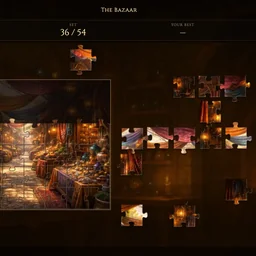
A jigsaw on a Vothmark glazier's bench. Each pane is a window of scrying-glass holding a place in Orenvalt — a spice bazaar under silk, a glass house with a tree that flowers in six colours, a drowned hall of shell and green water — and each has been broken into six, twenty-four, fifty-four or ninety-six shards that you set back into the lead.
The one thing this genre keeps getting wrong is losing your work: an advertisement between you and the piece you were placing, a mis-tap that puts a piece you had already placed back in the tray, a closed tab that takes an hour's board with it. None of those can happen here. A shard in the lead is fixed for good and no gesture can dislodge it; a shard you drop anywhere else stays exactly where you let it go, so you can sort the bench into colours and it will keep; and the pane survives a closed tab with every shard where you left it.
There is no zoom, because there is nothing too small to grab: the biggest cut is ninety-six, which is the most shards a phone can draw and still let a thumb hold one. There is no rotation, no hint, no advertisement, and nothing that interrupts. Near enough is near enough — let a shard go anywhere close to its place and it clicks home.
The picture is ghosted faintly inside the frame for everybody, and cannot be turned off: a setting that changes how hard a puzzle is, on a game that keeps public times, is a cheat or a handicap depending on which way you flip it. One difficulty, one board.
How to play
- Pick a pane and a cut and press Set the glass. The frame appears with the picture ghosted inside it, the shards lie scattered on the bench around it, and the clock starts.
- Drag a shard onto its place. You do not have to be accurate, only near: let it go anywhere close and it takes, with a click, and from then on nothing can knock it out.
- A shard dropped anywhere else stays exactly where you put it. Sort the bench however you like; nothing ever springs back to a pile.
- Gather (the button, or G) re-lays the loose shards in a tidy ring without touching anything you have set.
- The clock starts when the glass is dealt and does not stop. A pause does stop it, and gives up the run's place and its personal best. Leaving keeps the pane — it is waiting on the title screen with every shard where you left it — but a pane you come back to keeps no place and no best, because the clock cannot follow you across a closed tab.
Controls
| Drag · Swipe | Move a shard; let go near its place and it takes |
|---|---|
| , · . | Choose which loose shard you are holding |
| ↑ ↓ ← → | Move the cursor over the frame |
| Enter | Put the held shard down at the cursor |
| G | Gather the loose shards |
| Esc | Pause — which gives up the run's place |
Forty-eight boards of ten — twelve panes by four cuts — each one replay-verified on the server. Your best time per pane and cut, and the pane you are in the middle of, are kept in this browser and nowhere else.