About Twiddle
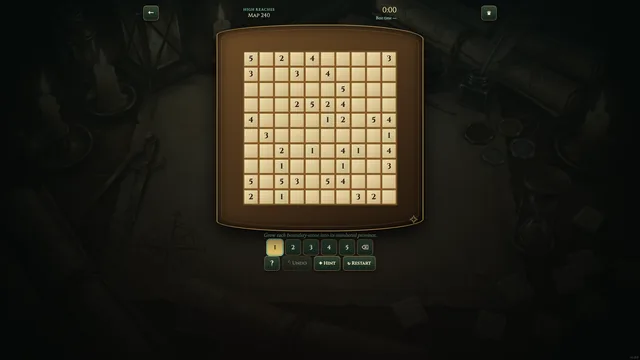
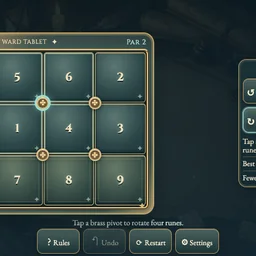
At a scholar’s worktable, numbered runes sit in a brass-edged ward tablet. Each brass pivot turns the four neighbouring runes together. Turn the overlapping squares until every rune returns to its numbered socket.
All 180 tablets are open from the start: sixty each at 3×3, 4×4 and 5×5. Every layout has a measured shortest route. The shown par is a real target, and both clockwise and counterclockwise turns count one turn.
Your first solve time and fewest turns are kept separately for each tablet. The public bests and their holders appear on each gallery card; the game page trophy holds the full rankings. Undo and Restart let you experiment without losing your place.
How to play
- Goal
- Rotate 2×2 groups until the runes read in order from the top left.
- How it ends
- A tablet is won when every rune reaches its numbered socket; there is no loss and every turn can be undone.
- Record
- Your first-solve time and fewest turns are kept separately for each tablet, with verified public bests beside its entry and on the page trophy.
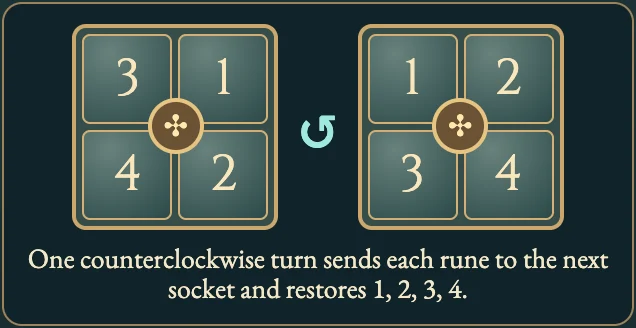
- Tap a brass pivot between four runes to rotate its 2×2 square. Choose clockwise or counterclockwise with the two direction buttons; a mouse right-click turns the other way.
- Put the numbers in reading order, from 1 at the top left to the largest at the bottom right. Pivots overlap, so a useful turn may move a rune you had already placed.
- The clock begins when you open a tablet and keeps running through a restart or return to the gallery. A later practice solve can improve your turn count, while only your first solve can rank for time.
Controls
| Tap / left click a pivot | Turn its four runes in the chosen direction |
|---|---|
| Direction buttons | Choose clockwise or counterclockwise |
| Right click a pivot | Turn the opposite direction |
| Arrow keys | Select a pivot |
| Enter / Space | Turn the selected pivot |
| Z / X | Turn counterclockwise or clockwise |
| U / Escape | Undo or return to the gallery |
All 180 layouts are fixed and independently shortest-path verified. The timer starts at deal and never pauses; only a first solve can rank for time, while turns can improve. Progress and reduced motion are kept in this browser; sound follows the shared site setting.