About Rune Drop
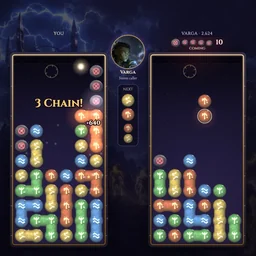
The falling-pairs chain puzzle in the Puyo Puyo tradition, in the casting wells of the Westmark Academy. Rune stones of five schools, Ember, Tide, Grove, Sun and Dusk, drop into a warded well two at a time. Four or more of one school touching vanish; the stones above fall, and if they make a new group of four that vanishes too, a chain, and every link scores far more than the last. Every stone carries its school's glyph as well as its colour, so no two schools are told apart by colour alone.
The rules are Puyo Puyo Tsu's, exactly: the hidden thirteenth row, the seal in the third column, wall and floor kicks and the quick turn in a one-wide shaft, the grace before a pair sets, the chain-power table, and a sealed deal with the same count of every school. In duels a chain's score becomes hexstones, grey stones of no school, dropped into your rival's well; your chain cancels those coming at you first, and after a minute and a half the stakes rise so every duel ends.
There is an Endless well whose fall quickens and where hexstones begin to rain after five minutes, a ladder of eight rival duellists of the Academy who see only what you see and grow stronger rung by rung, and 120 riddles in eight chapters: a board, a fixed list of pairs and a goal, each proved by an exhaustive search to have exactly one answer. Endless and each rival keep Top 10s for best score, longest chain and fastest win, every run re-played by the site before it is ranked; each riddle keeps its fastest first solve.
How to play
- Goal
- Join four or more rune stones of one kind so they vanish, and set off chains that score far more than single groups.
- How it ends
- Endless ends when the well fills to its seal; a duel ends when one well fills, and you win if it is your rival's; a riddle is solved when its goal is met and failed when its pairs run out.
- Record
- The ten best scores and the ten longest chains in Endless, and for each rival the ten best scores and the ten fastest wins, each proved by replaying the run; for each riddle, the fastest first solve.
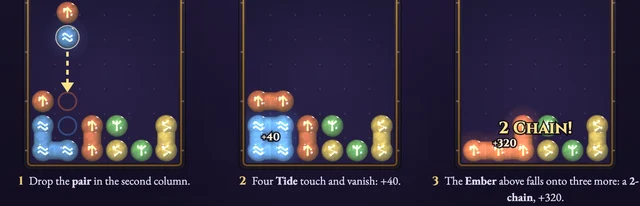
- Move the falling pair with ← →, turn it with X or ↑ (Z the other way), drop it faster with ↓; on a touch screen, drag the pair to a column, drag down to drop, tap to turn, or use the buttons.
- Join four or more stones of one school so they vanish. Build so that stones falling into the gap make the next group: a chain.
- In a duel your chains send hexstones to your rival; the well that fills to its seal loses. In a riddle nothing falls until you drop the pair: meet the goal with the pairs you are given.
Controls
| ← → | Move the pair |
|---|---|
| X · ↑ / Z | Turn it clockwise / anticlockwise (twice in a one-wide shaft flips it) |
| ↓ | Drop faster (hold) |
| Space · Enter | Drop the pair in a riddle; Backspace undoes |
| Drag, tap, buttons | The same on a touch screen: drag to a column, drag down, tap to turn |
| P · Escape | Pause (a timed run then counts as practice) |
The rune stones are Blender renders, each school in the sixteen shapes a stone takes when it joins its neighbours, placed in the Morass warehouse; the rivals' portraits and the backdrops are warehouse paintings and the sounds warehouse recordings. The simulation uses whole numbers only and a run is just the inputs you used, so every browser plays it back identically and the records worker re-plays each one, the rival's every decision included, before it enters a Top 10. Your progress stays in this browser under morass.rune-drop.v1. No ads or analytics run inside the game.