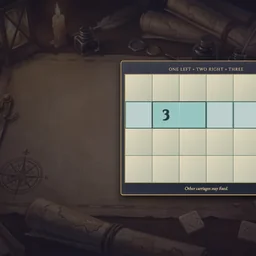
How to play
- Goal
- Put every number in one straight two- or three-cell carriage whose total sliding distance matches that number.
- How it ends
- The chart finishes when every carriage fits and every distance matches; Undo and Erase allow corrections while solving.
- Record
- Your first unassisted finish keeps your time for that chart; later plays are practice.
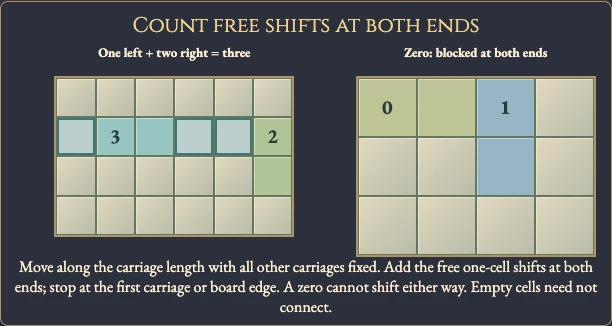
- Each carriage covers two or three consecutive cells in one row or column and contains exactly one printed number. Cover every number once without overlapping carriages.
- Keep the other carriages fixed. Count the consecutive free cells beyond each end of a carriage, stopping at the first other carriage or board edge. Add both counts; the result must equal its number. The current position is not a shift.
- A zero carriage cannot shift in either direction. Distinct carriages may touch along edges or corners. Empty cells need not connect, and there is no restriction on filled two-by-two areas.
- Tap two or three cells, then Place, or drag along their straight line and release. Tap a placed carriage to inspect its current distance. A distance that is too large may shrink when later blockers arrive.
- Erase removes a whole carriage. Empty notes are optional and count as free space. Escape withdraws a pending draft. Restart clears your marks after confirmation and keeps the original first clock running.
Controls
| Mouse / touch | Tap cells then Place, or drag a straight carriage; tap a placed carriage to inspect |
|---|---|
| Arrows + Enter / Space | Move and select a draft cell |
| P | Place the draft carriage |
| 1 / 2 / 3 | Choose Carriage / Note / Erase |
| Delete | Erase the whole carriage or note at the cursor |
| Z / Y | Undo / Redo |
| Escape | Cancel a draft, close a dialog or return to the atlas |
| Controller | D-pad moves; A selects; Y places; X erases; shoulders Undo/Redo; B cancels or returns; Start settings; Back rules |
Tips for Tren
- Count both ends Add the free shifts on both sides with every other carriage fixed.
- Inspect zero Both ends need a carriage or board edge immediately beyond them.
- Keep blockers in mind Placing another carriage can shorten a distance that is currently too large.
Questions about this game
Can a carriage bend?
No. It occupies two or three consecutive cells in one row or column.
Can carriages touch?
Yes. Distinct carriages may touch along edges or corners; they remain separate pieces.
Do other carriages move during a count?
No. Each carriage’s distance is measured with every other carriage fixed.
Do empty cells need notes or connectivity?
No. Empty notes are optional, and uncovered cells do not need to connect.
Can replay improve my first time?
No. Your first completed time is retained; replay is practice.
All 160 charts are open. Reload preserves carriages, Undo and the original clock; resumed solves finish locally. Replays preserve your first time.
Watch how to play
About Tren
Place numbered carriages on the carriage atlas. Each number counts the free one-cell shifts along its carriage’s length, added at both ends while the other carriages stay fixed.
All 160 original charts are open: twenty four-by-four, sixty five-by-five and eighty six-by-six charts across four shelves. Every chart has one independently verified carriage layout.
Your first finish keeps its time for that chart. An uninterrupted verified first solve under twenty-four hours can claim the named fastest time; later plays are practice.