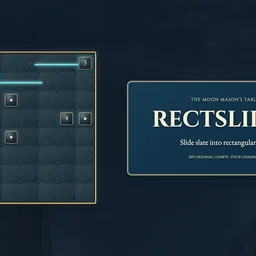
How to play
- Goal
- Move the dark stones so their destinations form separate rectangles, each larger than one cell.
- How it ends
- A chart is solved when every stone has a legal straight track and every final dark group is a rectangle; there is no loss.
- Record
- The fastest first solve of each chart is kept as a public record, with its holder's name.
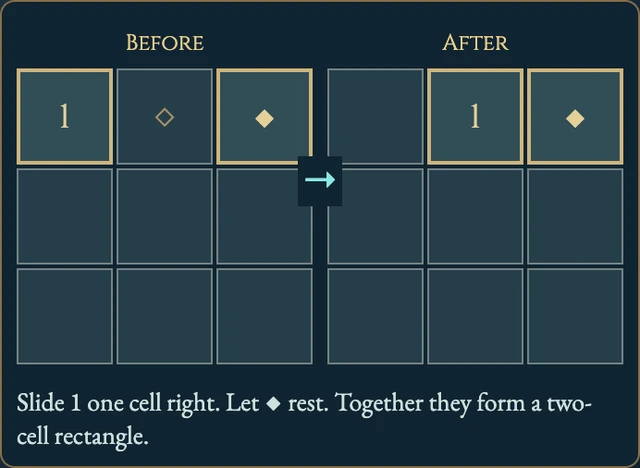
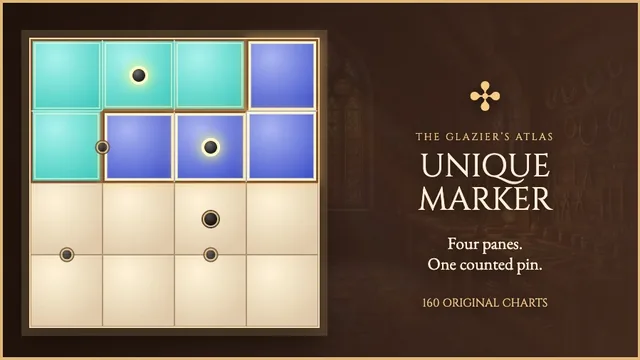
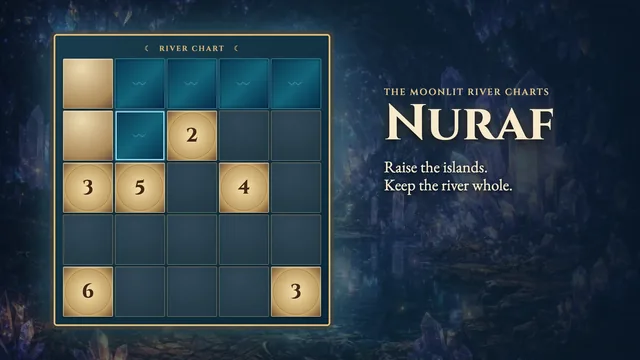
- Tap a dark stone, then a glowing destination in the same row or column. Numbered stones travel exactly the printed distance. The unnumbered ◆ may travel any distance or stay in its socket; tap it a second time to rest. The worked picture moves a 1 beside a resting stone to form a two-cell rectangle.
- A track cannot pass another starting socket, cross or share a cell with another track. No two stones can finish on the same cell. Every connected group of final stones must fill a rectangle of at least two cells; separate rectangles may touch at corners but never along an edge.
- Undo withdraws one placement. Clear stone returns the selected stone to its socket. Restart clears all tracks but keeps the first-deal clock running. The chart completes automatically when every stone is placed and all groups are rectangles; there is no loss.
Controls
| Tap / click a stone | Select it and show legal destinations |
|---|---|
| Tap / click a destination | Slide the selected stone along its straight track |
| Drag a stone | Release it on a legal destination |
| Tap the same ◆ twice | Let an unnumbered stone rest in its socket |
| Arrow keys | Move focus through the chart |
| Space / Enter | Select or place at the focused square |
| Z | Undo the last placement |
| Escape | Close a panel or return to the atlas |
All 160 charts have stable IDs and one independently verified finish. The track rule is necessary for uniqueness on every chart. Private witnesses and the enumerator do not ship. Progress uses morass.rectslider.v1. No ads or analytics run inside the game.
About Rectslider
At a moon mason's table in Orenvalt, dark slate stones wait in carved sockets. Slide each stone along one straight brass lane; pale blue fire remembers its route. When every final group fills a rectangle, the ward seals wake.
The 160 original charts grow from 5×5 to 8×8 across four chambers. Every chart has exactly one independently verified assignment. A numbered stone travels precisely its number; an unnumbered stone may move any distance or rest. Routes cannot cross or pass another starting stone.
Your first solve time is kept in this browser. An uninterrupted first solve may claim the public best shown beside the clock and on every chart card. Replays are untimed.