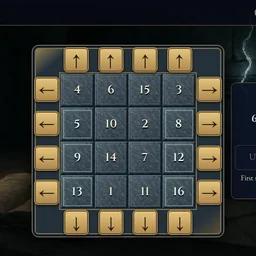
About Sixteen
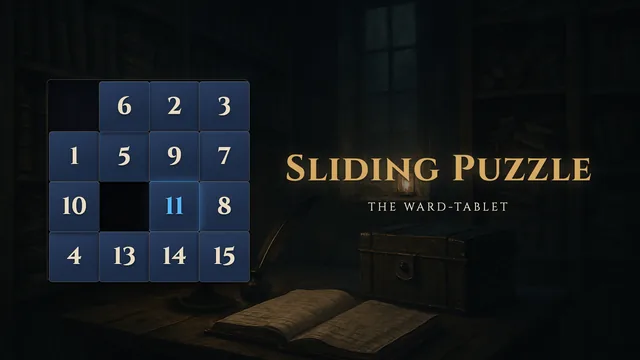
Slide a whole row or column of numbered stones. Its last stone wraps to the opposite end, so each move changes several positions at once.
Order 558 tablets on three grid sizes: 3×3, 4×3 and 4×4. Cross row and column shifts to restore the sequence, then return to improve your shift count.
How to play
- Goal
- Order the numbered stones from top left, reading each row left to right.
- How it ends
- Every number reaches its matching place. There is no loss.
- Record
- First-solve time; fewest applied shifts can improve.
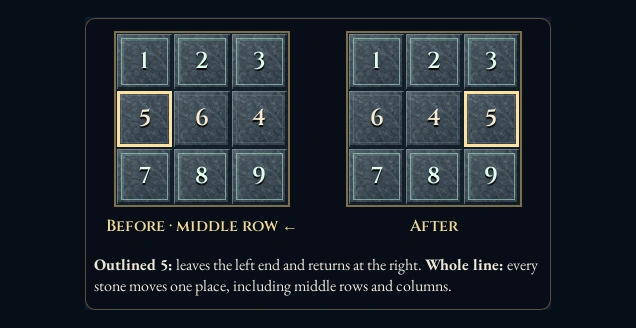
- Choose a tablet. Tap the page heading to jump between grid sizes and pages. Tap an edge arrow to shift its entire row or column by one place. The stone leaving one end returns at the other end.
- Every row and column can move, including the middle lines. Put 1 in the top-left place, then arrange the remaining numbers in order across each row.
- The correct-position count shows how many stones already match their places. A move can disturb those stones while bringing others closer. Every arrangement can be reversed.
- Undo applies the opposite of your last shift and counts another shift. Restart asks before restoring the opening arrangement and keeps the original clock.
- Your first-solve time stays fixed. Replay resets tiles and shifts while carrying the original clock forward; it can improve fewest shifts. Visiting Boards in the same page keeps the clock running; reload restores the route as practice. Watch shows your first completed route.
Controls
| Input | Action |
|---|---|
| Tap or click an edge arrow | Shift its row or column one tile |
| Arrow keys / Enter or Space | Move focus / activate |
| U / Undo | Apply the opposite of your last shift |
| R / Restart | Confirm resetting the current route |
| Escape | Close a dialog or return to Boards |
| Gamepad stick or D-pad / A | Move focus / activate |
| Gamepad B / Start | Back / menu |
| Gamepad LB | Undo one shift |
Tips
- Track a whole line Before pressing an arrow, follow every stone in that row or column, including the one wrapping around.
- Plan a crossing A row shift changes which stones a later column shift can move. Think about the two lines together rather than fixing one stone at a time.
Good to know
Progress stays in this browser. Reload keeps your route but makes time practice. The original clock continues through rules, Boards, Restart and Replay. Routes beyond 4,096 shifts stay local. Recorded times accept up to 24 hours.
Watch how to play
Questions
Why is it called Sixteen when some tablets have fewer stones?
The largest tablets have 16 stones. Smaller 3×3 and 4×3 tablets use the same whole-line shifting rule.
Is there an empty space?
No. All places contain stones. A shift wraps the end stone around instead of moving into a hole.
Can the middle row move?
Yes. Every row and column has arrows in both directions.