About Spades
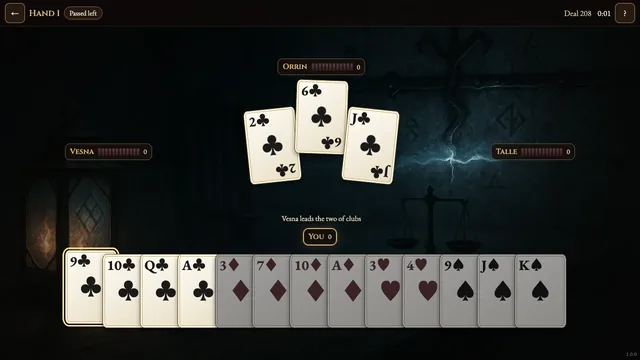
Bid how many tricks you expect to take, then work with your computer partner to make that promise. Follow suit, save useful spades and decide when an extra trick is worth another bag.
Play a 500-point Match or a fixed four-hand Challenge against Learner or Careful opponents. Finished-hand review shows every played card and the reasons recorded when the computer players chose.
How to play
- Goal
- Score more points than the other partnership by making your bids.
- How it ends
- A Match ends when a team reaches 500 points with a higher score; a Challenge ends after four hands.
- Record
- Challenges keep your highest team score and widest point margin on each sealed deal, from your first uninterrupted sitting.
- You sit South, partnered with North. Each seat receives 13 cards and bids 0–13 in turn. A zero bid is Nil: a promise to take no tricks. Confirm your bid before playing.
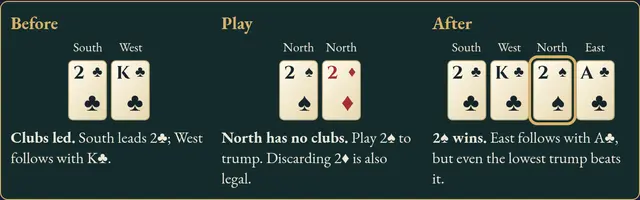
- Follow the led suit when you can. Otherwise play any card: trumping is optional. The highest spade wins; with no spades, the highest card of the led suit wins. The winner leads next.
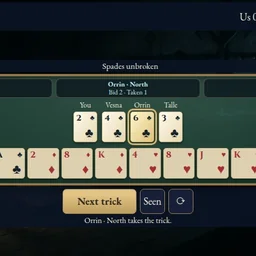
- Do not lead spades until one has been played, unless your hand contains only spades. Each completed trick stays visible until you choose Next trick.
- Partners' positive bids add. Cover that total to score 10 points per bid trick; miss it to lose that amount. Extra covering tricks score 1 point and 1 bag each. Every 10 accumulated bags costs 100 points.
- Nil earns 100 points for taking no tricks, or loses 100 if broken. Failed-Nil tricks count as bags but do not cover your partner's bid or earn positive trick points.
- A Match ends after a whole hand when a team has at least 500 and the scores differ; higher wins. A Challenge always plays four hands and may draw. Its highest team score and widest margin have separate Top 10 tables.
Controls
| Input | Action |
|---|---|
| Click or tap a bid / Confirm bid | Choose and commit your bid |
| Click or tap a card | Play it when legal; inspect the reason when refused |
| Next trick / Next hand | Continue after reviewing the table or scores |
| Arrow keys / Enter | Move through bids or cards / activate the focused control |
| Tab / Escape | Reach controls / close a panel |
| Controller directions / A / B / Start | Move focus / confirm / back / Settings |
Tips
- Count the partnership Your positive bids combine. A low losing card can preserve useful controls when North already wins the trick.
- Watch bags and Nil Extra tricks can trigger a 100-point bag penalty. Protect a partner's Nil when you can; a broken Nil does not help cover their positive contract.
Good to know
Matches and personal bests save in this browser. A Challenge ranks only its first uninterrupted sitting: hiding, leaving, reloading or restarting makes it Practice. Both opponent choices share that first sitting for the same deal. Browser storage and an exclusive table lease are required before Challenge cards appear. There is no time ranking. Music, Effects and Reduced motion are independent settings.
Watch how to play
Questions
Must I play a spade when I cannot follow suit?
No. You may trump or discard another suit. Even the lowest spade beats an ace in another suit.
Can the computer see my cards?
Each computer player chooses from its own hand and public information. Seen cards and finished-hand review make that public history available to you too.