About Line Up
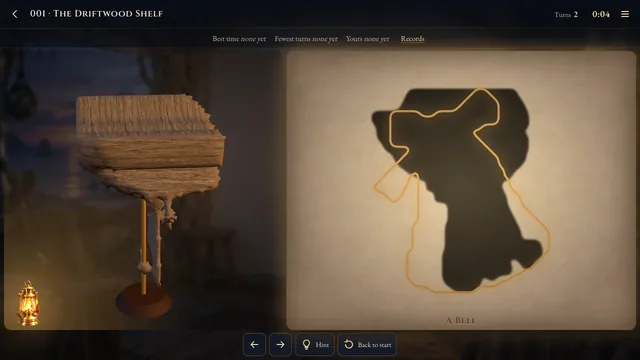
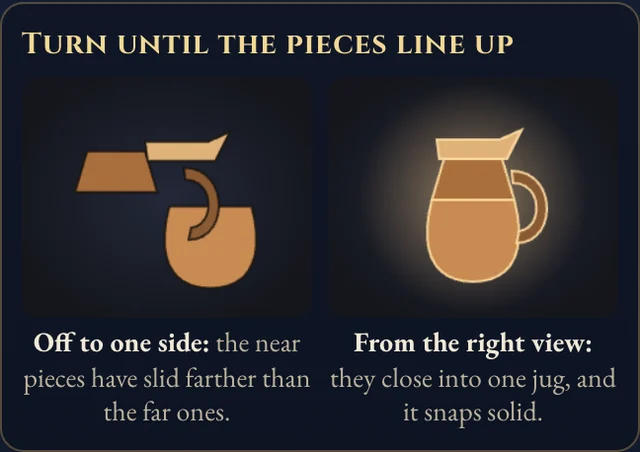
A cabinet of curiosities, broken up: the pieces of an egg, a vase or a skull hang in the air at different distances. Turn round them and they slide past one another, the near ones fast and the far ones slow, until from one view they close up and the object snaps solid.
120 real scanned objects on ten shelves: first four pieces, then more, views from below, a false start whose stray pieces line up somewhere else, and scenes with two objects to find. Every object keeps your fastest first find, with the best of everyone beside it.
How to play
- Goal
- Turn the view until the floating pieces line up into one whole object.
- How it ends
- The object snaps together when you find the one view that lines it up; you cannot lose, and a hint only nudges the view.
- Record
- Each object keeps the time of your first find, if you took no hint.
- Drag to turn round the pieces: across to go round them, up and down to see them from higher or lower. Arrow keys or WASD turn one degree a press; hold Shift for five.
- Every piece floats at its own distance, so near pieces slide faster than far ones as you turn. Pieces that close up mean you are turning toward the answer; pieces that drift apart mean you are turning away. Close to it a warm glow rises behind them, and in the one view where they line up the object snaps solid and its name appears. You cannot lose.
- Later shelves add more pieces, views from below, a false start (stray pieces of another object that line up somewhere else, never into the answer) and scenes with two objects, each snapping on its own.
- Stuck? After 30 seconds Hint turns the view a third of the way toward the answer; a find after a hint is practice. The clock starts when the pieces appear and does not stop, even for the menu; Back to start returns the view but the clock runs on. A shelf opens when 8 objects of the one before are found.
Controls
| Input | Action |
|---|---|
| Drag | Turn round the pieces (across) and higher or lower (up and down) |
| Arrow keys · WASD | Turn one degree; with Shift, five |
| H | Hint: turn a third of the way toward the answer (the find becomes practice) |
| R | Back to the start view (the clock runs on) |
| Escape | Menu |
Good to know
Each piece is scaled about one hidden viewpoint, so exactly one view lines the object up, symmetric objects included. The objects are scanned 3D models drawn as Gaussian splats and need WebGL 2. Progress stays in this browser.