About Butterfly Arena
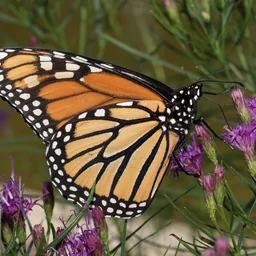
Seven competitions use real, individually reviewed butterfly photographs. Identify a butterfly by its common or scientific (Latin) name, choose its family from the name alone, pick a continent where it is native, estimate its wingspan, or match ten photographs and names. Worldwide score, time and player name lead the main menu.
The library holds 58 swallowtails and birdwings, 52 whites and sulphurs, 117 brush-foots, 64 blues, coppers and hairstreaks, and 47 skippers and metalmarks from every continent with butterflies. Choose familiar butterflies, one collection, or all of them. Native Regions uses 304 checked native ranges; Wingspan Reserve uses 219 wingspan ranges quoted from named field guides and databases.
How to play
- Goal
- Recognize butterflies and learn their scientific names, families, native continents and wingspans.
- How it ends
- Finish ten questions or ten pairs, exhaust the sprint clock, or make one sprint mistake.
- Record
- Best score, highest wingspan reserve or fastest matching finish, with time and the player’s name.
- Recognition Sprint: choose the pictured butterfly from eight names. You have 90 continuously running seconds; one wrong answer ends the run. Most correct answers wins, with time of the last correct answer breaking ties.
- Latin Names: choose the scientific (Latin) name of the pictured butterfly from eight, mostly from the same genus or family. Ten photographs; a wrong answer scores nothing but the run continues. Most correct answers wins, then the faster total time. The clock pauses while each answer is revealed.
- Name Search: identify ten photographs. Type part of a common, scientific or former name, ignoring case, and choose the exact butterfly from the filtered list. Correct answers rank first, then faster time.
- Native Regions: choose one continent where the named butterfly is native. Any correct native continent earns a point; introduced populations do not count. Complete ten questions.
- Family: ten butterflies are shown by English name only, without a photograph. Choose their family from six. Offered for All and Familiar butterflies.
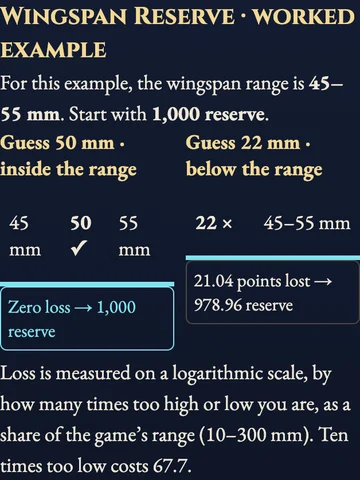
- Wingspan Reserve: estimate the wingspan in whole millimetres. You start with 1,000 reserve. Estimates inside the quoted range cost zero. Outside it, lose the distance to the nearest end on a logarithmic scale, as a share of the game's range of 10–300 mm, at most 100 per guess. Complete ten estimates; highest reserve wins, with time breaking ties.
- Matching Table: select or drag a photograph onto its butterfly name. Match all ten pairs. Each wrong pair adds three seconds; fastest adjusted finish wins.
Controls
| Input | Action |
|---|---|
| Tap / click | Choose answers, continents, families and matching pairs; double-click or double-tap an answer to confirm it at once |
| Drag | Drag either side of the Matching Table onto its partner to make a pair |
| Type a butterfly name | Filter names; Enter chooses a unique result |
| Wingspan estimate · mm | Enter an estimate; a number pad supports controllers |
| Enlarge · Zoom in · Fit photo | Inspect the photograph while the clock keeps running |
| 1–8 | Choose a Recognition Sprint, Latin Names or Family answer |
| Standard controller | D-pad navigates controls; A selects, Y opens Rules |
Tips
- Read the genus Latin Names offers relatives from the same genus and family first, so the second word often decides it.
- Names carry the family Swallowtails, birdwings and kites are Papilionidae; whites, sulphurs and yellows are Pieridae; blues, coppers and hairstreaks are Lycaenidae; skippers and darts are Hesperiidae.
- Read the wingspan scope Each range names its source and population. Birdwings pass 200 mm; many blues and skippers stay under 30 mm.
Good to know
Every photograph retains its creator, chosen licence, original title and source links. Creator credits appear beside the photograph; Full photo credit opens the complete attribution and sources. Opening help, rules or full credits during a ranked question, leaving the tab or restoring an unfinished run makes that attempt practice. Wingspan ranges are source-specific references, not universal limits.
Watch how to play
Questions
Why do some butterflies appear in fewer competitions?
A photograph does not prove a wingspan or a native range. A species joins those competitions only when its facts were quoted from a named reference and mapped the same way by a second, independent check.
Where do families and Latin names come from?
From the GBIF Backbone Taxonomy, with recorded corrections where the backbone lags current butterfly classification; Name Search also finds former names.
Why is Family played without photographs?
A swallowtail's tails or a sulphur's colour would give the family away; the name alone is the test.