About Battle Arena
Nine competitions on 12,130 battles, sieges and naval actions from Megiddo in 1457 BC to the end of 1999: the ancient world, the Middle Ages, the wars of religion and empire, Napoleon, the nineteenth century, both world wars and the Cold War. 3,638 of them are shown in real pictures from Wikimedia Commons — battle paintings, engravings, maps and period photographs — never in pictures made for the game.
Play the 554 best-known battles, everything at once, or one era. Wars, years, present-day countries and victors come from Wikidata (CC0) and English Wikipedia and are asked only where both agree. The tone is factual: casualty figures are never asked, and results the sources call inconclusive or disputed are left out.
How to play
- Goal
- Know the battles of world history up to 1999: how painters and photographers recorded them, which war they belonged to, when and where they were fought and which side the sources say won.
- How it ends
- Finish ten questions, ten pairs or five hidden names, run out the sprint clock, or make one sprint mistake.
- Record
- Best score, fastest Matching finish or fewest wrong letters, with time and the player’s name.
- Battle Sprint: choose the battle in the picture from eight names, from the same war, era and part of the world where possible. You have 90 seconds and one wrong answer ends the run. Most correct answers wins; the time of the last one breaks ties.
- Battle Round: the same eight-name choice at your own pace, ten pictures, each answer revealed. Most correct answers wins, then time.
- Name Search: identify ten pictures. Type part of a name or another known name and pick from the list; close spellings are offered. Battles of the same name or numbered series also count. Correct answers rank first, then faster time.
- War: choose the war each of ten battles belonged to from four, the nearest in time first. A battle of a campaign inside a larger war accepts either. Most correct answers wins, then time.
- Year: choose the year each of ten battles was fought from four, spaced more widely the older the battle. Most correct answers wins, then time.
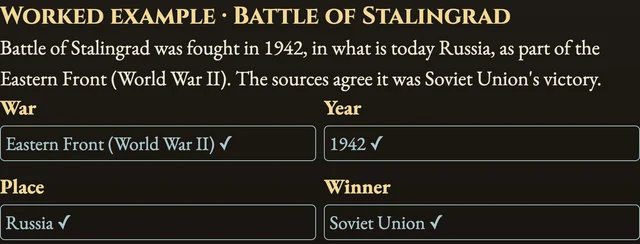
- Winner: for ten battles with two sides, choose the side the sources name as victor. Most correct answers wins, then time.
- Place: choose the present-day country holding each of ten battlefields, neighbours first. Most correct answers wins, then time.
- Matching Table: select a picture, then its name, or drag one onto its partner. Match all ten pairs. Each wrong pair adds three seconds; fastest adjusted finish wins.
- Name Hangman: five hidden battle names of up to four words, one at a time, with the picture as the clue. Guess letters; right letters are free, each wrong letter counts. Fewest wrong letters wins, then time.
Controls
| Input | Action |
|---|---|
| Tap / click | Choose names, wars, years, sides, countries and matching pairs |
| Drag | Drag either side of Matching Table onto its partner to make a pair |
| Type a name | Filter the Name Search list; Enter chooses a unique result |
| Letters | Guess letters in Name Hangman with the keyboard or the on-screen keys |
| Enlarge | Inspect the picture while the clock keeps running |
| 1–8 | Choose an answer in the pick-one competitions |
| Enter / Space | Continue from a revealed answer |
Tips
- Read the uniforms Red coats, blue coats, kilts, pikes, muskets or tanks place a picture in its century before any detail does.
- Ships and sieges A sea of sails is a naval action; walls, breaches and ladders a siege. The sky and the coastline often name the place.
- War spans Year choices that fall outside the war shown beside the battle can be ruled out; the four are spaced evenly around the answer.
Good to know
Every picture retains its creator, licence, original title and source links. The creator credit appears beside the picture; full credits open the complete attribution and sources. Opening full credits during a question, leaving the tab, restoring an unfinished run or a mid-run picture-loading interruption makes that attempt practice.
Watch how to play
Questions
Why do only some battles have a picture?
Only real paintings, prints, maps and photographs are shown, and each passed two independent reviews that it shows the named battle and reads at quiz size. Battles without one play in War, Year, Winner and Place.
Why does the game stop at 1999?
The data have a fixed cutoff: no battle after 1999 is asked, and countries are those of the present day.
Why are some winners missing?
A winner is asked only where Wikidata's infobox result and the article's opening text name the same victor between exactly two sides; inconclusive, disputed and many-sided results are left out.