About Armoury Glimpse
Seven competitions on arms and armour from before gunpowder, from Bronze Age daggers and Corinthian helmets to Gothic gauntlets, Japanese kabuto, halberds and crossbows. In Glimpse each object first shows only a small detail; every wrong guess crosses that type out and widens the view, and naming it sooner scores more.
Every one of the 468 objects is a photographed piece in The Metropolitan Museum of Art, released as open access. Types, places and dates follow the museum's own record, dated from 3000 BC to 1600. There are no firearms.
How to play
- Goal
- Tell the weapons and armour of the world before gunpowder apart from real museum objects: swords, polearms, helmets, plates and shields, where they were made and when.
- How it ends
- Finish ten questions, ten pairs or five hidden names, exhaust the sprint clock, or make one sprint mistake.
- Record
- Best score, highest Year Reserve or fastest Matching Table finish or fewest wrong letters, with time and the player’s name.
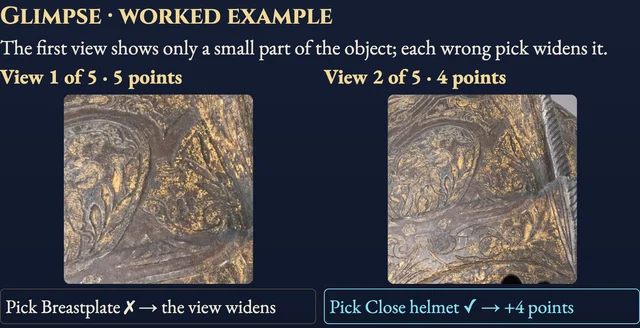
- Glimpse: ten objects, each shown first as a tight close-up with six types to choose from. A wrong pick crosses that type out and widens the view: 5 points on the first view, then 4, 3, 2 and 1 for the whole photograph. Most points out of 50 wins; time breaks ties.
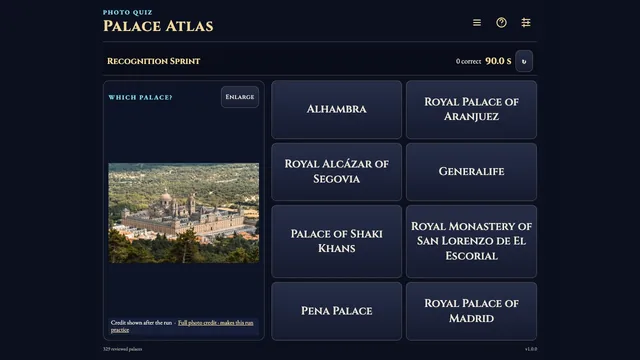
- Recognition Sprint: choose the pictured type from eight within 90 running seconds; one wrong answer ends the run. Most correct answers wins.
- Name Search: identify ten photographs by typing part of a type's name or another name it goes by, such as longsword, hauberk or poleaxe.
- Origin: choose where each pictured object was made from six regions, the wrong ones near the right one. Most correct answers wins, then total time.
- Year Reserve: type the year each named object was made and choose AD or BC. You start with 1,000 reserve; a guess inside the museum's date range is free, and outside it costs one point per ten years off, up to 100. Highest reserve wins.
- Matching Table: select or drag a photograph onto its type; each wrong pair adds three seconds. Fastest adjusted finish wins.
- Letter Hunt: five hidden type names. Right letters are free; fewest wrong letters wins.
Controls
| Input | Action |
|---|---|
| Tap / click | Choose types, regions and matching pairs |
| Drag | Drag either side of the Matching table onto its partner |
| Type | Filter type names in Name Search; enter a year in Year Reserve, A or B switches AD and BC |
| 1–8 | Choose an answer |
| Letter keys | Guess letters in Letter Hunt |
| Standard controller | D-pad moves between controls, A selects, B goes back, Y opens Rules, Start opens Settings |
Tips
- Read the edge A close-up of a blade's edge or fuller says sword or dagger; a socket, langets or a long side spike says polearm.
- Look for rivets and lames Overlapping plates held by rivets are armour for a limb or the body; a single domed shell with a face opening is a helmet.
- Narrow before you guess In Glimpse a wrong pick still teaches: rule out whole families first and the wider view usually settles the rest.
Good to know
Types, places and dates are those of The Metropolitan Museum of Art's catalogue record. Every photograph keeps its museum credit and a link to its object page. Leaving the game or restoring an unfinished run makes that attempt practice.
Watch how to play
Questions
Where do the objects come from?
All of them are from The Metropolitan Museum of Art's open-access collection, which releases these photographs into the public domain (CC0). Each reveal links to the object's own museum page.
Why are a sword and a two-handed sword never offered together?
Some types cannot be told apart from a photograph, such as an armet and a close helmet or a breastplate and a cuirass. They are never offered against each other, and either one counts.
Why do some collections not play every competition?
A collection plays a competition only when enough of its objects have the facts that competition needs and the choices stay fair.