About Spider & Arachnid Arena
Eight competitions on photographs of 4,188 arachnid species: spiders, scorpions, harvestmen, ticks, mites, whip scorpions and solifuges. Name an arachnid, choose its Latin name, search for it, pick where it lives, tell its family, say whether a spider spins a web or hunts, estimate its length, or match photographs to names.
Most arachnids have no English name, so Latin names carry much of the game. Play the familiar arachnids, a balanced mix or one of eleven groups, from orb weavers to scorpions. Facts come from iNaturalist, the World Spider Catalog, GBIF, Cardoso et al. (2011) and the World Arachnida Trait Database.
How to play
- Goal
- Recognize the world’s spiders and other arachnids from their photographs and learn their names, Latin names, where they live, families, how they catch prey and how long they are.
- How it ends
- Finish ten questions or ten pairs, exhaust the sprint clock, or make one sprint mistake.
- Record
- Best score, highest Length Reserve or fastest Matching finish, with time and the player’s name.
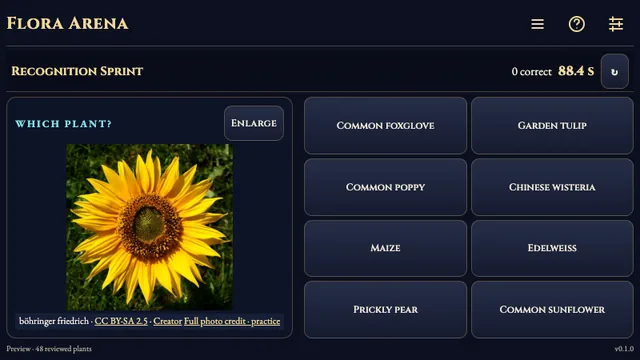
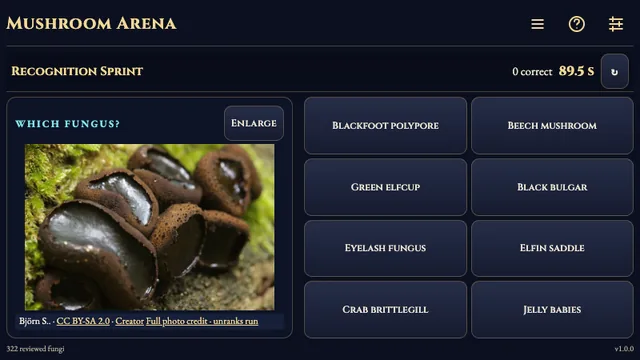
- Recognition Sprint: choose the pictured arachnid from eight English names, mostly related arachnids. You have 90 seconds and one wrong answer ends the run. Most correct answers wins; the time of the last one breaks ties.
- Latin Names: choose the scientific (Latin) name of the pictured arachnid from eight, mostly of related arachnids. Ten photographs; a wrong answer scores nothing. Most correct answers wins, then the faster total time.
- Name Search: identify ten photographs. Type part of a common or scientific name, a former name or an alias and choose the arachnid from the list. A lesser-known arachnid of the same genus also counts. Correct answers rank first, then faster time.
- Where It Lives: each named arachnid comes with six of thirteen regions of the world. Exactly one is a region where it lives in the wild, native or established; the other five have no record of it. Complete ten questions.
- Arachnid Family: choose the family of the named arachnid from eight, each shown with two of its best-known arachnids. Ten questions; most correct answers wins, then time.
- Hunter or Web-Builder: say how each of ten spiders catches prey: an orb web, a sheet or funnel web, a tangle or cobweb, or hunting without a catching web. Most correct answers wins, then time.
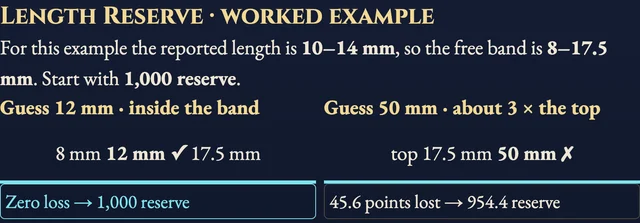
- Length Reserve: estimate the adult body length of ten spiders in millimetres, legs not included. You start with 1,000. A guess from a fifth below the shortest to a quarter above the longest reported length is free; beyond that you lose more the further off, up to 100 per spider. Highest reserve wins, then time.
- Matching: select a photograph, then its arachnid name, or drag one onto its partner. Match all ten pairs. Each wrong pair adds three seconds; fastest adjusted finish wins.
Controls
| Input | Action |
|---|---|
| Tap / click | Choose answers, regions, families, hunting styles and matching pairs |
| Drag | Drag either side of Matching onto its partner to make a pair |
| Type an arachnid name | Filter the Name Search list; Enter chooses a unique result |
| Length estimate | Enter an estimate in millimetres; a number pad supports controllers |
| Enlarge | Inspect the photograph while the clock keeps running |
| 1–8 | Choose an answer in the pick-one competitions; in Where It Lives select a region, then the same number or Enter confirms |
| Standard controller | D-pad navigates controls; A selects, Y opens Rules; in the Name Search list, left and right jump between first letters |
Tips
- Count the eyes and legs Eye arrangement and leg posture separate jumping, wolf, crab and orb-weaving spiders before the species matters.
- Read the genus Latin Names offers relatives, so the first word is often shared; the second word decides.
- Most spiders are small Length Reserve measures the body without legs; a big-looking spider is often under 20 mm.
Good to know
Every photograph retains its creator, chosen licence, original title and source links. Creator credits appear beside the photograph; Full photo credit opens the complete attribution and sources. Opening full credits during a question, leaving the tab, restoring an unfinished run or a mid-run photo-loading interruption makes that attempt practice. This is a quiz: nothing in it is advice on handling, keeping or identifying dangerous arachnids.
Watch how to play
Questions
Why are not all 52,000 spiders here?
An arachnid joins only with a photograph that two independent reviews both accepted as clear and correctly named. Most small spiders and mites have no such photograph yet.
Why do fewer arachnids appear in some competitions?
Where It Lives asks only arachnids with at least 100 GBIF records and a clear set of regions; Hunter or Web-Builder only spiders whose family hunts one way; Length Reserve only spiders with a published body length.
Where do the facts come from?
Names come from iNaturalist and English Wikipedia, families from iNaturalist and the World Spider Catalog, regions from GBIF occurrence records, hunting styles from Cardoso et al. (2011) and body lengths from the World Arachnida Trait Database (Pekár et al. 2021).