About Nobel Arena
Ten competitions use real, individually reviewed portraits of Nobel laureates. Name a laureate, choose their prize field, enter the year of their prize, pick their country of birth, choose who shared their prize, find the laureate behind a prize citation, match ten portraits and names, guess five hidden names letter by letter, or spot a famous laureate from a close-up that widens with every wrong pick.
Every laureate whose portrait passed review plays, 1901 to 2026, across Physics, Chemistry, Medicine, Literature, Peace and Economic Sciences. Play the best known, one field, one era or all of them. Every answer comes word for word from the official laureate record of Nobel Prize Outreach; data to 2026.
How to play
- Goal
- Recognize the Nobel laureates from their portraits and learn what, when and with whom they won.
- How it ends
- Finish ten questions, ten pairs or five hidden names, exhaust the sprint clock, or make one sprint mistake.
- Record
- Best score, highest Prize Year reserve, fastest matching finish or fewest wrong letters, with time and the player’s name.
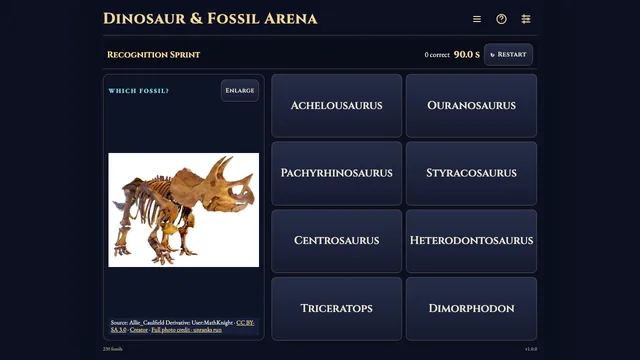
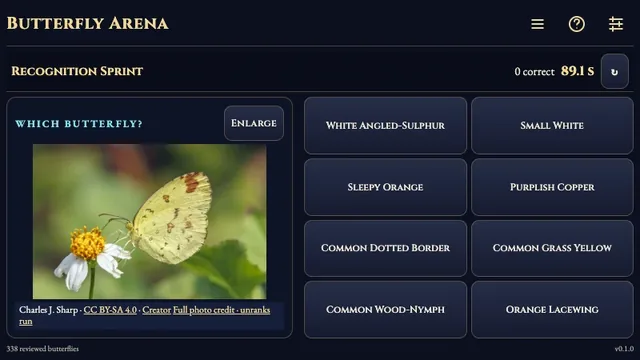
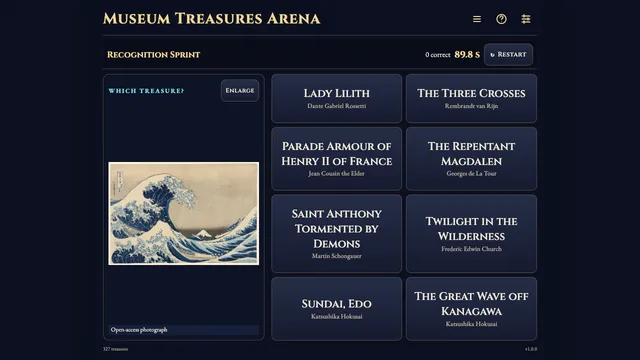
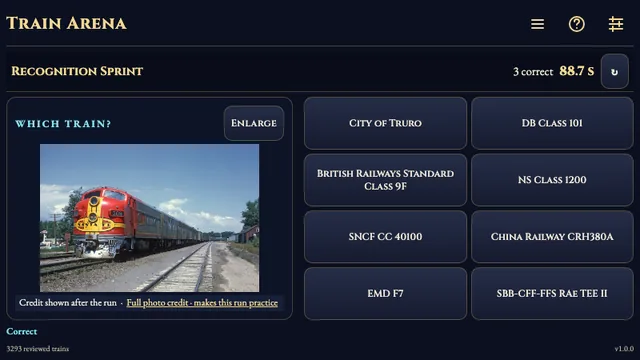
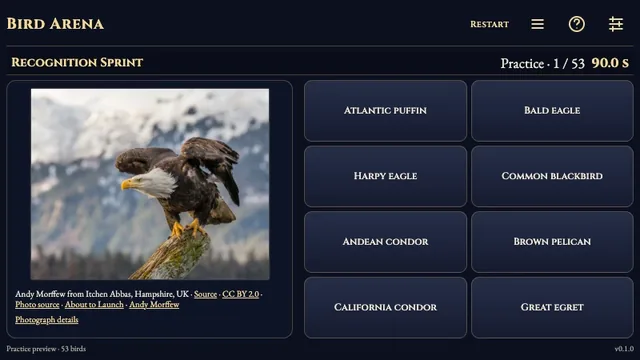
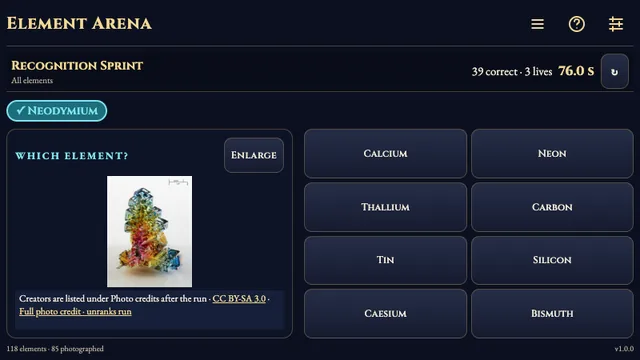
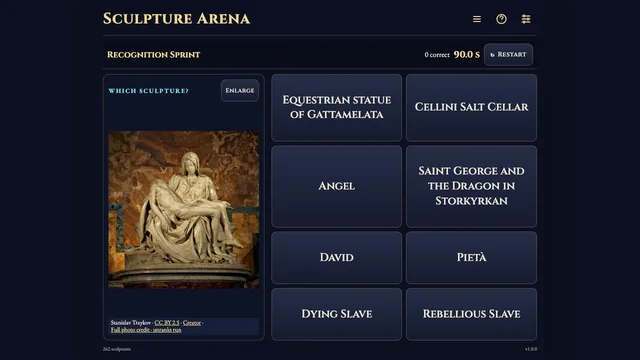
- Recognition Sprint: choose the pictured laureate from eight names. You have 90 continuously running seconds; one wrong answer ends the run. Most correct answers wins, with time of the last correct answer breaking ties.
- Name Search: identify ten portraits. Type part of a name or another name, ignoring case and accents, and choose the exact laureate from the filtered list.
- Prize Field: a portrait with the laureate's name; choose their prize from the six. A double laureate's every field is right (Marie Curie: Physics or Chemistry). Most correct answers wins, then the faster total time.
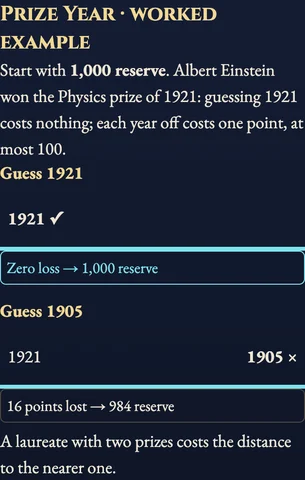
- Prize Year: a portrait, name and field; enter the year of the prize. Each year off the nearest of their prizes costs one reserve point, at most 100, from a 1,000 reserve. Highest reserve wins, with time breaking ties.
- Citation: read a prize citation and its field; choose the laureate from eight names. The wrong names won the same prize in nearby years, never alongside this laureate.
- Birth Country: a portrait and name; choose the country of birth, in today's borders as the record states, from eight.
- Shared With: a portrait, name, field and year; choose who shared that prize from eight. Any co-laureate of it is right.
- Matching: select or drag a portrait onto its name. Match all ten pairs. Each wrong pair adds three seconds; fastest adjusted finish wins.
- Letter Hunt: five laureates' names are hidden. Guess letters on the grid or with your keys; right letters are free, each wrong letter counts, and you cannot lose. The portrait appears when a name is solved. Fewest wrong letters wins, with time breaking ties.
Controls
| Input | Action |
|---|---|
| Tap / click | Choose answers, fields, countries and matching pairs; double-click or double-tap an answer to confirm it at once |
| Drag | Drag either side of the Matching table onto its partner to make a pair |
| Type a name | Filter names; Enter chooses a unique result |
| Prize year | Enter a whole year; a number pad supports controllers |
| Enlarge · Zoom in · Fit photo | Inspect the portrait while the clock keeps running |
| 1–8 | Choose an answer |
| Standard controller | D-pad navigates controls; A selects, Y opens Rules |
Tips
- Read the era from the photograph Studio sepia and wing collars point before 1930; colour stage photos to recent decades.
- Citations name the work A citation about a discovery is Physics, Chemistry or Medicine; one about a body of writing is Literature.
- Prizes are often shared Physics, Chemistry and Medicine have been shared in most years since the 1950s; Literature almost never.
Good to know
Every portrait retains its creator, chosen licence, original title and source links. Creator credits appear beside the portrait; Full photo credit opens the complete attribution and sources. Not affiliated with the Nobel Foundation; facts © Nobel Prize Outreach, CC0. Opening help, rules or full credits during a ranked question, leaving the tab or restoring an unfinished run makes that attempt practice.
Watch how to play
Questions
Why are some laureates missing?
A laureate plays only when a freely licensed portrait passed two independent reviews. Organisations such as the Red Cross have no portrait, but can still be the answer in Shared With.
Where do the facts come from?
Names, prizes, years, fields, citations and birth countries come word for word from the Nobel Prize Outreach laureate record (CC0). Nothing is mapped by hand.
Is this affiliated with the Nobel Foundation?
No. It is an independent quiz using the openly licensed Nobel Prize laureate data.