About Shakashaka
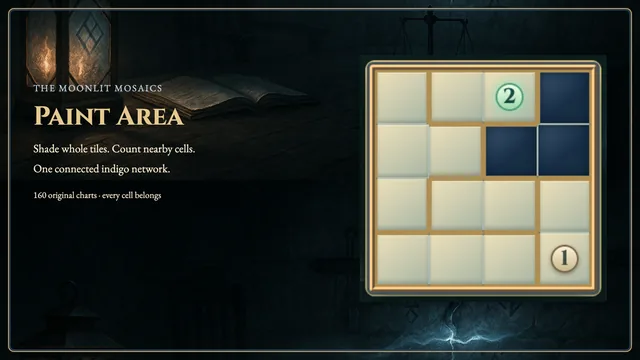
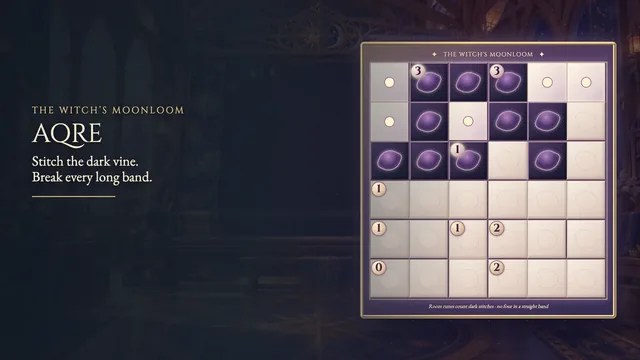
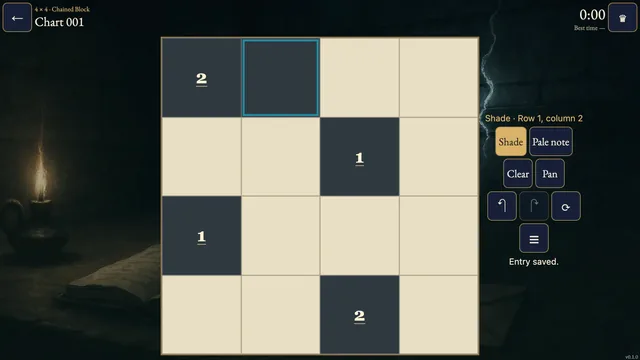
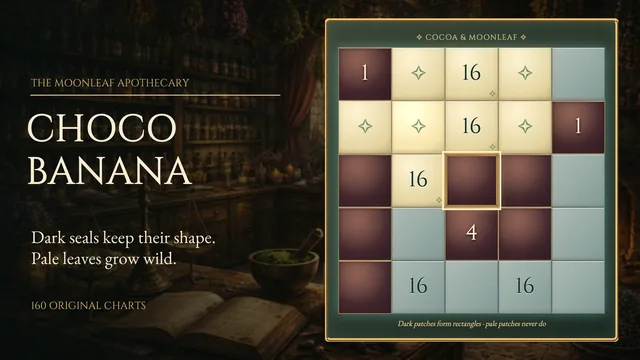
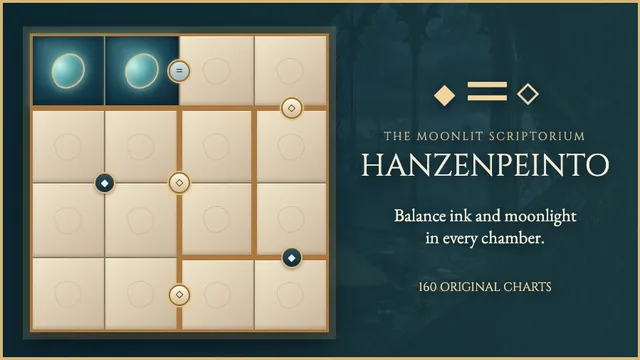
At a moonlit Orenvalt glasshouse, set dark slate triangles into luminous panes. The pale gaps must settle into straight or tilted rectangles, while numbered stones count adjacent triangles.
Four open galleries hold 160 original charts. Each puzzle has one solution.
Your first solve time stays with each chart. An uninterrupted first clear on the game page can claim the named fastest time; replay is practice.
How to play
- Goal
- Place corner triangles so every remaining pale region is a rectangle, straight or tilted, and each numbered stone sees exactly that many triangles beside it.
- How it ends
- A chart is won when the complete arrangement obeys both rules; there is no loss.
- Record
- The first unassisted solve of each chart earns one fastest-time record; later solves are practice.
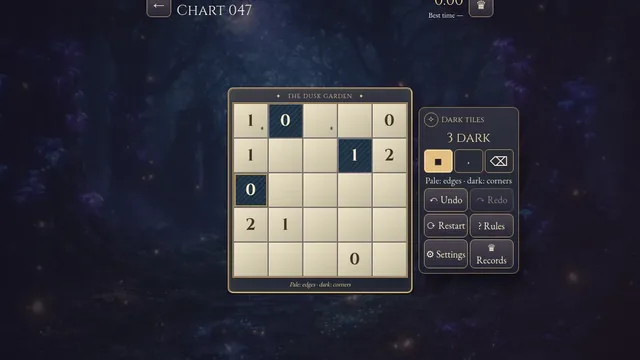
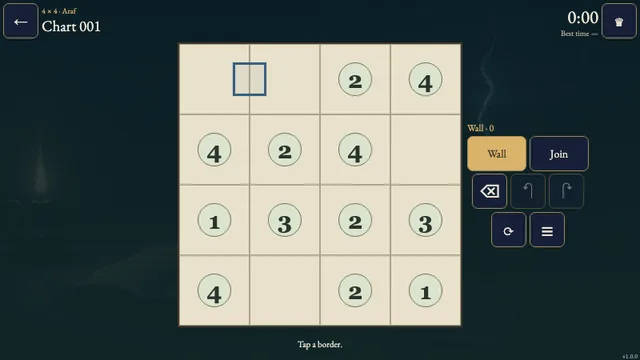
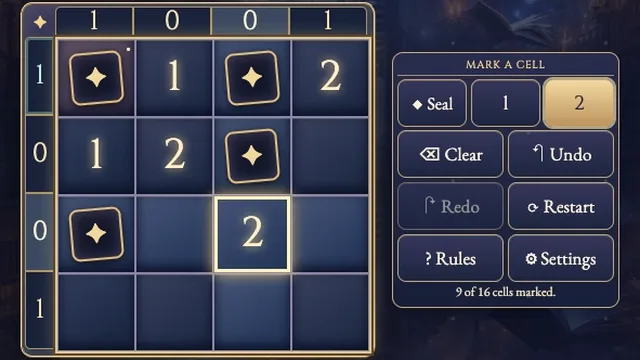
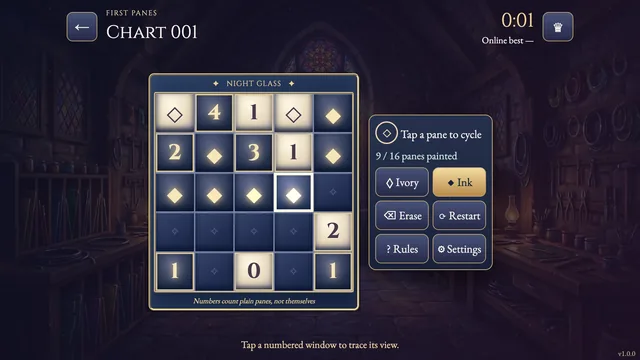
- Tap a corner of a pale cell to place its dark triangle; tap the same corner again to lift it. The numbered stones count triangles in their four side-neighbour cells. A bare stone simply blocks pale glass.
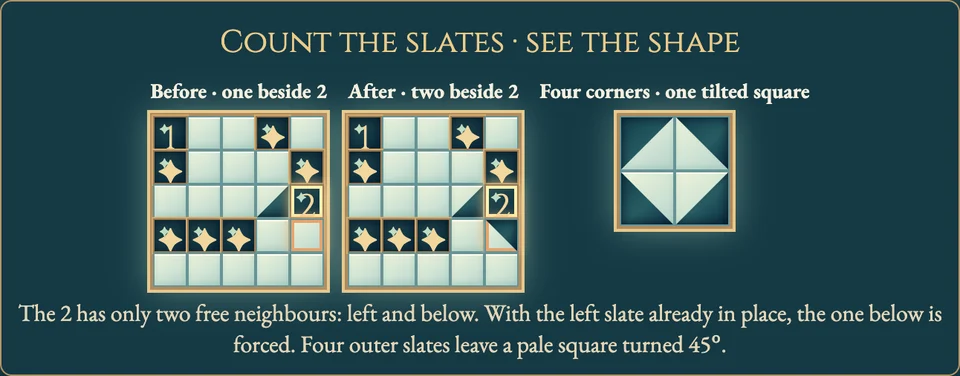
- Every connected pale opening left behind must be a true rectangle, including a tilted square. The worked picture shows a numbered stone forcing a triangle and a separate four-triangle tilted square.
- When all stone counts are met but pale shapes are still open, amber circles point to bends that need work. They are guidance for an unfinished chart, not a penalty. Undo, Redo and Restart let you revise; Restart keeps the first clock running.
- All 160 charts are open. Your first unassisted solve is the only timed result for that chart; later replays are practice. Returning to an unfinished chart in the same page keeps its marks and clock.
Controls
| Input | Action |
|---|---|
| Tap / click a cell corner | Place or lift that corner triangle |
| Corner buttons / Clear | Paint or clear the selected pane |
| Arrow keys | Move the visible cell focus |
| 1–4 / 0 / Space | Set a triangle, clear, or cycle a focused cell |
| Z / Y | Undo or redo |
| R / Escape | Restart the chart / close a panel or return to the atlas |
| Gamepad | D-pad moves; A cycles, X clears, Y undoes, B returns and Start opens settings |
Tips
- Read the stones A stone with only enough free neighbours left forces them all to contain triangles.
- Trace the pale edges A remaining opening needs four right angles, whether its edges run straight or diagonally.
- Use amber bends When the counts match, nearby amber circles point to pale corners that still need reshaping.
Good to know
Progress saves in this browser. Only the first solve can rank; replay is practice.
Watch how to play
Questions
Must every blank cell be marked?
No. A blank is a real empty pane; you only place the triangles the chart needs.
Can two pale regions touch at a point?
Yes. Point contact does not join them into one region.
Must I guess on a later chart?
No. All 160 charts have one exact answer and an independently checked sequence of forced moves.