How to play
- Goal
- Shade whole tiles so each number counts its side-adjacent shaded cells, all shaded cells connect, and no 2×2 block is entirely shaded or entirely unshaded.
- How it ends
- A chart is complete when every clue and shading rule agrees; Undo and Erase repair mistakes, so there is no loss state.
- Record
- The fastest uninterrupted first solve of each chart is kept with its holder's name; replay is practice.
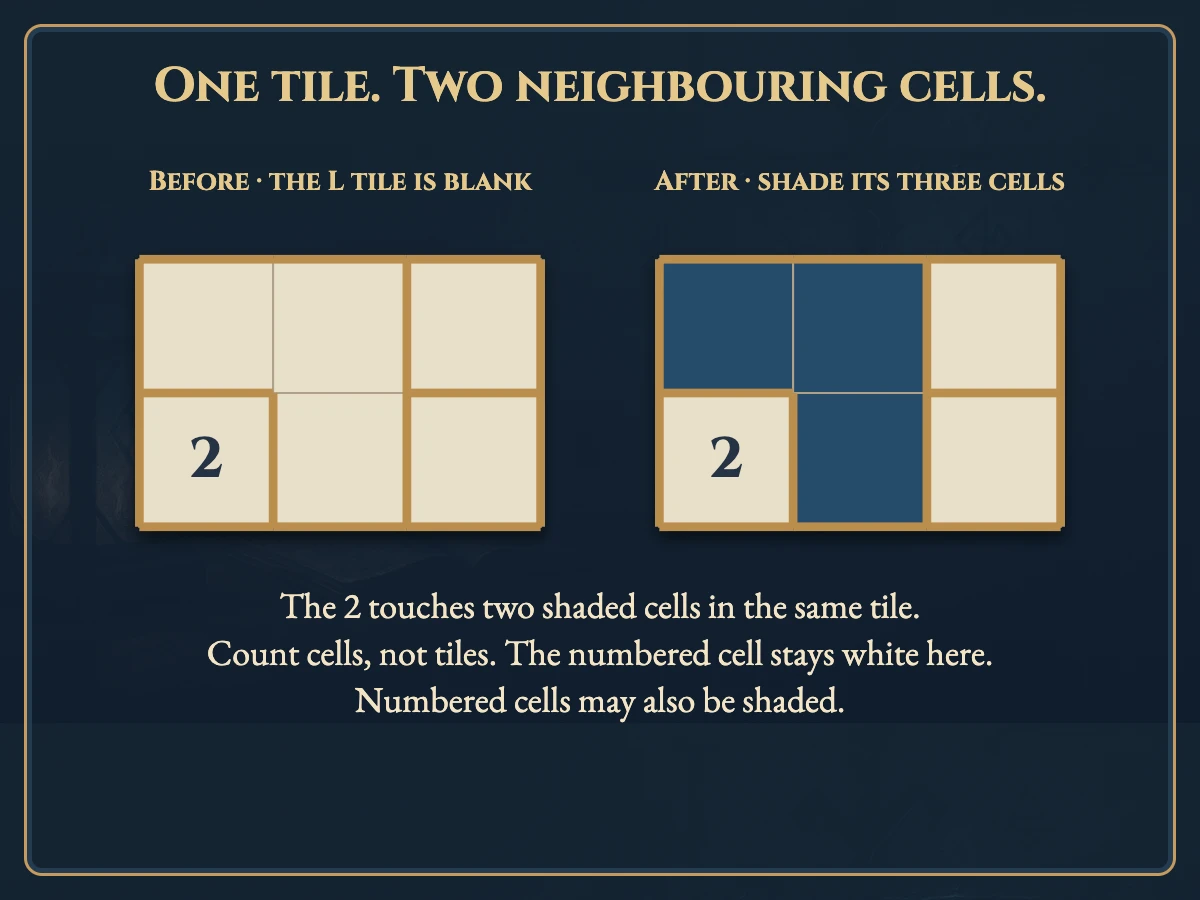
- Shade whole outlined tiles. Each number counts shaded cells immediately above, below, left and right of its cell. Count cells, even when several belong to the same tile; do not count the numbered cell itself.
- All shaded cells must form one side-connected network, including across tile outlines. No 2×2 group may be entirely shaded or entirely unshaded. White cells need not connect, and a numbered tile may be shaded.
- Choose Shade, White or Erase, then tap a cell or drag across cells and release. The whole touched tile changes; one released gesture is one Undo. White notes are optional: unmarked tiles count as white at completion.
- Choose Pan to drag the view without painting. Return to Shade, White or Erase to edit. Keyboard arrows bring the selected cell into view.
- Restart preserves the first clock. Reload preserves marks and Undo; the resumed first finish stays local. Replay preserves your first time.
Controls
| Mouse / touch | Tap a cell or drag across cells and release to mark whole tiles |
|---|---|
| Arrows + Enter / Space | Move between cells and apply the selected tool |
| S / W / E | Shade / White note / Erase |
| Pan | Drag the view without changing tiles |
| Z / Y | Undo / Redo |
| R | Restart confirmation |
| Escape | Cancel a draft, close a dialog or return to the atlas |
| Controller | D-pad moves; A applies; X cycles tools; Y focuses the board; shoulders Undo/Redo; B returns; Start settings. |
Tips for Paint Area
- Count contacts, not tiles A bent tile can touch a clue on two or three sides. Every shaded neighbouring cell counts.
- Check both kinds of square Three shaded cells in a 2×2 force the fourth white; three white cells force the fourth shaded.
- Keep a route for the shade Tile outlines do not block the shaded network. Avoid cutting off its only possible bridge.
Questions about this game
Can a numbered cell be shaded?
Yes. Its number counts only its side neighbours, never itself.
Must white cells connect?
No. Only the shaded cells must form one side-connected network.
Must every white tile have a note?
No. Unmarked tiles count as white when all rules agree.
Can replay improve my first time?
No. Your saved first finish stays unchanged; replay is practice.
All charts are open. White notes are optional. Reload retains marks, Undo and the clock; resumed finishes stay local. Practice preserves your first time.
Watch how to play
About Paint Area
Glaze a moonlit mosaic in indigo. Bronze outlines divide the cells into tiles: every cell in a tile takes the same shade.
All 160 original charts are open, with forty each at 4×4, 5×5, 6×6 and 7×7. Each has one independently verified ending and a complete deduction path.
Your first finish keeps its time. An uninterrupted verified first solve can claim the named fastest time; replay is practice.