About Nawabari
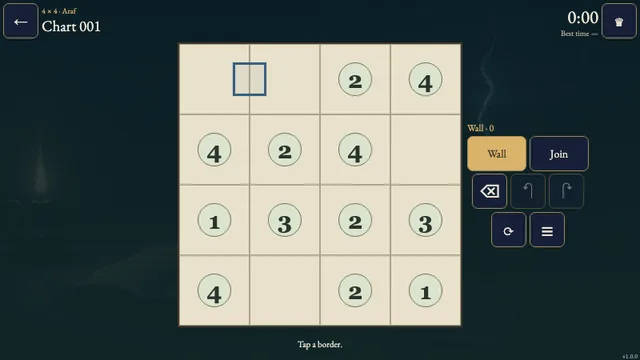
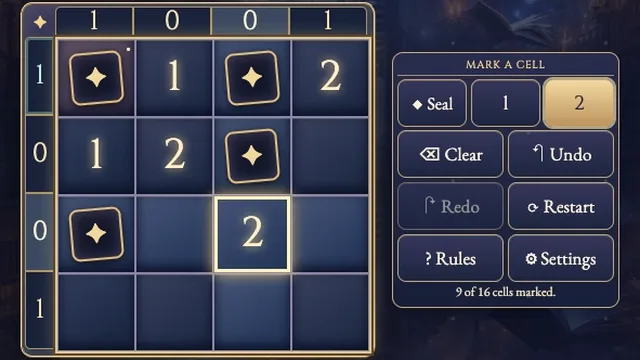
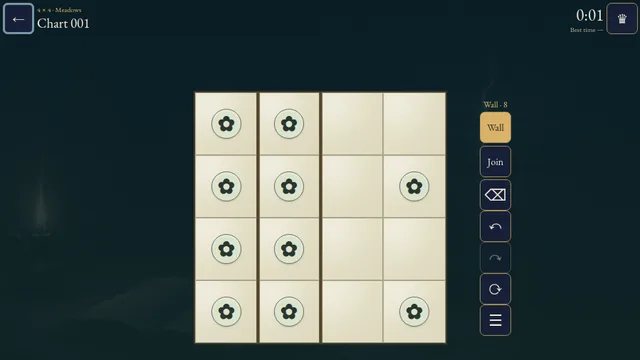
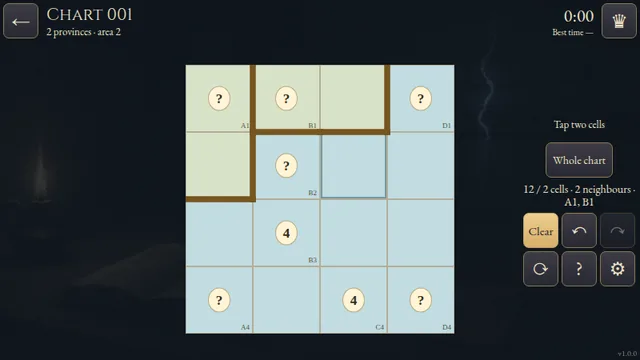
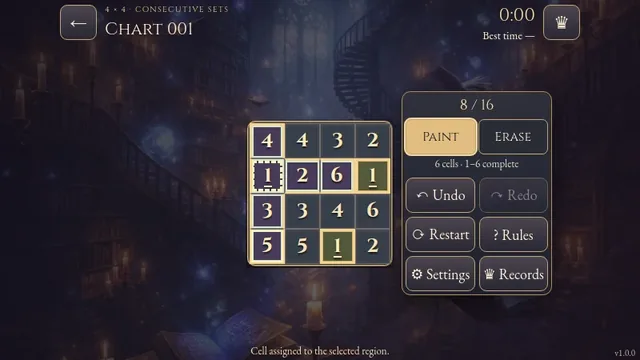
Restore a brass survey mosaic by dividing it into rectangular territories. Each rune counts the sides of its own cell touching its territory’s border.
All 160 original charts are open from the start. Each has one checked partition and a deduction path, from compact four-square lessons to six-square mosaics.
Your first completed time stays with each chart. An uninterrupted first solve on the game page can claim the named best; replay is untimed practice.
How to play
- Goal
- Divide the whole mosaic into rectangles with exactly one numbered rune each, matching the rune’s count of its own cell sides on the rectangle boundary.
- How it ends
- Complete every cell to finish; there are no lives or losing moves.
- Record
- Your fastest first solve is kept for each chart.
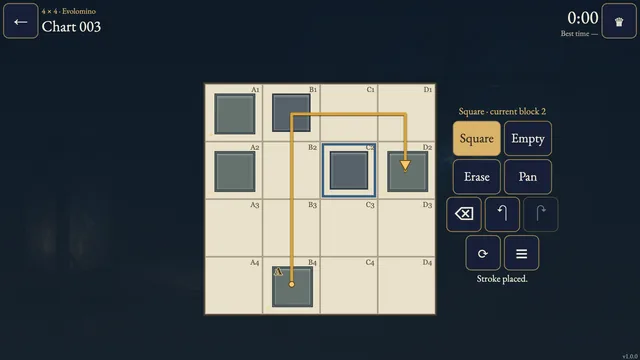
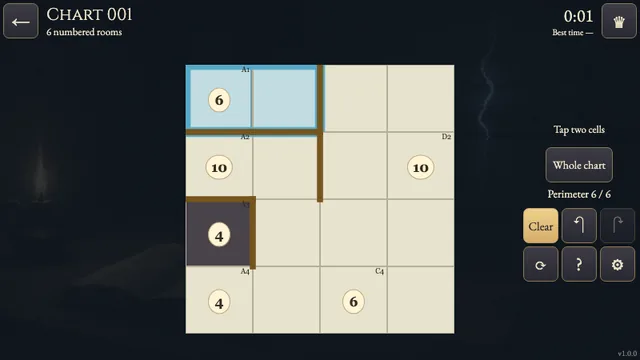
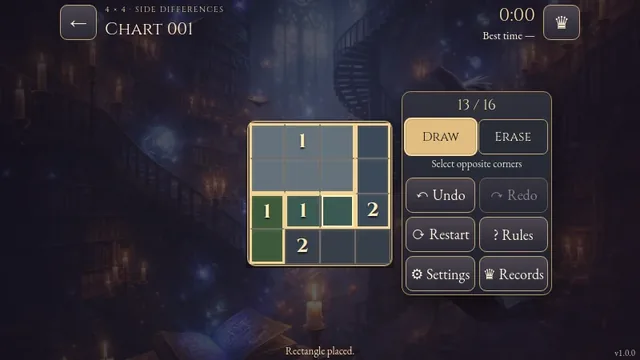
- Tap one corner and then its opposite, or drag between them, to place a rectangle. Cover every cell without overlaps; each territory must contain exactly one numbered rune.
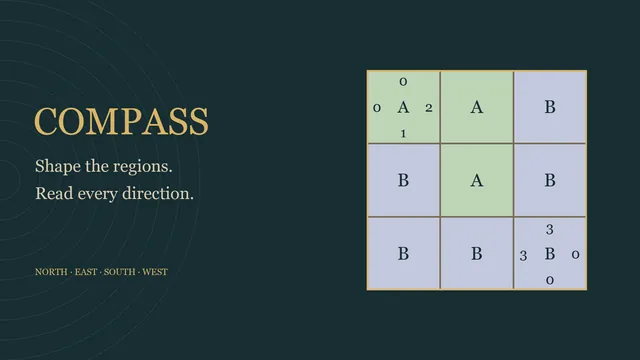
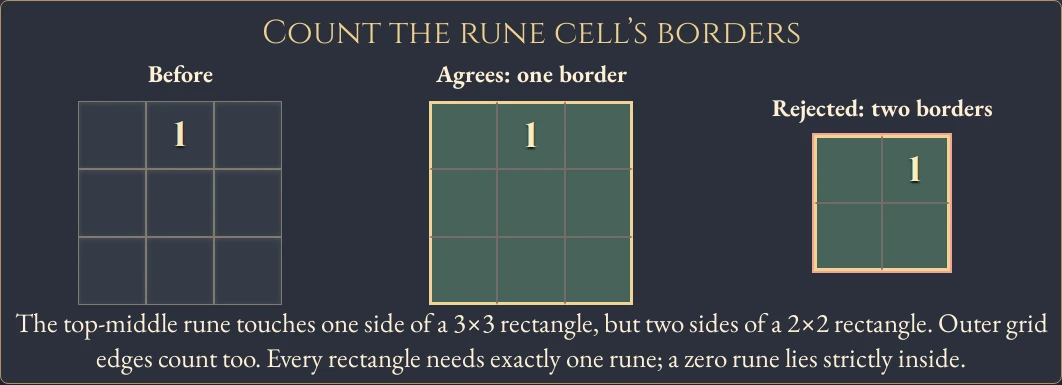
- A rune counts its own cell sides on the rectangle boundary, including the outside edge of the grid. It does not count area. Zero must lie strictly inside, four stands alone, and thin strips can count opposite sides.
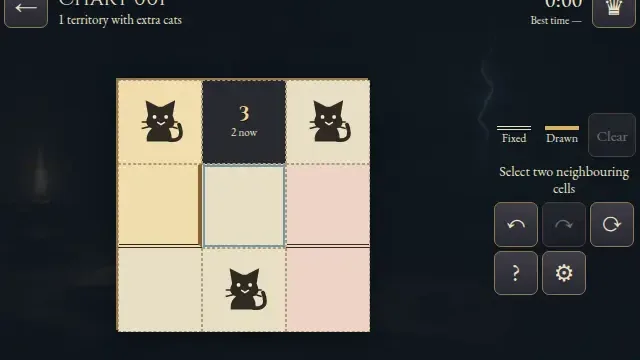
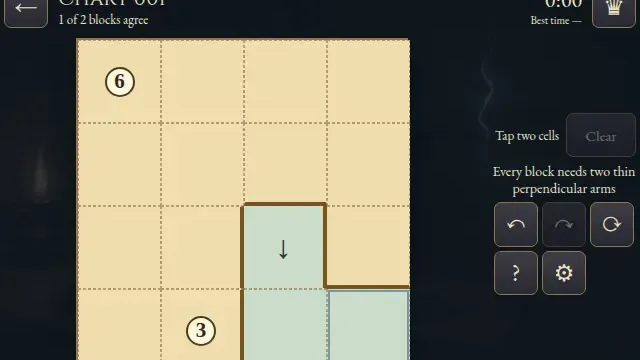
- The worked picture shows a top-middle one in a valid 3×3 rectangle and a rejected 2×2 rectangle with two touching sides. Choose Erase to remove a territory, or Undo and Redo to correct placements. Restart clears territories while the original first clock continues.
Controls
| Input | Action |
|---|---|
| Tap two corners / drag | Place one territory; overlaps are refused |
| Draw / Erase | Choose drawing or remove an entire territory |
| Arrows; Enter / Space | Move the cursor; set a corner or place the rectangle |
| Delete / Backspace; Escape | Erase the selected territory; cancel a draft or return |
| Z / Y; Undo / Redo | Reverse or restore a territory change |
| Restart | Clear territories after confirmation; keep the first clock |
| Gamepad | D-pad moves, A selects corners, X erases, shoulders undo/redo, B cancels/returns and Start opens Settings |
Tips
- Start with fours A four is always a single cell.
- Separate numbered neighbours Every territory contains exactly one rune. Adjacent runes need a border between them.
- Watch the rune’s own cell A large rectangle can still give a rune just one touching side.
Good to know
All charts are open. Progress saves in this browser; a reloaded attempt finishes locally on its original clock.
Watch how to play
Questions
Does the outside grid edge count?
Yes. Every side of the rune cell on its rectangle boundary counts, including outside grid edges.
Does a zero mean an empty cell?
No. Zero is a real rune and must lie strictly inside its territory. Unnumbered cells are blank.
Can replay improve my first time?
No. Your first completed time remains saved; replay is untimed practice.