About Star Atlas
Nine competitions on 3,119 real stars: every Yale Bright Star Catalogue star with a Bayer or Flamsteed designation, plus every naked-eye IAU-named star. Pin a star on the chart, name its constellation, Bayer designation or IAU name, choose its spectral class, order stars by brightness, estimate distances, match names to designations, or uncover hidden names.
Every answer has one source: the Yale Bright Star Catalogue (5th ed., 1991), Hipparcos (2007 reduction), the IAU Catalog of Star Names to 2026-10-15 and the IAU constellation boundaries. Play the famous stars, the named stars, one part of the sky, the zodiac or the whole sky.
How to play
- Goal
- Find, name and classify real catalogued stars by their place in the sky, constellation, designation, spectral class, brightness and distance.
- How it ends
- Finish ten questions, ten placements, ten pairs or five hidden names; no run is lost early.
- Record
- Best score or highest reserve, fastest Matching finish or fewest wrong letters, with time and the player’s name.
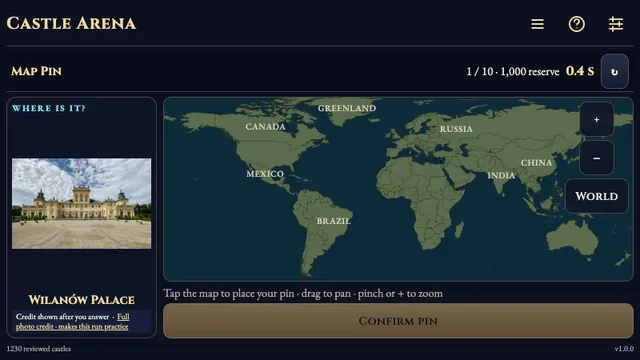
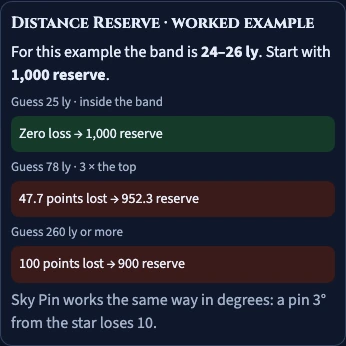
- Sky Pin: ten stars by name. Tap the chart where each one sits, drag to pan, pinch or wheel to zoom, then confirm. Within 1° is free; beyond that each degree costs 5 of your 1,000 reserve, at most 100 per star. Highest reserve wins, then time.
- Constellation: choose which of eight constellations holds a named star. The wrong answers are the constellations whose IAU boundaries come nearest the star.
- Bayer Name: choose a named star's Bayer designation, a Greek letter and the constellation's Latin genitive, from eight real designations of the same and nearby constellations.
- Proper Name: the reverse. The Bayer designation is shown; choose the star's IAU name from eight.
- Spectral Class: choose the star's Morgan–Keenan class letter, from hottest O to coolest M. No letter answers more than four of the ten.
- Brightness Order: the first star is placed for you; place ten more, one at a time, into a line from brightest to faintest by visual magnitude. Most right placements wins.
- Distance Reserve: estimate how many light-years away each star is. Inside the Hipparcos parallax band costs nothing; outside it you lose more the more times off you are, up to 100 per star from 1,000.
- Matching Table: select an IAU name, then its Bayer designation. Match ten pairs; each wrong pair adds three seconds.
- Hidden Name: five named stars, each shown on its constellation chart with designation, magnitude and class. Guess the IAU name letter by letter; fewest wrong letters wins, then time.
Controls
| Input | Action |
|---|---|
| Tap / click | Choose answers, gaps in the brightness line and matching pairs |
| Chart | Tap to place the pin, drag to pan, pinch or wheel to zoom; Confirm places it |
| Arrows, + and − | Move and zoom the pin on the focused chart; Enter confirms |
| Distance | Type the light-years, or use the on-screen number pad |
| 1–8 | Choose an answer; 1–9 choose a gap in Brightness Order |
| Letters | Guess a letter in Hidden Name |
| R | Restart the run (asks first) |
| Standard controller | D-pad navigates controls; A selects, B goes back, Y opens Rules, Start opens Settings |
Tips
- Hotter is bluer O and B stars look blue-white, A white, F and G yellow-white, K orange and M red: Rigel is B, Betelgeuse M.
- Alpha is not always brightest Bayer letters roughly follow brightness, but not always: Betelgeuse is Alpha Orionis and Rigel, Beta, is usually brighter.
- Lower magnitude means brighter Sirius is −1.46, Vega 0.03, Polaris about 2; each step of one magnitude is about 2.5 times fainter.
Good to know
Stars as catalogued: positions J2000, Hipparcos 2007, Yale Bright Star Catalogue 5th ed. (1991), IAU star names as adopted to 2026-10-15. The chart is drawn as seen from inside the sky, east to the left. Opening Rules during a question, leaving the tab or restoring an unfinished run makes that attempt practice.
Watch how to play
Questions
Where do the facts come from?
Positions, designations and spectral types from the Yale Bright Star Catalogue, 5th revised edition (1991). Parallaxes from Hipparcos, the 2007 new reduction; second magnitudes and spectral types from the original Hipparcos catalogue (1997). Names from the IAU Catalog of Star Names as adopted to 2026-10-15. Constellations from the IAU boundaries (Delporte 1930).
Why is a star missing from one competition?
A star is asked only where its fact is certain. Variable stars and stars whose two catalogues disagree on magnitude stay out of Brightness Order; stars whose catalogues disagree on class stay out of Spectral Class; Distance Reserve asks only stars whose parallax is measured to within 10%.
Why not Gaia?
Gaia saturates on the brightest stars, so it cannot measure Sirius or Vega well. Hipparcos measured every star in the game.