About Temple Atlas
Ten competitions use real, individually reviewed photographs of temples, shrines, pagodas and stupas, from Angkor Wat to the Parthenon. Name a temple, choose the city or country it stands in or the faith it was built for, pin it on a zoomable world map, enter the year it was built, match ten photographs and names, uncover five hidden names letter by letter, or spot a famous temple from a close-up that widens with every wrong pick.
The library holds 735 Hindu, Buddhist, Shinto, Jain, Sikh, Taoist and ancient temples in 44 countries as Wikidata and the English Wikipedia recorded them in November 2026. Play the famous temples, one region or the whole world. No photograph shows the temple's name.
How to play
- Goal
- Know the world’s temples, shrines and pagodas: what they look like, which city and country they stand in, which faith built them, where they are on the map and when they were built.
- How it ends
- Finish ten questions, ten pairs or five hidden names, exhaust the sprint clock, or make one sprint mistake.
- Record
- Best score, highest map or year reserve, fastest matching finish or fewest wrong letters, with time and the player’s name.
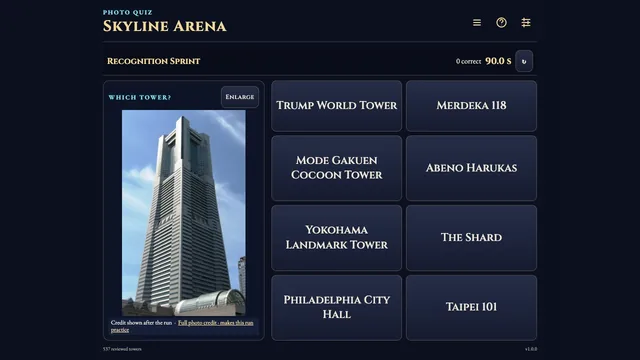
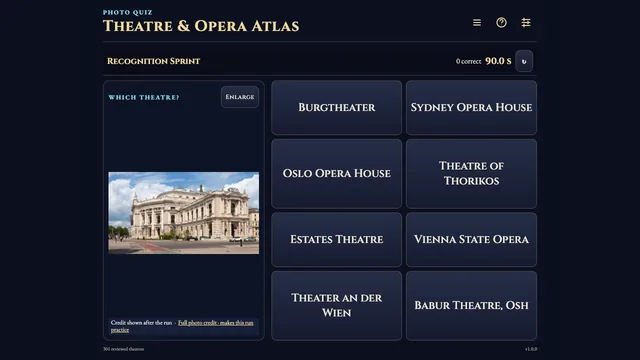
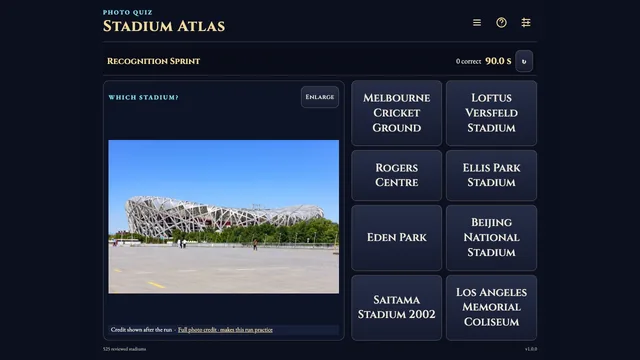
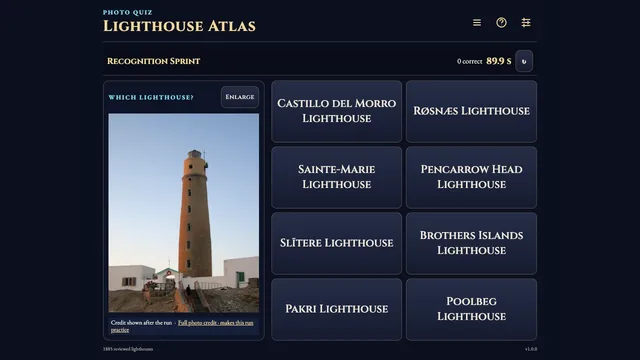
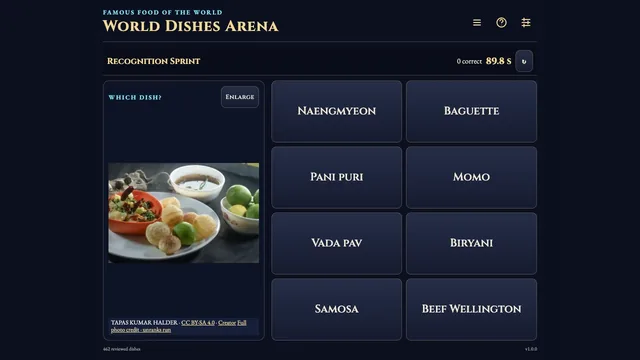
- Recognition Sprint: choose the pictured temple from eight names within 90 running seconds; one wrong answer ends the run. Most correct answers wins; the last correct answer’s time breaks ties.
- Name Search: identify ten photographs by typing part of any name, ignoring case and accents, and choosing the temple from the filtered list.
- City and Country: a photograph only, the name hidden until you answer. Choose from eight; the others are nearby cities or countries with temples of their own. Most correct answers wins, then total time.
- Faith: a photograph only, the name hidden. Choose the faith it was built for from four; any faith its sources give counts, and a run holds at most three temples of the commonest faith. Most correct answers wins, then total time.
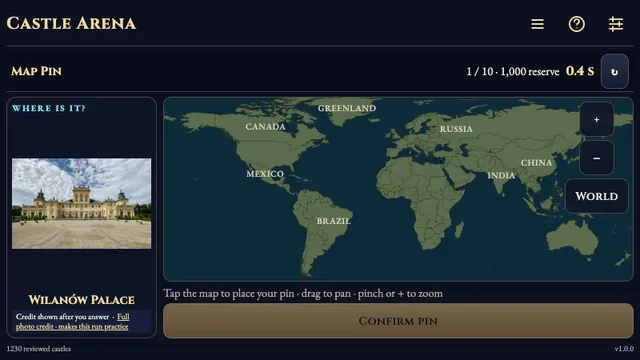
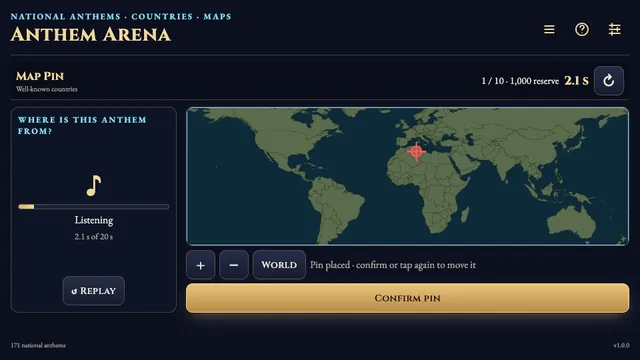
- Map Pin: a photograph only; tap and zoom the world map, then confirm. You start with 1,000 reserve. A pin within 10 km costs nothing; each further started 10 km costs one point, at most 100.
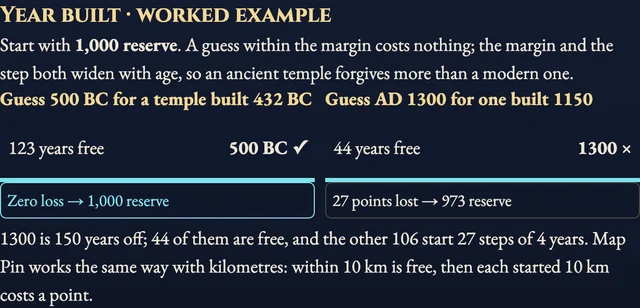
- Year built: a photograph and its name; enter the year and choose AD or BC. The first building and the present one both count. The free margin and the step widen with age, so an ancient temple forgives more; each further step costs one point, at most 100. Reserve modes rank by reserve, then time.
- Matching Table: select or drag a photograph onto its name; each wrong pair adds three seconds. Fastest adjusted finish wins.
- Letter Hunt: five hidden temple names. Right letters are free; fewest wrong letters wins.
Controls
| Input | Action |
|---|---|
| Tap / click | Choose answers, cities, countries, faiths and matching pairs; double-click or double-tap an answer to confirm it at once |
| Drag | Drag either side of the Matching table onto its partner to make a pair; drag the map to pan |
| Pinch / wheel | Zoom the Map Pin map |
| Type a name | Filter names; Enter chooses a unique result |
| Year estimate | Enter a whole number and choose AD or BC; a number pad supports controllers |
| Enlarge · Zoom in · Fit photo | Inspect the photograph while the clock keeps running |
| 1–8 | Choose an answer |
| Standard controller | D-pad navigates controls and moves the map pin; LB/RB step through long name lists; A selects, B goes back, Y opens Rules, Start opens Settings |
Tips
- Read the roof Stacked curved roofs suggest an East Asian pagoda, a vermilion gate a Shinto shrine, a soaring carved tower over the sanctum a Hindu temple of India, and a bell-shaped dome a stupa.
- Zoom before you pin A pin inside 10 km is free; zooming to the right city saves more than a fast answer.
- Old dates forgive more An ancient temple's free margin is wider, so a near guess of its century is often enough.
Good to know
Every photograph retains its creator, chosen licence, original title and source links. Creator credits appear beside the photograph; Full photo credit opens the complete attribution and sources. Opening help, rules or full credits during a ranked question, leaving the tab or restoring an unfinished run makes that attempt practice.
Watch how to play
Questions
Which temples count?
Standing temples, shrines, pagodas, stupas and gurdwaras, and the remains of ancient Greek, Roman and Egyptian temples, with an exterior photograph that passed two independent reviews, enough Wikipedia language editions and a place Wikidata recorded in November 2026. Churches, mosques and synagogues are left out; Cathedral Atlas has the churches. In countries without freedom of panorama a temple plays only when its design is out of copyright.
Why is the name hidden in City, Country, Faith and Map Pin?
Many temple names carry their city, country or faith, so the name appears only with the answer.
Why are some temples missing from City, Faith or Year built?
A temple whose name carries its city never plays City, nor one named for its faith Faith. The others join only when two independent readings of the sources agree on the fact.