How to play
- Goal
- Know the chemical elements: recognise samples, name symbols and families, place them on the periodic table, estimate melting points and order their discoveries.
- How it ends
- Finish ten questions, ten placements or ten pairs, exhaust the sprint clock, or make a third sprint mistake.
- Record
- Best score, highest melting-point reserve or fastest matching finish, with time and the player’s name.
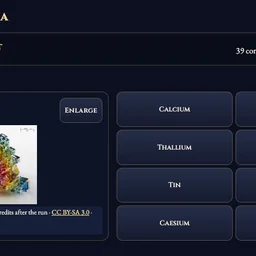
- Recognition Sprint: choose the pictured element sample from eight names. At most one other name belongs to a sample of the same look (another silvery metal, another gas tube). You have 90 continuously running seconds and three lives: a wrong answer shows the right name and play goes on until the third. Most correct answers wins, with time of the last correct answer breaking ties. Offered for All elements, Well-known elements and Main group.
- Symbol: choose the named element's symbol from eight. Wrong symbols share its first letter where possible (Na, N, Ne, Ni). Ten elements; a wrong answer scores nothing but the run continues. Most correct answers wins, then the faster total time. The clock pauses while each answer is revealed.
- Periodic Table: find the named element's cell on a blank table of 18 groups and 7 periods, numbered along the edges, with the lanthanides and actinides in the two rows below. Click or tap a cell to select it, then click or tap it again or press Confirm. Ten elements.
- Family: choose the named element's family from those that occur in the collection: alkali metal, alkaline earth metal, transition metal, post-transition metal, metalloid, nonmetal, halogen, noble gas, lanthanide or actinide. Ten elements.
- Melting Point: estimate the melting point in °C; negative values are allowed. You start with 1,000 reserve. An exact guess costs nothing; a miss costs 100 × distance ÷ 3,681 °C, at most 100. Highest reserve wins, with time breaking ties.
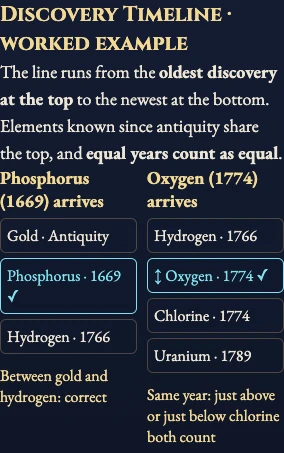
- Discovery Timeline: one element starts on a line with the oldest discovery at the top (the year as WebElements dates it, usually when the element was first isolated). Place ten more, one at a time: select the gap where each belongs, then tap it again or press Place card. Elements known since antiquity and equal years count as equal, so either side is right. A misplaced element is filed in its right place and play continues. Most correct placements wins, then the faster time.
- Matching Table: select a symbol, then its element name. Match all ten pairs. Each wrong pair adds three seconds; fastest adjusted finish wins.
Controls
| Tap / click | Select a cell or timeline gap, then press it again (or Confirm / Place card); choose answers, families and matching pairs |
|---|---|
| Arrow keys · Enter | Move across the periodic table or between timeline gaps, then answer |
| Melting estimate · °C | Type an estimate; a number pad with a − key supports controllers |
| 1–8 | Choose a Recognition Sprint or Symbol answer |
| 1–9, 0 | Choose a family |
| Enlarge · Zoom in · Fit photo | Inspect a sample photograph while the clock keeps running |
| Standard controller | D-pad navigates controls and table cells; A selects, a second A answers a cell; Y opens Rules |
Tips for Element Arena
- Latin symbols Ten symbols come from another name: Na natrium, K kalium, Fe ferrum, Ag argentum, Sn stannum, Sb stibium, Au aurum, Hg hydrargyrum, Pb plumbum, and W from wolfram.
- Count across the table Groups 1–2 and 13–18 are the main group; the ten transition columns sit between. The period is the row: potassium starts period 4, caesium period 6.
- Melting anchors Mercury melts at −39 °C, gallium at 30 °C, lead at 327 °C, iron at 1,538 °C and tungsten, the highest, at 3,422 °C.
Questions about this game
Why are some elements missing from Melting Point or Discovery Timeline?
A fact is played only where two sources agree. Helium has no melting point at normal pressure, carbon and arsenic sublime, the astatine and francium values are estimates never measured, and values past einsteinium are predictions; a few discovery years differ between PubChem and WebElements and are left out.
Why do elements 104–118 never appear in Family?
Their chemistry is predicted from their position, not established by experiment, so they have no agreed family.
Where are lanthanum and actinium on the table?
In the two separate rows below the main table, at the start of the lanthanides and actinides. Group 3 of periods 6 and 7 only names those two ranges and is never an answer.
Element samples are real photographs that retain their creator, chosen licence and source links; a credit that names an element waits until the answer is revealed. Opening full credits during a question, leaving the tab, restoring an unfinished run or a mid-run photo-loading interruption makes that attempt practice. No safety or handling advice is given. No ads, SDKs or analytics run in the game.
Watch how to play
About Element Arena
Seven competitions on the chemical elements. Name the symbol of an element, find its cell on a blank periodic table, choose its family, estimate its melting point, file it on a discovery timeline, match ten symbols with their names, or recognise real element samples against the clock. Worldwide score, time and player name lead the main menu.
All 118 elements, with Well-known elements, Main group, Transition metals and Lanthanides & actinides collections. A fact is played only where two sources agree: melting points from PubChem and the Los Alamos periodic table (90 elements), discovery years from PubChem and WebElements (101), families as PubChem classifies them (103), and group and period checked against Los Alamos.