About Impact Crater Atlas
Eight competitions on Earth's confirmed impact craters, from Meteor Crater, Vredefort and Chicxulub to Lonar Lake and Kaali. Recognise a crater from its aerial or satellite photograph, name its country, slide to its width or its age, pin it on a zoomable world map, match photographs to names, or uncover hidden names letter by letter.
The atlas holds 198 structures confirmed by the Earth Impact Database (University of New Brunswick), 52 of them with a reviewed photograph. Buried and worn-down craters that no photograph shows appear only in Country, Diameter, Age and Map Pin.
How to play
- Goal
- Know the Earth’s impact craters: what they look like from the air and from orbit, which country holds them, where they lie, how wide they are and how long ago the impact struck.
- How it ends
- Finish ten questions, ten pairs or five hidden names, exhaust the sprint clock, or make one sprint mistake.
- Record
- Best score, highest reserve, fastest matching finish or fewest wrong letters, with time and the player’s name.
- Recognition Sprint: choose the pictured crater from eight names within 90 running seconds; one wrong answer ends the run. Most correct answers wins; the last correct answer's time breaks ties.
- Name Search: identify ten photographs by typing part of any name, ignoring case and accents; words such as crater, lake, impact structure and astrobleme may be left out.
- Country: ten craters by name, with a photograph where one shows the crater. Choose from eight countries, the nearest crater-holding countries offered as the wrong ones. Most correct answers wins, then total time.
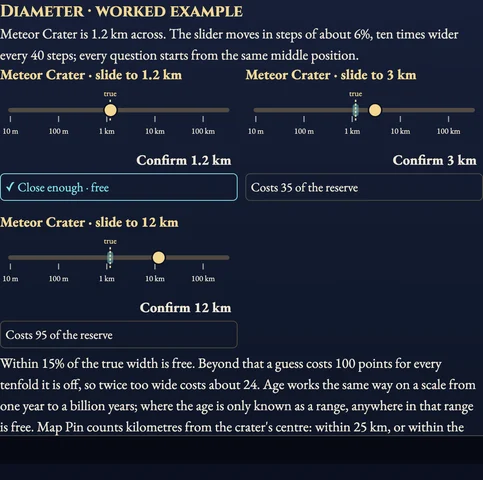
- Diameter and Age: slide to your guess and confirm. You start with 1,000 reserve. Within 15% of the true width or inside the known age range is free; beyond that a guess costs 100 for every tenfold it is off. Highest reserve wins, then time.
- Map Pin: tap and zoom the world map where the crater lies, then confirm. A pin within 25 km, or inside a larger crater's own radius, costs nothing; further misses cost less per kilometre. Highest reserve wins, then time.
- Matching Table: select or drag a photograph onto its name; each wrong pair adds three seconds. Fastest adjusted finish wins.
- Letter Hunt: five hidden crater names. Right letters are free; fewest wrong letters wins.
Controls
| Input | Action |
|---|---|
| Tap / click | Choose answers, countries and matching pairs; double-click or double-tap an answer to confirm it at once |
| Drag | Move the Diameter and Age slider, drag either side of the Matching table onto its partner, drag the map to pan |
| Pinch / wheel | Zoom the Map Pin map |
| Type a name | Filter names; Enter chooses a unique result |
| ← → · Page Up/Down · Enter | Nudge the slider, jump tenfold, confirm |
| 1–8 | Choose an answer |
| Standard controller | D-pad navigates controls, nudges the slider and moves the map pin; LB/RB jump the slider tenfold and step through long name lists; A selects, B goes back, Y opens Rules, Start opens Settings |
Tips
- Read the scale A crisp bowl with a raised rim is small and usually young; a ring of lakes or hills tens of kilometres wide is a large crater worn down over many millions of years.
- Think in tenfolds The Diameter and Age sliders are logarithmic: being twice too wide costs about a quarter as much as being ten times too wide.
- Deserts and shields Fresh bowls survive in deserts (Australia, Arabia, the Sahara); the old craters of Canada and Scandinavia are lakes in ancient shield rock.
Good to know
Positions, diameters and ages are those of the Earth Impact Database; countries are the Natural Earth outline holding the crater. Every photograph retains its creator, licence, original title and source links; Full photo credit opens the complete attribution. Opening full credits during a ranked question, leaving the tab or restoring an unfinished run makes that attempt practice.
Watch how to play
Questions
Which craters count?
Every structure the Earth Impact Database lists as confirmed, joined to its Wikidata entry. Photographs are aerial pictures from Wikimedia Commons or true-colour Sentinel-2 and Landsat scenes, each passed by two independent reviews.
Why do some craters have no photograph?
Many impact structures are buried under younger rock or worn almost flat, so no picture shows them. They appear by name in Country, Diameter, Age and Map Pin only.
Why do some collections not play every competition?
A collection plays a competition only with at least 30 qualified craters, and Country also needs five different countries.