How to play
- Goal
- Recognize minerals and learn their chemical formulas, crystal systems, hardness and density.
- How it ends
- Finish ten questions, ten placements or ten pairs, exhaust the sprint clock, or make one sprint mistake.
- Record
- Best score, highest density reserve or fastest matching finish, with time and the player’s name.
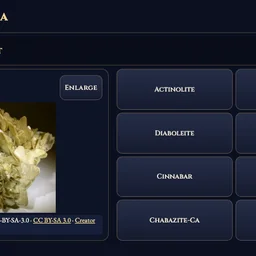
- Recognition Sprint: choose the pictured mineral from eight names. You have 90 continuously running seconds; one wrong answer ends the run. Most correct answers wins, with time of the last correct answer breaking ties.
- Formula: choose the pictured mineral's chemical formula from eight. Ten photographs; a wrong answer scores nothing but the run continues. Most correct answers wins, then the faster total time. The clock pauses while each answer is revealed.
- Name Search: identify ten photographs. Type part of a mineral name or a gem variety such as amethyst or ruby, and choose the exact mineral from the filtered list.
- Crystal System: choose the crystal system of the named mineral from the seven: cubic, tetragonal, hexagonal, trigonal, orthorhombic, monoclinic and triclinic. Complete ten questions.
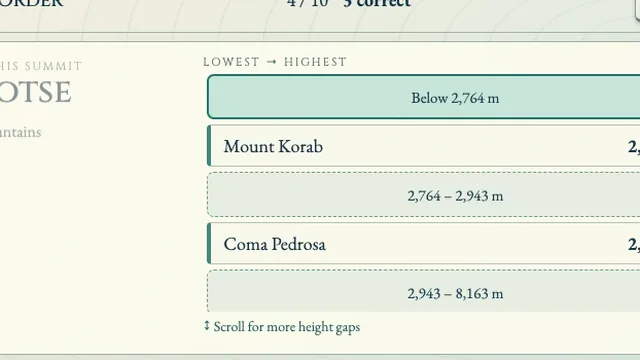
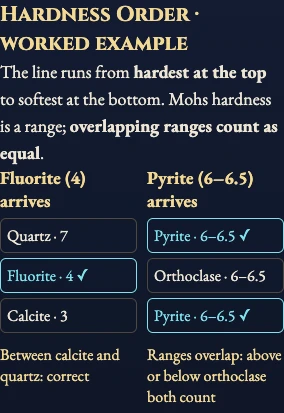
- Hardness Order: one mineral starts on a line with the hardest at the top. Place ten more, one at a time, in the gap where each belongs on the Mohs scale. Hardness is often a range; minerals whose ranges overlap count as equal, so either side is right. A misplaced mineral is filed in its right place and play continues. Most correct placements wins, then the faster time.
- Density: estimate the mineral's specific gravity in g/cm³ (water is 1, quartz about 2.65, galena about 7.5). You start with 1,000 reserve. Estimates inside the published range cost zero. Below it, lose 100 × (1 − guess/minimum); above it, lose 100 × (1 − maximum/guess). Highest reserve wins, with time breaking ties.
- Matching Table: select a photograph, then its mineral name. Match all ten pairs. Each wrong pair adds three seconds; fastest adjusted finish wins.
Controls
| Tap / click | Choose answers, systems, hardness gaps and matching pairs |
|---|---|
| Type a mineral name | Filter names; Enter chooses a unique result |
| ↑ ↓ · Enter | Move between hardness gaps and place the mineral |
| Density estimate · g/cm³ | Enter an estimate; a number pad supports controllers |
| Enlarge · Zoom in · Fit photo | Inspect the photograph while the clock keeps running |
| 1–8 | Choose a Recognition Sprint or Formula answer |
| Standard controller | D-pad navigates controls; A selects, Y opens Rules |
Tips for Mineral Arena
- Know the Mohs anchors Talc 1, gypsum 2, calcite 3, fluorite 4, apatite 5, orthoclase 6, quartz 7, topaz 8, corundum 9, diamond 10. A fingernail scratches up to about 2.5, steel about 5.5.
- Heavy metals, heavy minerals Lead, silver and gold minerals are dense: galena is about 7.5, cerussite 6.6. Silicates mostly sit between 2.5 and 3.5.
- Read the formula's anion CO₃ is a carbonate, SO₄ a sulfate, PO₄ a phosphate, SiO₄ and Si₂O₇ silicates; a formula with only a metal and S is a sulfide.
Questions about this game
Why do some minerals appear in fewer competitions?
A mineral joins Formula, Crystal System, Hardness Order or Density only when two researchers independently read the same value from the source. Minerals whose structures fall in more than one crystal system, or whose hardness is not measured, are left out of those modes.
Why are ruby and sapphire not separate answers?
They are gem varieties of one mineral, corundum. Gem and trade names (amethyst, emerald, aquamarine) are accepted in Name Search and shown on the reveal, but the answer is the mineral species.
Why are some similar minerals never offered together?
Species that only a laboratory can tell apart, such as the tourmalines or the garnets, are never offered as choices for one another.
Every photograph retains its creator, chosen licence, original title and source links. Creator credits appear beside the photograph; a credit that names a mineral waits until the answer is revealed. Opening full credits during a question, leaving the tab, restoring an unfinished run or a mid-run photo-loading interruption makes that attempt practice. No ads, SDKs or analytics run in the game.
Watch how to play
About Mineral Arena
Seven competitions use real, individually reviewed photographs of natural mineral specimens. Name each mineral, choose its chemical formula or crystal system, place it on a Mohs hardness line, estimate its density, or match ten photographs and names. Worldwide score, time and player name lead the main menu.
The library holds 369 species in seven chemical collections, from native elements and sulfides to framework silicates, with familiar and gem collections. Formulas come from the IMA list of minerals; hardness (360 minerals), density (366) and crystal system (351) from the Handbook of Mineralogy, each read by two researchers independently; only values both agree on are played.