About Theatre & Opera Atlas
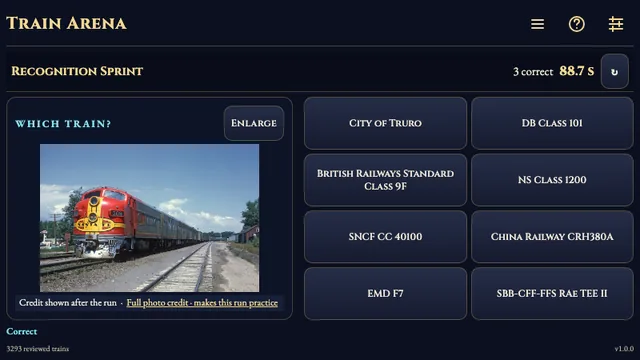
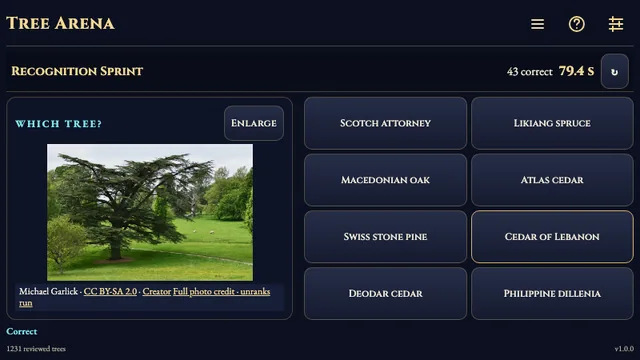
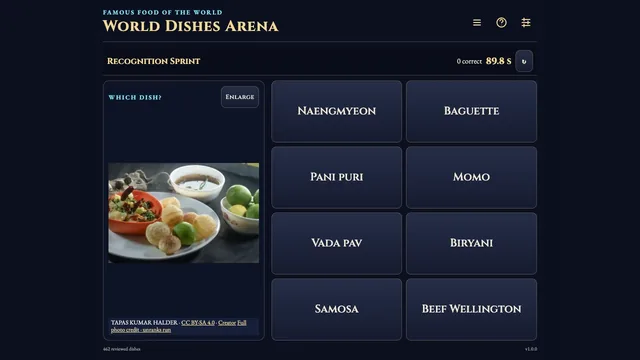
Eleven competitions use real, individually reviewed photographs of theatres and opera houses, from Greek stages to the Sydney Opera House. Name a house, choose the city or country it stands in or the architect who designed it, pin it on a zoomable world map, enter the year it opened or its seats, match ten photographs and names, uncover five hidden names letter by letter, or name a famous theatre from a close-up that widens with every wrong pick.
The library holds 307 houses in 69 countries as Wikidata and the English Wikipedia recorded them in November 2026. Play the famous houses, one region or the whole world. No photograph shows the house's name.
How to play
- Goal
- Know the world’s theatres and opera houses: what they look like, which city and country they stand in, who designed them, where they are on the map, when they opened and how many they seat.
- How it ends
- Finish ten questions, ten pairs or five hidden names, exhaust the sprint clock, or make one sprint mistake.
- Record
- Best score, highest map, year or seats reserve, fastest matching finish or fewest wrong letters, with time and the player’s name.
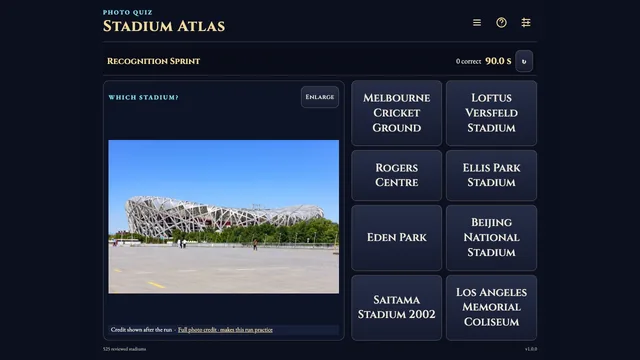
- Recognition Sprint: choose the pictured house from eight names within 90 running seconds; one wrong answer ends the run. Most correct answers wins; the last correct answer’s time breaks ties.
- Name Search: identify ten photographs by typing part of any name, ignoring case and accents, and choosing the house from the filtered list.
- City and Country: a photograph only, the name hidden until you answer. Choose from eight; the others are nearby cities or countries with houses of their own. Most correct answers wins, then total time.
- Architect: a photograph only, the name hidden. Choose the credited architect or firm from eight; the others designed the nearest other houses. Most correct answers wins, then total time.
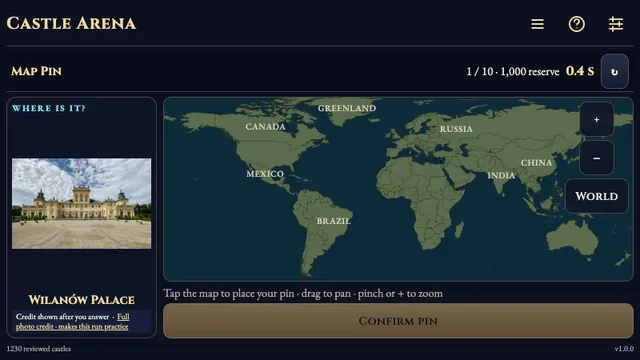
- Map Pin: a photograph only; tap and zoom the world map, then confirm. You start with 1,000 reserve. A pin within 10 km costs nothing; each further started 10 km costs one point, at most 100.
- Year opened: a photograph and its name; enter the year it opened. The first opening on the site and the present building’s opening both count, two years either side free; each further year costs one point, at most 100.
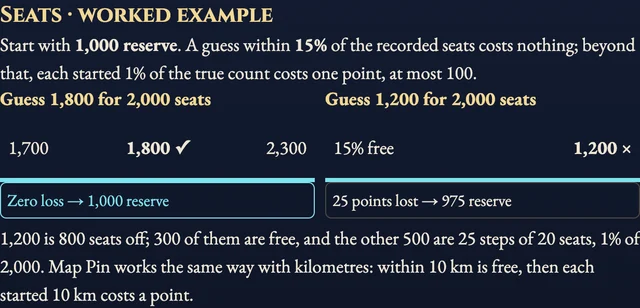
- Seats: a photograph and its name; enter the seats of the main hall. Within 15% costs nothing; each further started 1% of the true count costs one point, at most 100. Reserve modes rank by reserve, then time.
- Matching Table: select or drag a photograph onto its name; each wrong pair adds three seconds. Fastest adjusted finish wins.
- Letter Hunt: five hidden house names. Right letters are free; fewest wrong letters wins.
Controls
| Input | Action |
|---|---|
| Tap / click | Choose answers, cities, countries, architects and matching pairs; double-click or double-tap an answer to confirm it at once |
| Drag | Drag either side of the Matching table onto its partner to make a pair; drag the map to pan |
| Pinch / wheel | Zoom the Map Pin map |
| Type a name | Filter names; Enter chooses a unique result |
| Year or seats estimate | Enter a whole number; a number pad supports controllers |
| Enlarge · Zoom in · Fit photo | Inspect the photograph while the clock keeps running |
| 1–8 | Choose an answer |
| Standard controller | D-pad navigates controls and moves the map pin; LB/RB step through long name lists; A selects, B goes back, Y opens Rules, Start opens Settings |
Tips
- Read the facade A horseshoe of boxes under a painted ceiling points to an Italian-style opera house; a cavea of stone steps is Greek or Roman; glass and concrete on an open plaza is usually a postwar civic house.
- Zoom before you pin A pin inside 10 km is free; zooming to the right city saves more than a fast answer.
- Seats are the main hall’s A house with several stages counts only its largest auditorium.
Good to know
Every photograph retains its creator, chosen licence, original title and source links. Creator credits appear beside the photograph; Full photo credit opens the complete attribution and sources. Opening help, rules or full credits during a ranked question, leaving the tab or restoring an unfinished run makes that attempt practice.
Watch how to play
Questions
Which houses count?
Standing theatres and opera houses with a photograph that passed two independent reviews, at least seven Wikipedia language editions and a place Wikidata recorded in November 2026. Destroyed houses, arenas and concert halls are left out; an ancient stage counts when Wikidata records it as a theatre building.
Why is the name hidden in City, Country, Architect and Map Pin?
Many theatre names carry their city, country or founder, so the name appears only with the answer.
Why are some houses missing from City, Architect, Year opened or Seats?
A house whose name carries its city never plays City. The others join only when two independent readings of the sources agree on the fact; ancient theatres never play Year opened or Seats.