About Cheese Cellar
Eight competitions use real, individually reviewed photographs of named cheeses, from Parmesan, Roquefort and Gouda to Stinking Bishop and Torta del Casar. Name a cheese, choose the country that makes it, the animal whose milk it is made from or its style, pin its home town on a zoomable world map, match ten photographs and names, or uncover five hidden names letter by letter.
The cellar holds 235 cheeses as Wikidata, the English Wikipedia and the EU protected-origin register recorded them in November 2026. Play the famous cheeses, France, Italy, Britain with the Alps and the North, or the whole world. No photograph shows the cheese's name.
How to play
- Goal
- Know the world’s cheeses: what they look like, which country makes them, whose milk they are made from, what style of cheese they are and which town they come from.
- How it ends
- Finish ten questions, ten pairs or five hidden names, exhaust the sprint clock, or make one sprint mistake.
- Record
- Best score, highest map reserve, fastest matching finish or fewest wrong letters, with time and the player’s name.
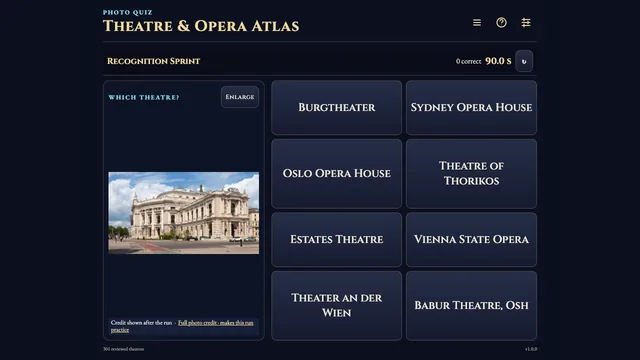
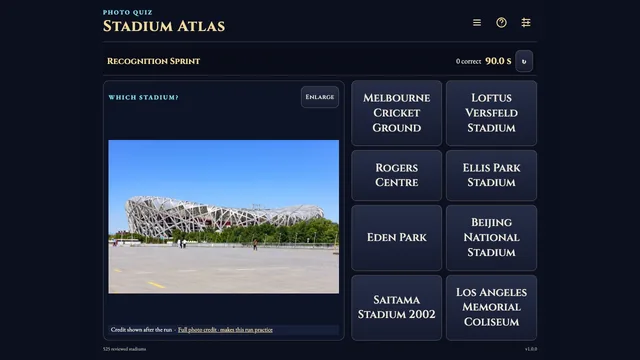
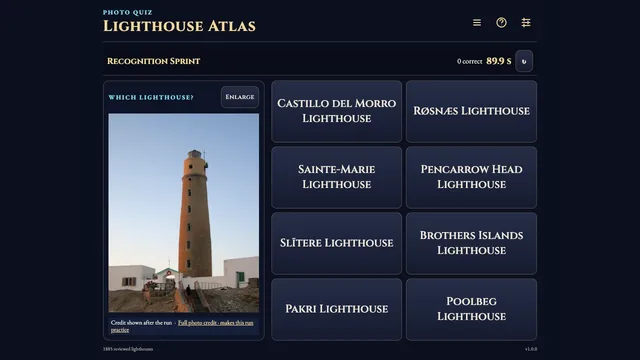
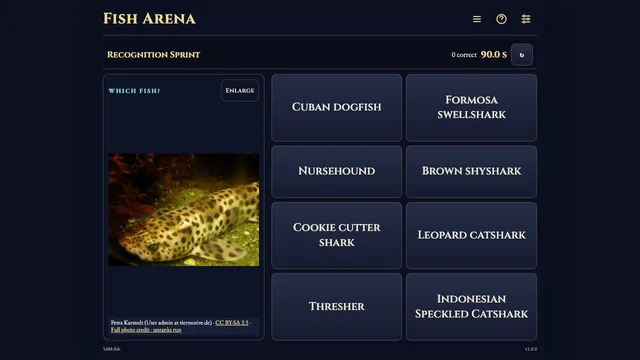
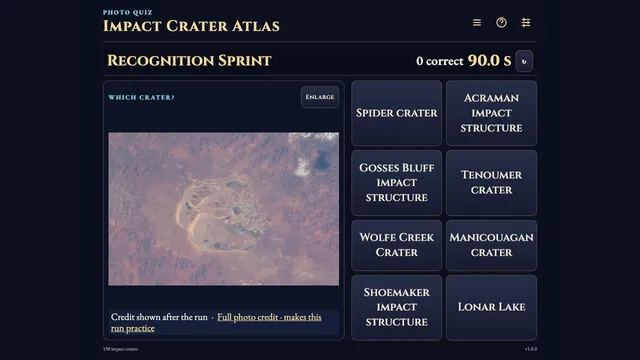
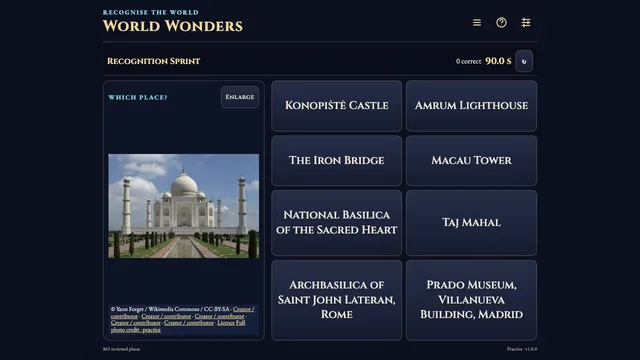
- Recognition Sprint: choose the pictured cheese from eight names within 90 running seconds; one wrong answer ends the run. Most correct answers wins; the last correct answer’s time breaks ties.
- Name Search: identify ten photographs by typing part of any name, ignoring case and accents; queso, formaggio, fromage, käse and the like count as the word cheese.
- Country: a photograph only, the name hidden until you answer. Choose from eight countries, the nearest cheese-making countries offered as the wrong ones. Most correct answers wins, then total time.
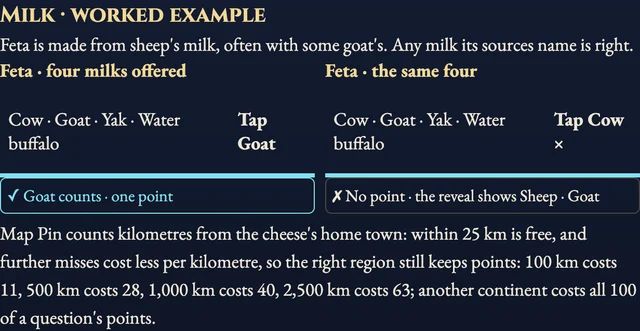
- Milk and Style: a photograph only, the name hidden. Choose the milk (cow, sheep, goat, water buffalo…) or the kind of cheese (fresh, bloomy rind, washed rind, semi-soft, semi-hard, hard, blue, stretched curd, brined or whey) from four; any its sources give counts. Most correct answers wins, then total time.
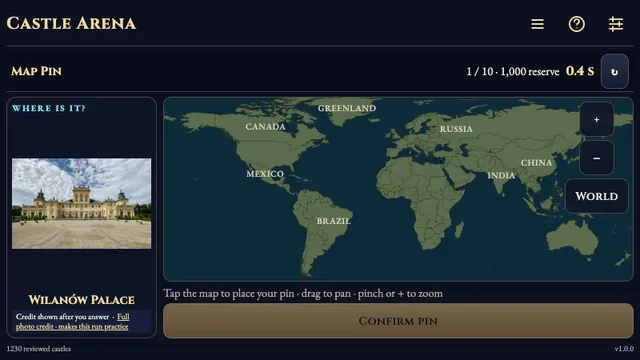
- Map Pin: a photograph only; tap and zoom the world map at the town the cheese is named after or made in, then confirm. You start with 1,000 reserve. A pin within 25 km costs nothing; further misses cost less per kilometre, at most 100 a question. Highest reserve wins, then time.
- Matching Table: select or drag a photograph onto its name; each wrong pair adds three seconds. Fastest adjusted finish wins.
- Letter Hunt: five hidden cheese names. Right letters are free; fewest wrong letters wins.
Controls
| Input | Action |
|---|---|
| Tap / click | Choose answers, countries, milks, styles and matching pairs; double-click or double-tap an answer to confirm it at once |
| Drag | Drag either side of the Matching table onto its partner to make a pair; drag the map to pan |
| Pinch / wheel | Zoom the Map Pin map |
| Type a name | Filter names; Enter chooses a unique result |
| Enlarge · Zoom in · Fit photo | Inspect the photograph while the clock keeps running |
| 1–8 | Choose an answer |
| Standard controller | D-pad navigates controls and moves the map pin; LB/RB step through long name lists; A selects, B goes back, Y opens Rules, Start opens Settings |
Tips
- Read the rind A white downy rind suggests a bloomy cheese such as Brie, a sticky orange one a washed rind, blue-green veins a blue, and a hard grainy wheel a long-aged cheese.
- Many names are towns Camembert, Gouda, Cheddar and Roquefort are named after the place that makes them; Map Pin hides that town's map label until you answer.
- Zoom before you pin A pin inside 25 km is free, and the right region still keeps most of a question's points.
Good to know
Every photograph retains its creator, chosen licence, original title and source links. Creator credits appear beside the photograph; Full photo credit opens the complete attribution and sources. Opening help, rules or full credits during a ranked question, leaving the tab or restoring an unfinished run makes that attempt practice.
Watch how to play
Questions
Which cheeses count?
Named cheeses with their own Wikidata entry, enough Wikipedia language editions and a photograph of the cheese itself that passed two independent reviews. Generic kinds such as cream cheese or processed cheese are left out.
Why is the name hidden in Country, Milk, Style and Map Pin?
Many cheese names carry their country, milk, style or town, so the name appears only with the answer, and a cheese whose name holds the answer is not asked.
Why do some cheeses or collections not appear in every competition?
A cheese joins Country, Milk, Style or Map Pin only when two independent readings of its sources agree on that fact, and a collection plays a competition only with at least 30 such cheeses.