About Bridge Atlas
Recognize 368 photographed bridges, including 74 well-known landmarks, in eleven competitions. Compare main spans and opening years, recognize bridges from pictures or approximate map locations, name their countries and crossings, estimate spans, match names with photographs, uncover hidden names letter by letter, or spot a famous bridge from a close-up that widens with every wrong pick.
Photographs and facts qualify separately: 82 reviewed main spans, 30 opening years, 96 country assignments, 65 named crossings and 25 approximate reference locations. Each competition uses only its qualified bridges. Named rankings are separate for each available competition and collection; your own results also save in this browser.
How to play
- Goal
- Know the world’s bridges: their appearance, locations, crossings, main spans and opening years.
- How it ends
- Bridge Line ends on the third mistake or when its collection runs out; other competitions end after ten questions, placements or pairs, or five hidden names.
- Record
- Most correct answers, then fastest answering time; Span Reserve keeps the most reserve, Matching the fastest time with penalties, and Letter Hunt the fewest wrong letters, separately for each competition and collection.
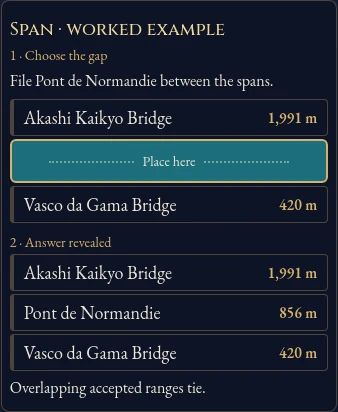
- Bridge Line: place bridges by their longest individual main span, longest at the top. Three mistakes end the run. Span Order scores ten placements; overlapping accepted ranges tie.
- Opening Order: place ten bridges by the year the pictured structure opened to intended traffic. Reconstruction dates are identified where relevant.
- Photo: identify a bridge from eight names. Map: identify the bridge at an approximate reference point, with zoom controls. Each has ten questions. Countries and Crossing ask for one of six supported answers.
- Span Reserve: estimate ten main spans from 1,000 points. Inside the accepted range costs nothing; outside it, loss grows with distance to the nearest edge.
- Matching Table: match ten names and photographs. Each incorrect pair adds three seconds.
- Choose a collection and competition. On ordering tables, choose a gap, then press Place here or press the same gap again. Complete a fresh uninterrupted run to enter its ranking.
- Letter Hunt: five hidden bridge names, one at a time. Spaces, hyphens and apostrophes are shown; guess letters from the A–Z grid or the keyboard. A right letter is free, each wrong letter counts, and you cannot lose. A solved name reveals its photograph, then Next name. Fewest wrong letters wins, then faster time.
Controls
| Input | Action |
|---|---|
| Tap / click | Choose an answer or pair; select a gap, then confirm with Place here |
| Drag | Drag either side of the Matching Table onto its partner to make a pair |
| 1–8 | Choose a quiz answer |
| Arrow keys · Enter | Move between choices and confirm |
| H · R · Escape | How to play, restart, return |
Tips
- Compare the main span Use the longest individual main span, rather than the total bridge length, height or clearance.
Good to know
Individual photograph creators, licences and source changes are linked in the game. Span and opening facts use separately reviewed source accounts. Context maps: Natural Earth, public domain; reviewed OpenStreetMap reference points credit © OpenStreetMap contributors under ODbL in the game. Backdrop: Golden Gate Bridge photograph by Supercarwaar, CC BY-SA 4.0, via Wikimedia Commons. Gameplay cover: Øresund Bridge photograph by Nick-D, CC BY-SA 4.0, via Wikimedia Commons, presented in the game interface.
Watch how to play
Questions
How many bridges can I play with?
There are 368 reviewed photographed bridges. Main spans, opening years, countries, crossings and map locations qualify independently, so each competition has its own eligible set. Choose All bridges or an available regional or well-known collection.
Why are some competitions unavailable?
Each competition needs enough independently reviewed facts and distinct choices for a full run. Facts qualify separately from photographs.
Why are some measurements ranges?
Independent source accounts can report slightly different measurements of the same span. Reviewed agreements within 15% can play as a range. Estimates inside that range cost nothing.