About World Dishes Arena
Six competitions use real, individually reviewed photographs of dishes from every continent. Identify each from its photograph, search its name, choose its country of origin or kind of dish, pin where it comes from on a world map, or match ten photographs and names. Worldwide score, time and player name lead the main menu.
462 dishes in nine regional collections, from Western Europe to Africa. Country and Map Pin use 172 countries of origin, Dish Type 286 kinds; two researchers read each fact from dictionary definitions independently, and only facts both agree on are played.
How to play
- Goal
- Recognize famous dishes of the world and learn their names, their countries, their kinds and where they come from on the map.
- How it ends
- Finish ten questions or ten pairs, exhaust the sprint clock, or make one sprint mistake.
- Record
- Best score, highest map reserve or fastest matching finish, with time and the player’s name.
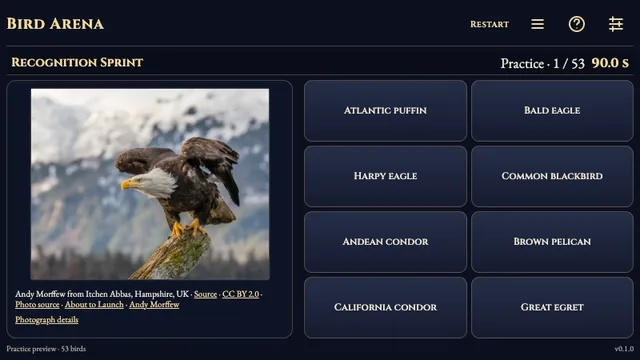
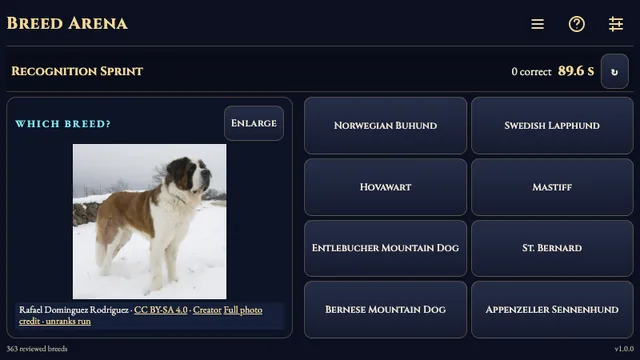
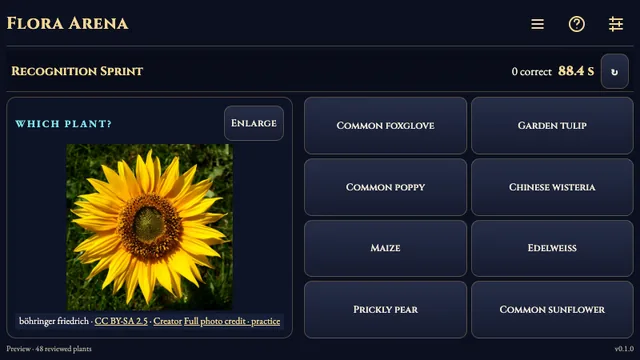
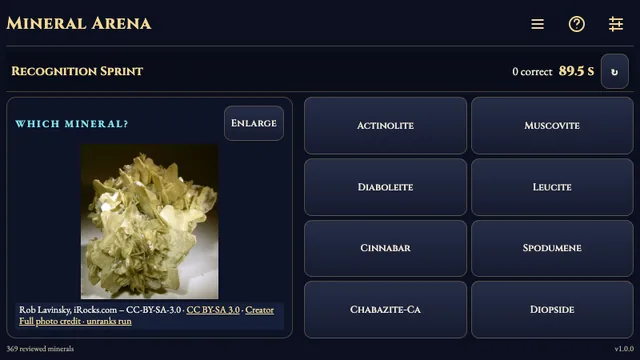
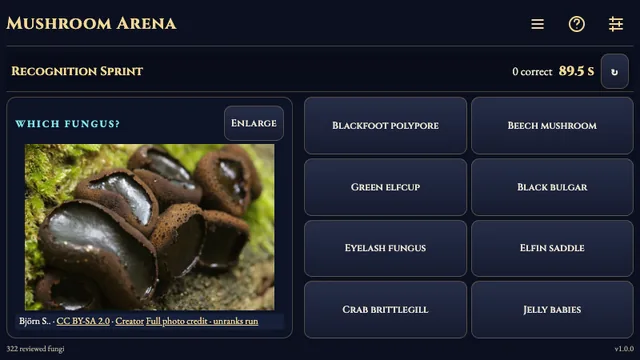
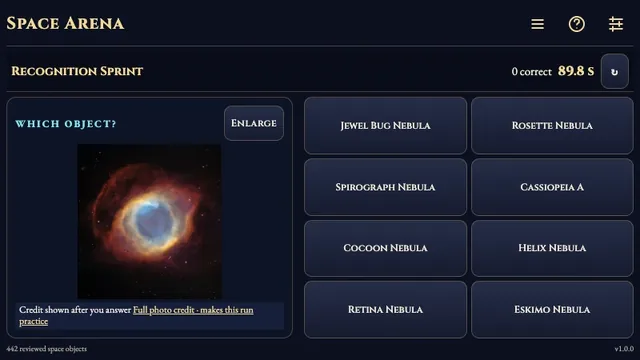
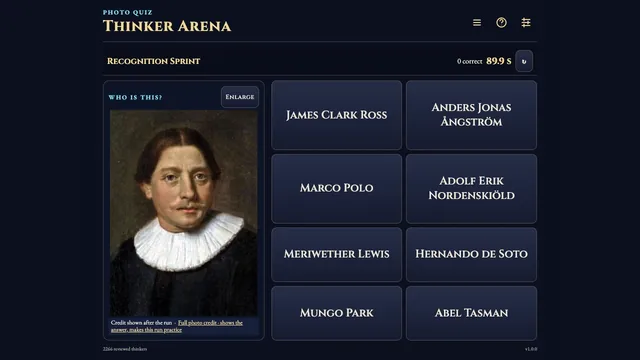
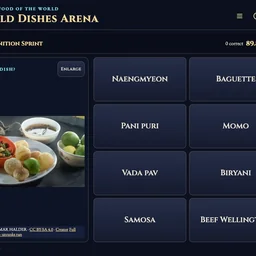
- Recognition Sprint: choose the pictured dish from eight names, mostly dishes of the same region or kind. You have 90 continuously running seconds; one wrong answer ends the run. Most correct answers wins, with time of the last correct answer breaking ties.
- Name Search: identify ten photographs. Type part of the dish's name, ignoring case and accents, and choose the exact dish from the filtered list. Correct answers rank first, then faster time.
- Country: choose the country the named dish comes from, from eight. When sources name more than one country, any of them earns the point. Countries are today's. Complete ten questions.
- Dish Type: the dish is shown by name only, without a photo; choose its kind from ten: soup; stew or curry; dumpling or filled pastry; noodles or pasta; rice dish; bread or flatbread; sandwich, wrap or taco; salad or cold dish; grilled, fried or roast; dessert or sweet. Any kind the sources give earns the point. Complete ten questions.
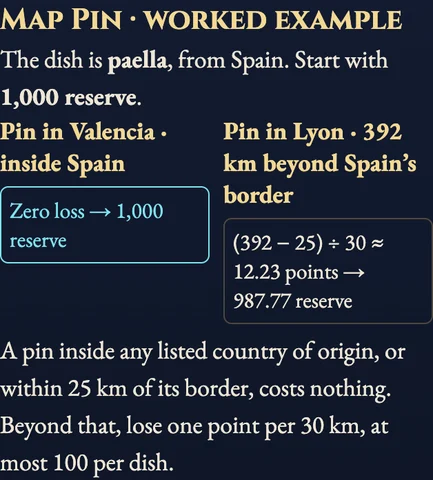
- Map Pin: tap the world map where the named dish comes from, then confirm. You start with 1,000 reserve. A pin inside a country of origin, or within 25 km of its border, costs nothing; beyond that you lose one point per 30 km, at most 100 per dish. Complete ten dishes; highest reserve wins, with time breaking ties.
- Matching Table: select a photograph, then its dish name. Match all ten pairs. Each wrong pair adds three seconds; fastest adjusted finish wins.
Controls
| Input | Action |
|---|---|
| Tap / click | Choose answers, countries, kinds and matching pairs; double-click a country to confirm it at once |
| Drag | Drag either side of the Matching Table onto its partner to make a pair |
| Type a dish name | Filter names; Enter chooses a unique result, a country or a placed pin |
| Map · tap, zoom, drag | Place the pin, then Confirm |
| Enlarge · Zoom in · Fit photo | Inspect the photograph while the clock keeps running |
| 1–8 · 1–0 | Choose a Recognition Sprint answer or a dish type |
| Standard controller | D-pad navigates and moves the map pin; A selects, Y opens Rules |
Tips
- Look at the vessel Clay pots, bamboo steamers, banana leaves and skewers often say as much about a dish as the food on them.
- Borders, not capitals Map Pin measures to the nearest border of any country of origin, so a pin anywhere inside that country is perfect.
- Kinds follow the dish, not the plate Gyros and quesadillas count as sandwiches, wraps or tacos; pierogi, samosas and empanadas as dumplings or filled pastries.
Good to know
Every photograph retains its creator, chosen licence, original title and source links. Creator credits appear beside the photograph; Full photo credit opens the complete attribution and sources. Opening full credits during a question, leaving the tab, restoring an unfinished run or a mid-run photo-loading interruption makes that attempt practice. Country borders come from Natural Earth (public domain).
Watch how to play
Questions
Why do some dishes appear in fewer competitions?
A dish joins Country, Map Pin or Dish Type only when two researchers independently read the same fact from a dictionary definition. Dishes that dictionaries describe only by a region spanning several countries, or not at all, stay out of those competitions.
Which countries count?
Today's sovereign countries. A Scottish dish counts as the United Kingdom. Dishes whose English name already states the country, such as Swedish meatballs, are left out of Country and Map Pin.
Why are there no home-language names?
A Native Names competition was designed, but not enough dishes had two agreeing sources for their home-country name, so it is not part of 1.0.