How to play
- Goal
- Recognize plants and learn their scientific names, native continents and mature heights.
- How it ends
- Finish ten questions or ten pairs, exhaust the sprint clock, or make one sprint mistake.
- Record
- Best score, highest height reserve or fastest matching finish, with time and the player’s name.
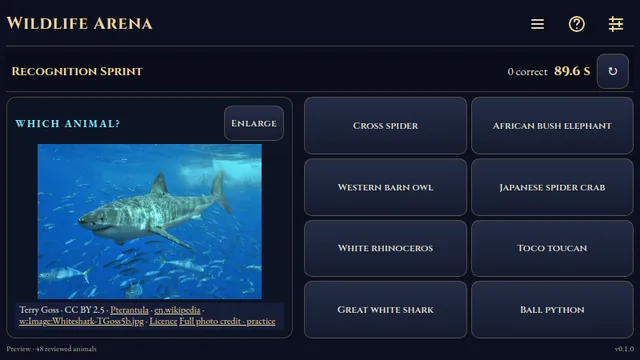
- Recognition Sprint: choose the pictured plant from eight names. You have 90 continuously running seconds; one wrong answer ends the run. Most correct answers wins, with time of the last correct answer breaking ties.
- Latin Names: choose the scientific (Latin) name of the pictured plant from eight, mostly from the same botanical family. Ten photographs; a wrong answer scores nothing but the run continues. Most correct answers wins, then the faster total time. The clock pauses while each answer is revealed.
- Name Search: identify ten photographs. Type part of a common or scientific name, or a broad term such as rose, cactus or fern, ignoring case. Choose the exact plant from the filtered list. Correct answers rank first, then faster time.
- Native Regions: choose one continent where the named plant grows natively. Any correct native continent earns a point; introduced, naturalised and garden plants do not count. For crops known only in cultivation, the answer is where the crop originated. Complete ten questions.
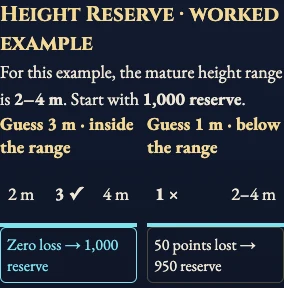
- Height Reserve: estimate the mature height in metres or centimetres. You start with 1,000 reserve. Estimates inside the reviewed range cost zero. Below it, lose 100 × (1 − guess/minimum); above it, lose 100 × (1 − maximum/guess). Complete ten estimates; highest reserve wins, with time breaking ties.
- Matching Table: select a photograph, then its plant name. Match all ten pairs. Each wrong pair adds three seconds; fastest adjusted finish wins.
Controls
| Tap / click | Choose answers, native continents and matching pairs |
|---|---|
| Type a plant name | Filter names; Enter chooses a unique result |
| Height estimate · m / cm | Enter an estimate; a number pad supports controllers |
| Enlarge · Zoom in · Fit photo | Inspect the photograph while the clock keeps running |
| 1–8 | Choose a Recognition Sprint or Latin Names answer |
| Standard controller | D-pad navigates controls; A selects, Y opens Rules |
Tips for Flora Arena
- Families share Latin roots Latin Names offers relatives from the same botanical family, so read the genus (first word) carefully.
- Any one continent counts Many plants are native to several continents. Pick the one you are surest of; the full native range is revealed afterwards.
- Read the height scope Some ranges describe plants in cultivation, others wild plants. Garden trees often stay smaller than wild giants.
Questions about this game
Why do some plants appear in fewer competitions?
A photograph does not prove a plant’s height or native range. A species joins those competitions only when its facts have been verified from a named botanical source.
Where do native ranges come from?
From Kew’s World Checklist of Vascular Plants, mapped from botanical regions to continents. Introduced and naturalised records never count.
Why are some Latin names unfamiliar?
Scientific names follow current botanical acceptance, so a few differ from older names still used in gardens; Name Search also finds the older names.
Every photograph retains its creator, chosen licence, original title and source links. Creator credits appear beside the photograph; Full photo credit opens the complete attribution and sources. Opening full credits during a question, viewing help, leaving the tab, restoring an unfinished run or a mid-run photo-loading interruption makes that attempt practice. Reviewed height ranges are source-specific references, not universal limits for every plant. No ads, SDKs or analytics run in the game.
About Flora Arena
Six competitions use real, individually reviewed plant photographs. Identify the plant by its common or scientific (Latin) name, choose a continent where it grows natively, estimate its mature height, or match ten photographs and names. Worldwide score, time and player name lead the main menu.
This opening collection gives equal space to trees, flowers, shrubs and climbers, succulents and carnivorous plants, food plants and herbs, and ferns, mosses and grasses. Broader collections are being curated. Each competition uses the plants with verified facts for that question.