How to play
- Goal
- Recognize mushrooms and other fungi and learn their scientific names, spore print colours and cap sizes.
- How it ends
- Finish ten questions or ten pairs, exhaust the sprint clock, or make one sprint mistake.
- Record
- Best score, highest cap-size reserve or fastest matching finish, with time and the player’s name.
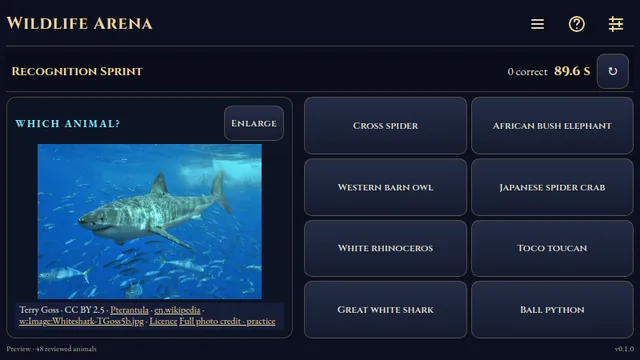
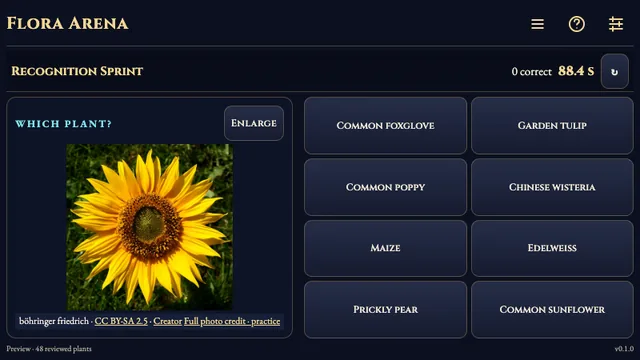
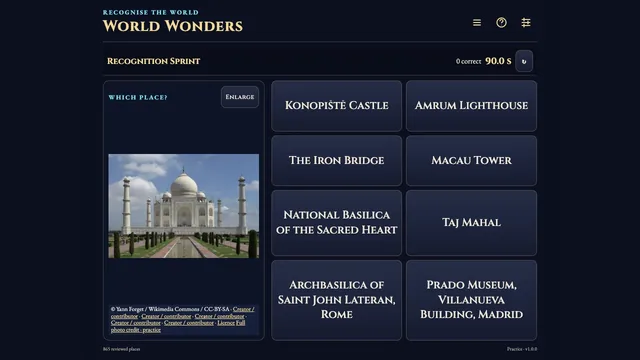
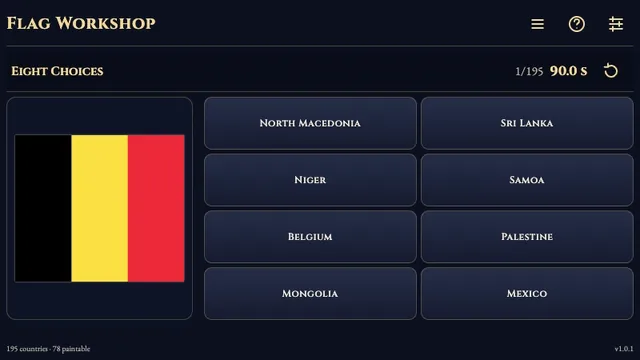
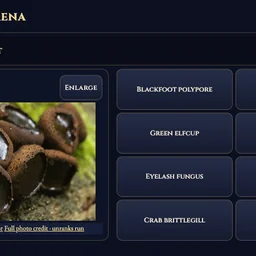
- Recognition Sprint: choose the pictured fungus from eight names. You have 90 continuously running seconds; one wrong answer ends the run. Most correct answers wins, with time of the last correct answer breaking ties.
- Latin Names: choose the scientific (Latin) name of the pictured fungus from eight, mostly from the same genus or family. Ten photographs; a wrong answer scores nothing but the run continues. Most correct answers wins, then the faster total time. The clock pauses while each answer is revealed.
- Name Search: identify ten photographs. Type part of a common or scientific name, or a broad term such as amanita, bolete or puffball, ignoring case. Choose the exact fungus from the filtered list. Correct answers rank first, then faster time.
- Spore Print: choose one of eight colours for the named fungus’s spore print. When references describe a range, such as white to cream, any colour in it earns the point. Complete ten questions.
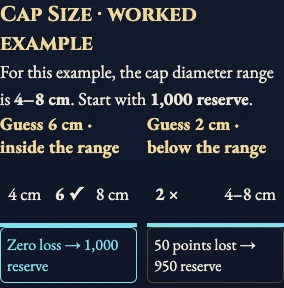
- Cap Size: estimate the cap diameter in centimetres. You start with 1,000 reserve. Estimates inside the reviewed range cost zero. Below it, lose 100 × (1 − guess/minimum); above it, lose 100 × (1 − maximum/guess). Complete ten estimates; highest reserve wins, with time breaking ties.
- Matching Table: select a photograph, then its fungus name. Match all ten pairs. Each wrong pair adds three seconds; fastest adjusted finish wins.
Controls
| Tap / click | Choose answers, spore print colours and matching pairs |
|---|---|
| Type a fungus name | Filter names; Enter chooses a unique result |
| Cap estimate · cm | Enter an estimate; a number pad supports controllers |
| Enlarge · Zoom in · Fit photo | Inspect the photograph while the clock keeps running |
| 1–8 | Choose a Recognition Sprint or Latin Names answer |
| Standard controller | D-pad navigates controls; A selects, Y opens Rules |
Tips for Mushroom Arena
- Read the genus first Latin Names offers relatives from the same genus, so the second word (the species) often decides it.
- Gill colour hints at the print Pale gills often drop a pale print and dark gills a dark one, but young gills can mislead: Field mushroom gills start pink and its print is chocolate purple-brown.
- Any listed colour counts Many prints are described as a range, such as white to cream. Pick one colour you are sure of; the source’s full description is revealed afterwards.
Questions about this game
Can I use this to pick mushrooms to eat?
No. It is a quiz, not a foraging guide, and never says whether a fungus is edible. Many edible species have deadly look-alikes that a photograph cannot separate.
Why do some fungi appear in fewer competitions?
A species joins Spore Print or Cap Size only when that fact was found in a named mycological reference and independently re-checked. Puffballs have no spore print and cups have no cap, so they stay out of those competitions.
Why are some Latin names unfamiliar?
Scientific names follow the GBIF Backbone Taxonomy, and fungal names change often as DNA studies regroup species. Older names are shown as former names, and Name Search finds them.
Every photograph retains its creator, chosen licence, original title and source links. Creator credits appear beside the photograph; Full photo credit opens the complete attribution and sources. Opening full credits during a question, leaving the tab, restoring an unfinished run or a mid-run photo-loading interruption makes that attempt practice. Reviewed cap ranges are source-specific references, not limits for every fruitbody. No ads, SDKs or analytics run in the game.
Watch how to play
About Mushroom Arena
Six competitions use real, individually reviewed photographs of mushrooms and other fungi. Identify each by its common or scientific (Latin) name, choose its spore print colour, estimate its cap diameter, or match ten photographs and names. Worldwide score, time and player name lead the main menu.
The library holds 123 gilled mushrooms, 29 brittlegills and milkcaps, 38 boletes, 38 brackets and crusts, 25 puffballs, earthstars and stinkhorns, 40 cups, morels and jelly fungi, and 29 chanterelles, corals and tooth fungi. Spore Print uses 267 spore print descriptions and Cap Size 211 cap ranges, each from a named mycological reference and checked independently. It is a quiz, not a foraging guide: it never says whether a fungus is edible.