About Wildlife Arena
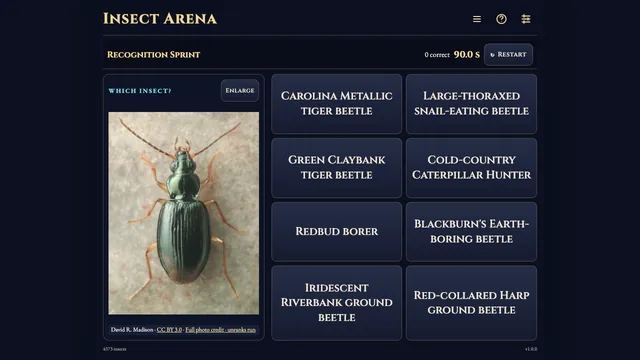
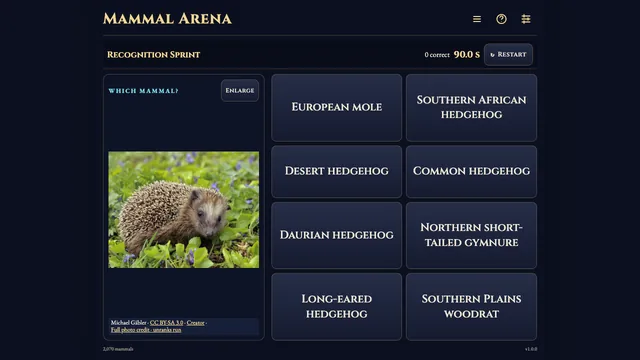
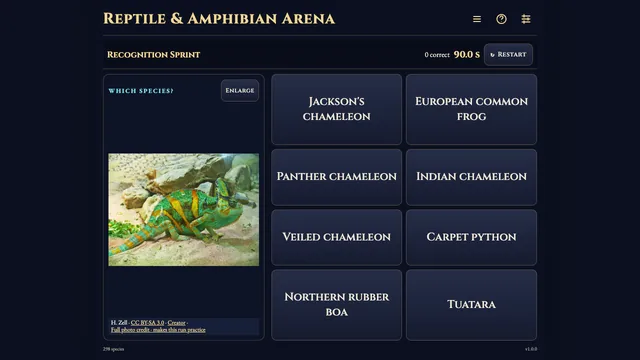
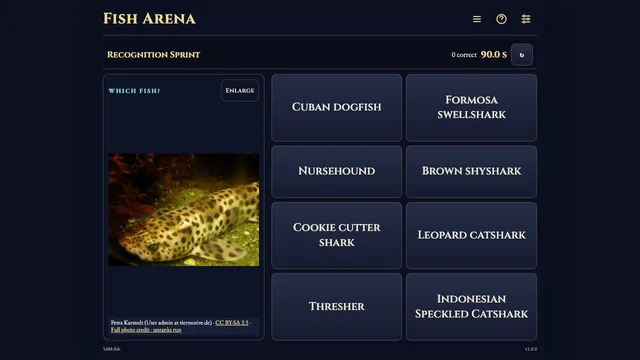
Nine competitions use real, individually reviewed animal photographs. Identify the species by its common or scientific (Latin) name, choose its native continents or oceans, estimate a reference mass range, match ten photographs and names, or name a famous animal from a close-up that widens with every wrong pick. Worldwide score, time and player name lead the main menu.
The library balances 90 mammals, 80 birds, 50 reptiles, 30 amphibians, 50 fish and 60 invertebrates, including at most 30 insects. Choose familiar animals, a group, or balanced wildlife. Size Reserve uses 88 sourced intervals; Native Regions uses 259 verified native sets.
How to play
- Goal
- Recognize animals and learn their scientific names, native regions and reference size ranges.
- How it ends
- Finish ten questions, ten pairs or five hidden names, exhaust the sprint clock, or make one sprint mistake.
- Record
- Best score, smallest size error, fastest matching finish or fewest wrong letters, with time and the player’s name.
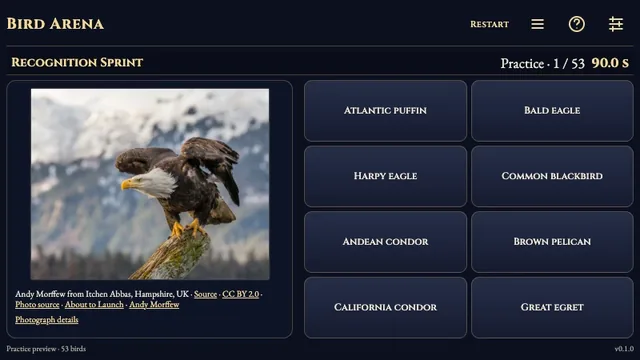
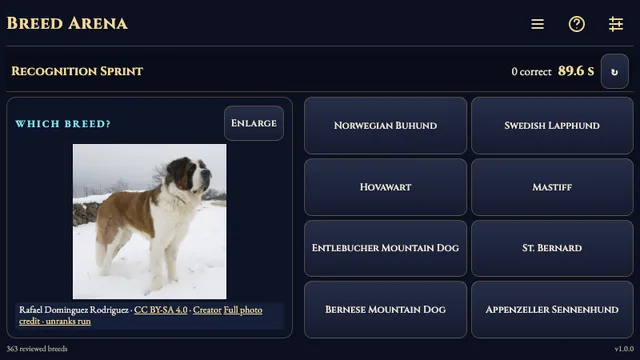
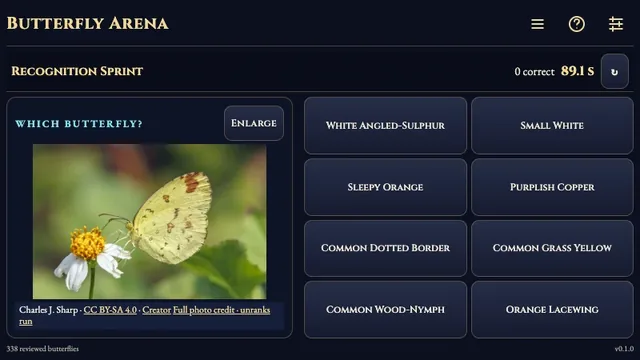
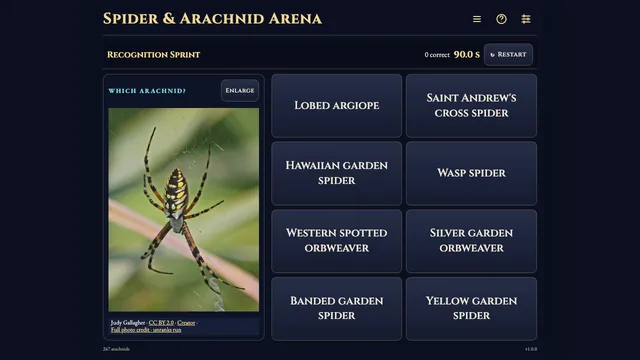
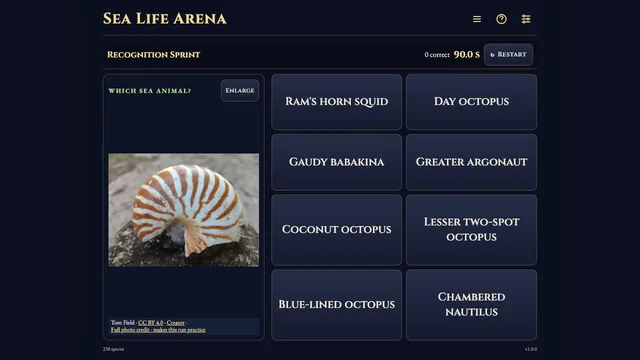
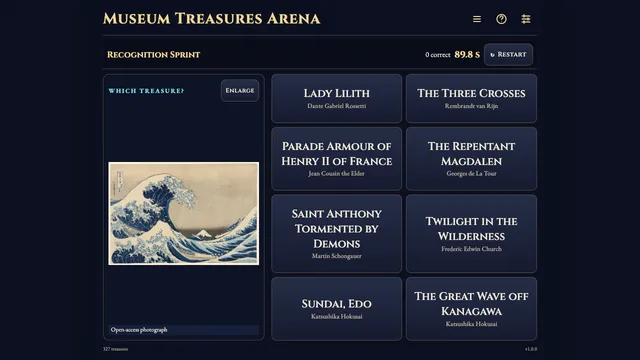
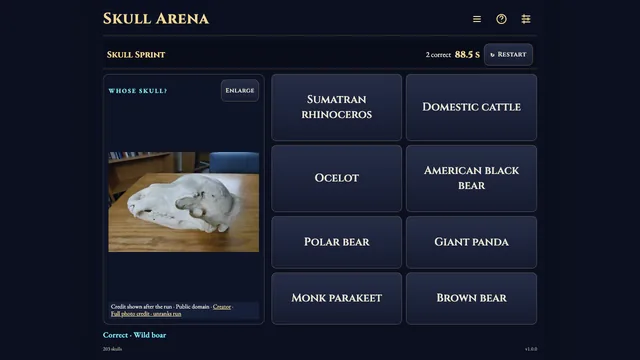
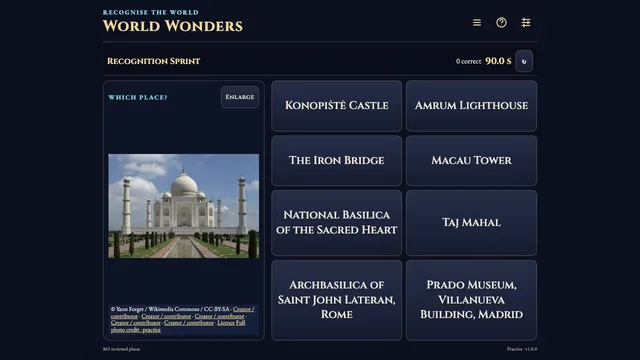
- Recognition Sprint: choose the pictured animal from eight names. You have 90 continuously running seconds; one wrong answer ends the run. Most correct answers wins, with time of the last correct answer breaking ties.
- Latin Names: choose the scientific (Latin) name of the pictured animal from eight, mostly of related animals. Ten photographs; a wrong answer scores nothing but the run continues. Most correct answers wins, then the faster total time. The clock pauses while each answer is revealed.
- Name Search: identify ten photographs. Type part of a common or scientific name, or a descriptive term such as duck, ignoring case. Choose the exact animal from the filtered list. Correct answers rank first, then faster time.
- Native Regions: choose one present-day native continent for the named animal, or one native ocean basin for marine questions. Any correct native region earns a point. Regular migration counts; introduced populations, captive animals and vagrants do not. Complete ten questions.
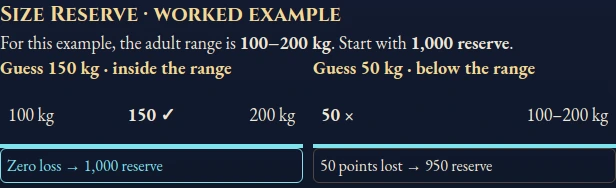
- Size Reserve: estimate the reference mass shown by the question’s sex or population scope, in kilograms or grams. You start with 1,000 reserve. Estimates inside the reviewed interval cost zero. Outside it, lose the distance to the nearest end on a logarithmic scale (times too heavy or light), as a share of the game's range of 0.006–6,100 kg, at most 100 per guess. Complete ten estimates; highest reserve wins, with time breaking ties.
- Matching Table: select a photograph, then its animal name. Match all ten pairs. Each wrong pair adds three seconds; fastest adjusted finish wins.
- Letter Hunt: guess letters to uncover five hidden names; right letters are free, each wrong letter counts. A solved name shows its photograph. Fewest wrong letters wins, then time. The Latin version hides scientific names.
Controls
| Input | Action |
|---|---|
| Tap / click | Choose answers, native regions and matching pairs; double-click a region to confirm it at once |
| Drag | Drag either side of the Matching Table onto its partner to make a pair |
| Type an animal name | Filter names; Enter chooses a unique result |
| Mass estimate · kg / g | Enter an estimate; a number pad supports controllers |
| Enlarge · Zoom in · Fit photo | Inspect the photograph while the clock keeps running |
| 1–8 | Choose a Recognition Sprint or Latin Names answer |
| Standard controller | D-pad navigates controls; A selects, Y opens Rules |
Tips
- Any one region counts Animals may naturally live on several continents. Pick the one you are surest of; the full native range is revealed afterwards.
- Read the measurement scope Some ranges refer to males, females or a named population. The image never determines the animal’s sex for scoring.
- Use broad search terms Try duck, lizard or salamander to narrow the name list, then select the species.
Good to know
Every photograph retains its creator, chosen licence, original title and source links. Creator credits appear beside the photograph; Full photo credit opens the complete attribution and sources. Opening full credits during a question, leaving the tab, restoring an unfinished run or a mid-run photo-loading interruption makes that attempt practice. Reviewed size intervals are source-specific references, not universal limits for every individual.
Watch how to play
Questions
Why do some animals appear in fewer competitions?
A photograph does not prove an animal’s weight or native range. A species joins those competitions only when its relevant facts have been verified.
Is one exact weight required?
No. Every estimate inside the stated reference interval earns zero loss. The source’s sex and population scope appears before your estimate.
Why use continents and oceans?
Most animals have wide natural ranges. Choose any one correct native continent, or ocean basin for marine animals. The complete native range is revealed after your answer.
Do captive photographs change the range answer?
No. Native regions describe regular wild populations; a zoo or aquarium photograph only helps identify the species.