About Sudoku
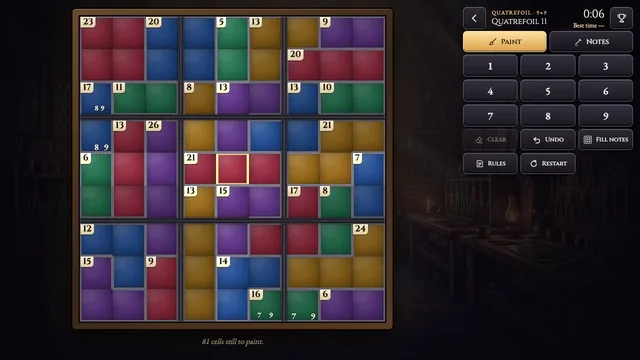
Classic 9×9 sudoku on a moonlit heath: 480 boards in four tiers, from singles to X-Wings and Swordfish.
Every board is proven to have exactly one solution that you can reach without guessing. No mistake limit, no countdown.
How to play
- Goal
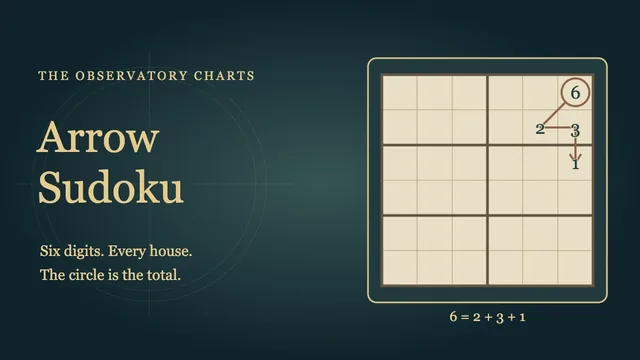
- Fill the grid so every row, column and 3×3 box holds 1 to 9 once.
- How it ends
- A board is solved when every cell is filled by those rules. There is no way to lose.
- Record
- The fastest first solve of each board, with its holder's name.
- Fill every row, column and 3×3 box with 1–9, each once.
- Tap a cell, then a number. Notes writes pencil marks.
Controls
| Input | Action |
|---|---|
| Tap a cell, then a number | Place |
| Hold a number | Lock it, then tap cells |
| Arrows · 1–9 · Shift+1–9 | Move · place · note |
| N · Backspace · Z · Y | Notes · clear · undo · redo |
| Shift+R · Restart | Clear the board to its givens; the clock keeps running |
Tips
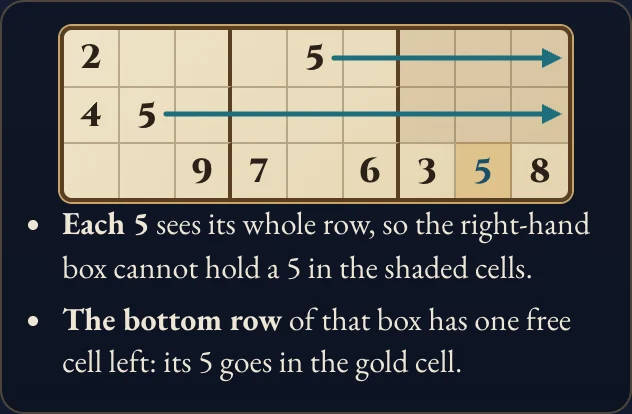
- Scan by number. Pick a number and check each box: where can it still go?
- Finish nearly-full lines first. A row, column or box with one or two gaps gives the next number cheapest.
- Use notes on harder tiers. Fill notes writes every candidate at once.
Good to know
Progress is saved in this browser.
Watch how to play
Did you know?
Nikoli introduced the puzzle to Japan as “Number Place” in 1984. Its long Japanese title was later shortened to Sudoku: “su” means number and “doku” means single.
Source: Nikoli: Sudoku history
Questions
Does every board have one solution?
Yes. Each board has exactly one solution.
Will I have to guess?
No. Every board can be solved by reasoning alone.
What are the tiers?
Apprentice: singles. Adept: pointing and pairs. Warden: triples and quads. Archwarden: X-Wing, Skyscraper, XY-Wing, XYZ-Wing, Swordfish.
Is there a mistake limit?
No.