How to play
- Goal
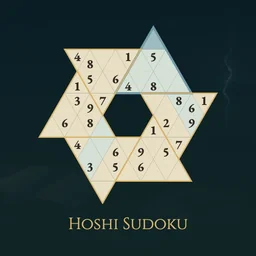
- Fill each large triangle with one through nine once each, and repeat no digit on any straight line, including lines interrupted by the central gap.
- How it ends
- The chart finishes when all fifty-four cells obey the printed givens, triangle and line rules; entries can be erased or undone.
- Record
- Your first unassisted finish keeps its time for this chart; later plays are Practice.
- Fill all fifty-four triangular cells with digits one through nine. Within each large triangle, every digit appears once. Printed givens stay fixed.
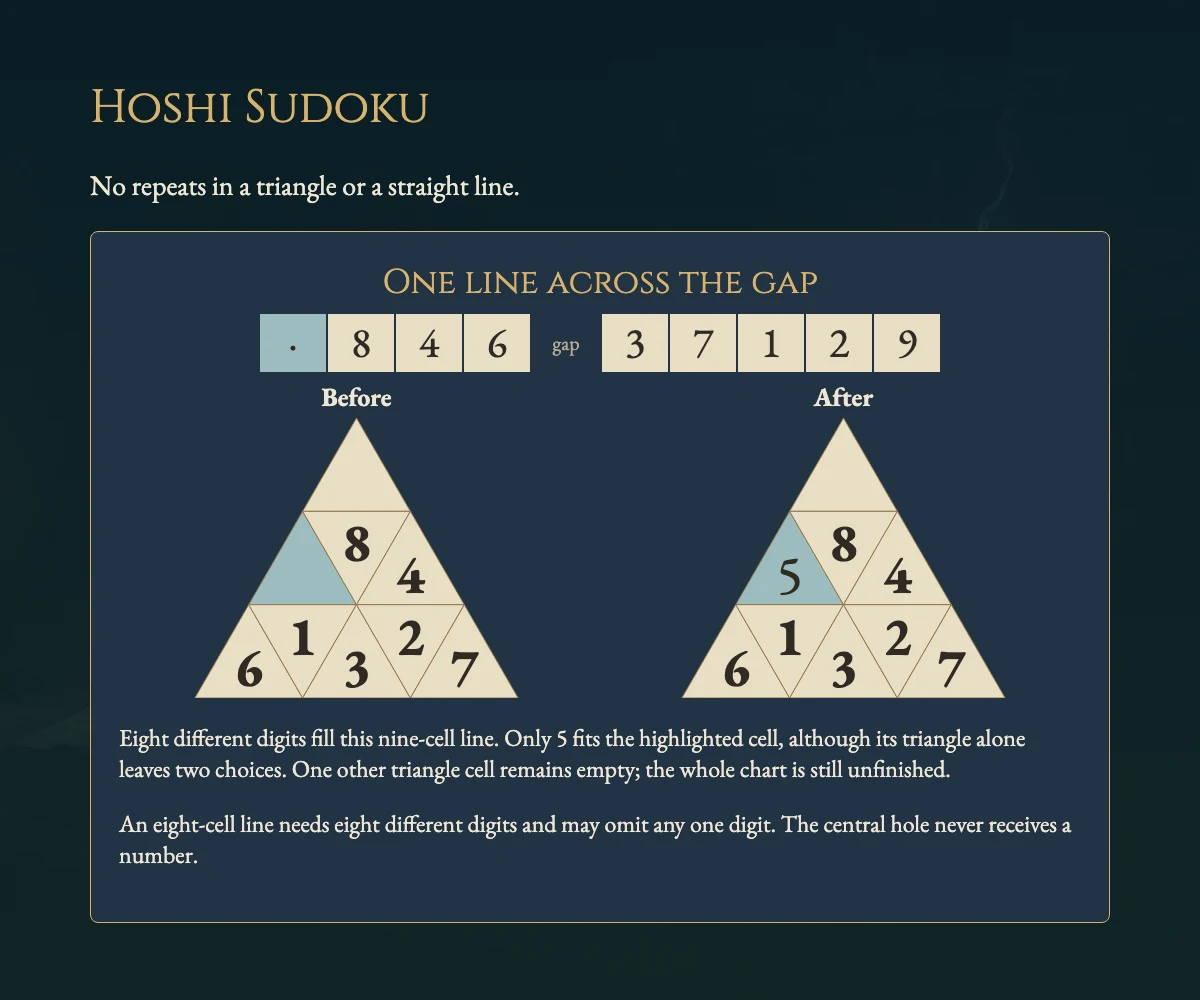
- No digit repeats along a straight line. The two portions of a line crossing the central gap form one constraint. Twelve enforceable lines have nine cells, and six have eight; an eight-cell line may omit any one digit. Leave the central hexagon empty.
- Choose a numbered triangle, select a cell in its enlarged entry view, then press a digit. The full-star overview shows its original position. Star opens the full chart and the selected cell’s Across, Rising and Falling lines.
- N toggles manual pencil notes. Entering or erasing a digit clears that cell’s notes; Undo and Redo restore the complete entry. Restart clears ink and notes while preserving the first clock. Menus and atlas returns keep the active clock running.
Controls
| Mouse / touch | Choose a numbered triangle, then an enlarged cell and digit |
|---|---|
| Arrows + Enter / Space | Navigate cells and enter the selected digit |
| 1–9 / N | Enter a digit / toggle manual pencil notes |
| 0 / Delete / Backspace | Erase the selected cell |
| Z / Y / R | Undo / Redo / Restart confirmation |
| Escape | Close a dialog or return to the atlas |
| Controller | D-pad focuses; A enters; X cycles digit; Y erases; shoulders Undo/Redo; B returns; Start opens Settings. |
Tips for Hoshi Sudoku
- Combine triangle and line exclusions A triangle may leave two possible digits while a line across the gap rules one out.
- Keep the line together The central hole does not split an interrupted line into two independent groups.
- Read the shorter lines literally An eight-cell line needs eight distinct digits, not every digit from one to nine.
- Use the enlarged entry view Choose the numbered triangle that contains the cell you want; its orientation matches the full-star overview.
Questions about this game
Can I put a digit in the middle?
No. The central hexagon stays empty.
Do the six large triangles overlap?
No. Each of the fifty-four cells belongs to one large triangle. Straight lines connect constraints across triangles.
Must an eight-cell line include every digit?
No. It may omit any one digit, provided its eight entries are distinct.
Are notes automatic?
No. Pencil notes are manual; the game does not fill candidate digits for you.
Can replay replace my first time?
No. Replay is Practice and retains your first result.
These charts and the worked example are original. Reload preserves digits, notes and Undo; reloaded first solves remain local. A wall-clock or browser-suspension discontinuity makes the solve local-only. A monotonic clock that pauses during OS sleep may exclude that pause from local elapsed time.
Watch how to play
About Hoshi Sudoku
Place digits in six triangular arms around an empty central hexagon. Each large triangle contains one through nine once. Every straight line has distinct digits, including a line that continues on the other side of the central gap.
All 96 original charts are open across four shelves of eight, sixteen, twenty-four and forty-eight charts. Every retained chart has one independently verified ending and a complete verified deduction trace. Shelf names describe progression, rather than a measured difficulty rating.