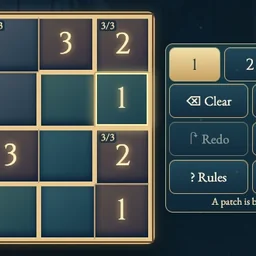
How to play
- Goal
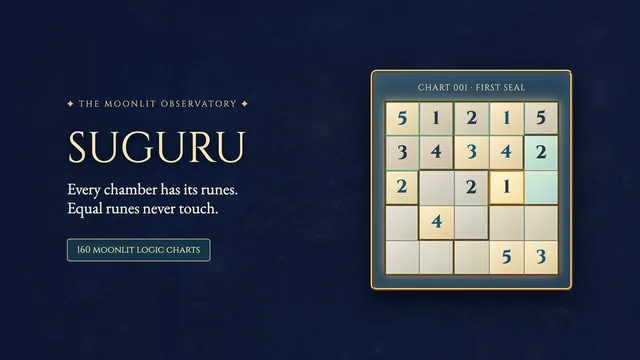
- Place positive numbers in some cells so each room's numbers sum to the number of cells in that room, and any two equal numbers in a row or column have a different number between them.
- How it ends
- A chart is won when both rules hold throughout the grid; there is no loss state.
- Record
- The first unaided solve of each chart earns one time record; later solves are practice and keep the first time.
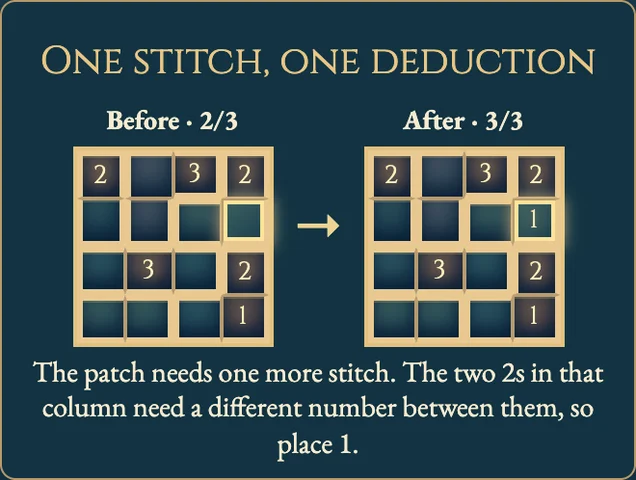
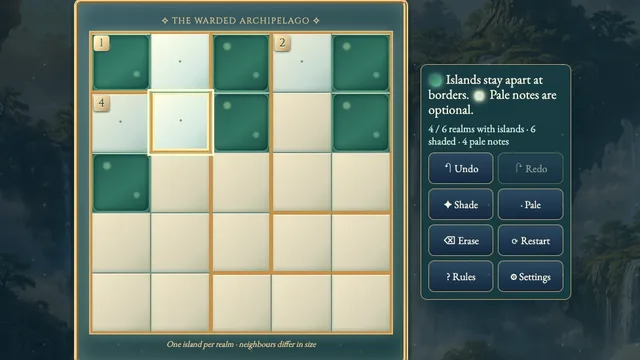
- Each thick brass outline is a patch. Add positive numbers to some cells until the numbers inside every patch sum to its number of cells. The small corner count shows the sum so far over that patch’s size. Bare cells are allowed and never need an X.
- Along any row or column, two equal positive numbers must have a different positive number between them; bare cells do not separate them. In the worked picture, a patch has 2 of 3 stitches. Two 2s in its column need a different number between them, so placing 1 in the highlighted square both completes the patch and separates the 2s.
- Tap a square to cycle its possible values, or select it and choose a number from the rail. Givens cannot change. Undo and Redo repair slips. Restart clears entries on the same chart while its first-solve clock keeps running. A first solve can rank once; later solves are practice.
Controls
| Tap / click a square | Select it and cycle through its numbers; fixed givens stay unchanged |
|---|---|
| Number rail / Clear | Set or clear the selected square directly |
| Arrow keys | Move through the loom |
| 1–6; 0 / Delete / Backspace | Set a value or clear the selected square |
| Enter / Space | Cycle the selected square |
| Undo / U; Redo / R | Step backward or forward through edits |
| Restart | Clear this chart without resetting its first-solve clock |
| Escape | Close a panel or return to the atlas |
| Gamepad | D-pad moves; A cycles, X clears, LB/RB undo/redo, Y rules, Start settings, LT number rail, RT restart |
Tips for Zabuton
- Read a full patch Its total is the number of outlined squares, including the ones you leave bare.
- An empty gap is not a separator Equal numbers need a different positive number between them, in the same row or column.
- Finish with just the stitches You never have to mark bare cloth with X to complete a chart.
Questions about this game
May some squares stay empty?
Yes. Only the positive numbers count toward a patch total, and bare squares need no mark.
Does an empty square separate equal numbers?
No. The number between them must be positive and different.
Does Restart reset my first time?
No. The clock starts when a chart first opens and keeps running through Restart.
Why is a resumed chart local only?
A saved unfinished chart is still playable after reloading the page, but only an uninterrupted first solve can be submitted as a record.
All 160 charts have distinct pinned identities, one independently counted solution, a no-guess deduction trace, and a second solution if the separation rule is removed. Private witnesses never ship. Progress uses morass.zabuton.v1. Replays keep the first solve time. Sound follows shared arcade settings. No ads or analytics run inside the game.
Watch how to play
About Zabuton
In a moonlit weaver’s loft, each outlined cloth patch needs as many numbered stitches as it has cells. Leave other cells bare, but separate matching numbers along each row and column with a different positive number.
All 160 original charts are open. The first 64 use a four-by-four loom; the remaining 96 use five by five. Every chart has one independently proved solution, needs both rules and can be completed by deductions without guessing.
Your first solve time stays with each pattern. An uninterrupted first solve on the game page can claim the named best shown beside the clock and on its atlas card.