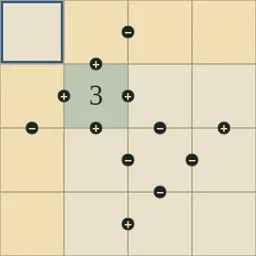
How to play
- Goal
- Fill each row and column with every digit once. Reading right or down, + means one higher, − means one lower, and unsigned neighbours cannot be consecutive.
- How it ends
- The chart finishes when every square is filled and every row, column, sign and unsigned edge agrees. Entries can be erased or undone.
- Record
- Your first unassisted finish keeps its time for this chart; later plays are Practice.
- Use digits 1–4 on four-by-four charts, 1–5 on five-by-five, and 1–6 on six-by-six. Each row and column uses each digit once.
- Read a sign right or down. Plus means the second digit is exactly one higher; minus means exactly one lower.
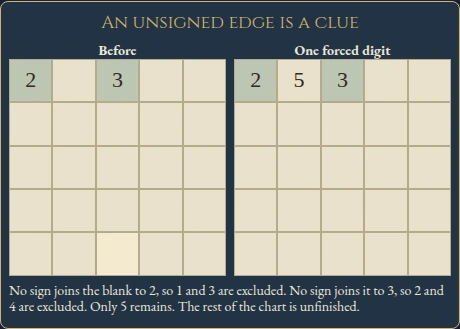
- Every consecutive orthogonal pair is signed. Unsigned neighbours cannot differ by one, in either order. There is no wraparound, diagonal or box rule.
- Select a square, then tap a digit. Repeating it clears it. Given digits are fixed; Erase, Undo and Redo remain available.
- Red outlines identify entered duplicates or violated neighbour relations. Fill every square and satisfy every rule to finish.
Controls
| Mouse / touch | Select a square, then enter an available digit |
|---|---|
| Arrows + Enter / Space | Move grid focus and apply the selected digit |
| 1–6 | Enter an available digit on the focused grid cell |
| Delete / Backspace | Erase the focused grid cell |
| Z / Y / R | Undo / Redo / Restart confirmation |
| Escape | Close a dialog or return to the atlas |
| Controller | D-pad focuses; A applies; X cycles digits; Y/LB Undo; RB Redo; B returns; Start Settings; Back rules. |
Tips for Sign In
- Follow a signed chain A plus or minus beside a given often determines its neighbour immediately. Always read right or down.
- Use the missing signs An unsigned edge beside 2 excludes both 1 and 3.
- Cross rows and columns Combine the neighbour clues with the digits already used in both crossing lines.
Questions about this game
Does a plus mean any higher digit?
No. It means exactly one higher, reading right or down. Minus means exactly one lower.
Can unsigned neighbours be consecutive?
No. Every consecutive orthogonal pair is marked. Unsigned edges exclude a difference of one in either order.
Does the largest digit wrap to one?
No. Only ordinary numerical difference counts, and diagonals have no neighbour rule.
What happens when I replay?
Replay is Practice and preserves your first finish time. Reloaded or interrupted first attempts remain local, while progress and Undo are retained.
All charts and worked diagrams are original. Progress and Undo save in this browser. Reloaded first finishes and detected clock or browser-suspension discontinuities remain local. If progress cannot be saved safely, the game tells you. Classic rules are described by Puzzler; this is an independent implementation.
Watch how to play
About Sign In
9
6
o
r
i
g
i
n
a
l
c
o
m
p
a
c
t
L
a
t
i
n
c
h
a
r
t
s
.
F
i
l
l
e
a
c
h
r
o
w
a
n
d
c
o
l
u
m
n
w
i
t
h
e
v
e
r
y
d
i
g
i
t
o
n
c
e
.
D
i
r
e
c
t
e
d
p
l
u
s
a
n
d
m
i
n
u
s
s
i
g
n
s
m
a
r
k
e
x
a
c
t
c
o
n
s
e
c
u
t
i
v
e
s
t
e
p
s
,
w
h
i
l
e
u
n
s
i
g
n
e
d
e
d
g
e
s
f
o
r
b
i
d
c
o
n
s
e
c
u
t
i
v
e
n
e
i
g
h
b
o
u
r
s
.
C
h
o
o
s
e
a
n
y
o
f
t
h
r
e
e
a
l
w
a
y
s
-
o
p
e
n
s
i
z
e
s
h
e
l
v
e
s
,
f
r
o
m
f
o
u
r
b
y
f
o
u
r
t
o
s
i
x
b
y
s
i
x
.