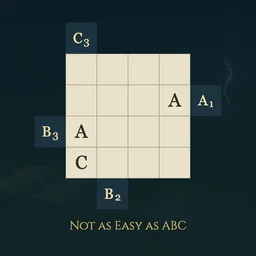
How to play
- Goal
- Place each letter once per row and column, leaving one gap, so every indexed edge clue names the letter at that rank when gaps are skipped.
- How it ends
- The chart finishes when every row, column and indexed clue agrees. Gap notes are optional, and entries can be erased or undone.
- Record
- Your first unassisted finish keeps its time for this chart; later plays are Practice.
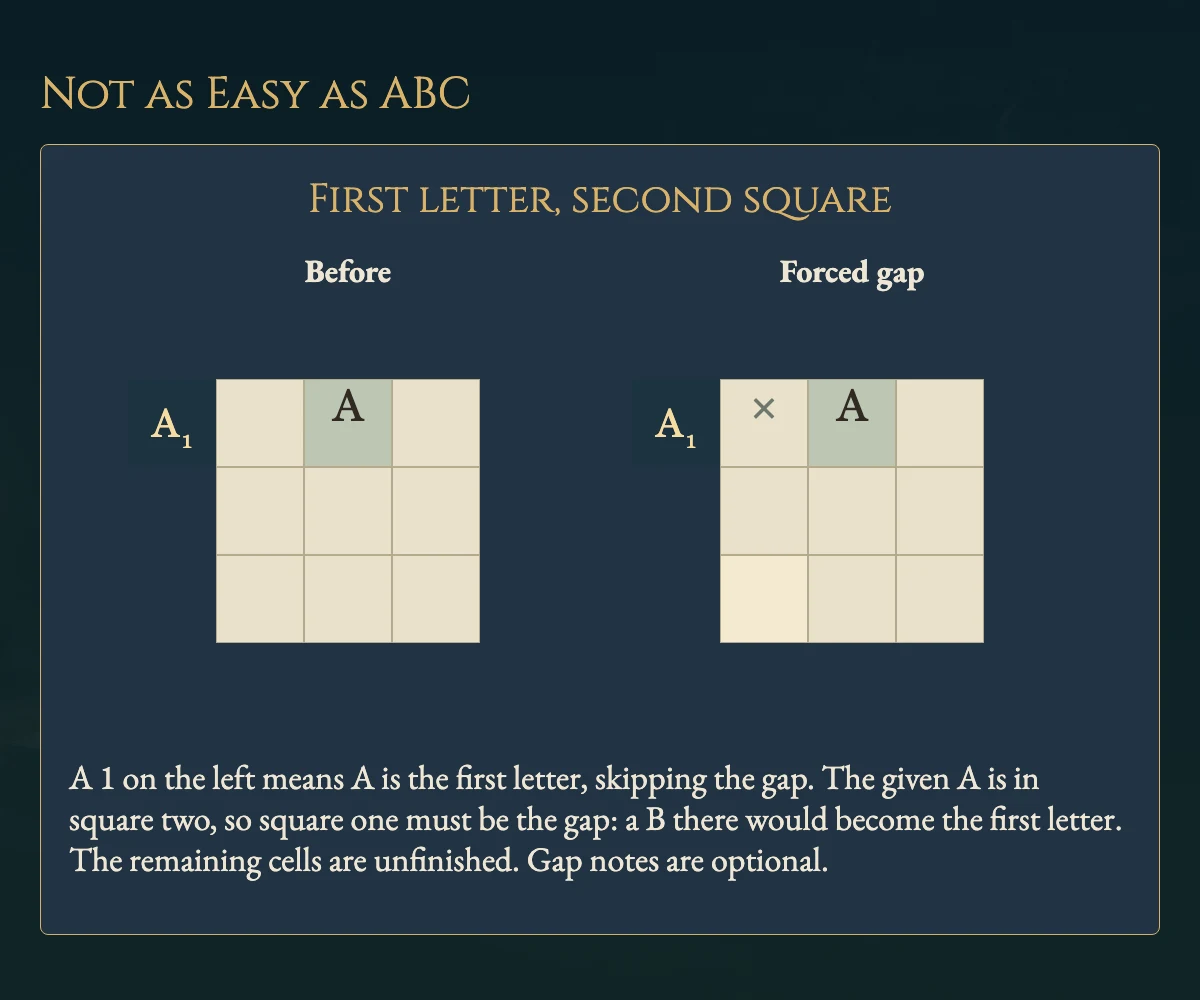
- Place every available letter exactly once in each row and column. Each line has exactly one gap. The available letters are A–C on a 4×4 chart, A–D on 5×5 and A–E on 6×6.
- Read each edge clue inward from its own side. A letter and rank, such as B 2, means B is the second letter seen when the gap is skipped. The rank counts letters, not physical squares.
- Select a square, then tap a letter to enter it. The cross is an optional gap note: remaining empty squares count as gaps once every letter is placed. Fixed givens cannot change. Repeating an entry clears it.
- Tap an edge clue to inspect its inward line while keeping your selected square. Red outlines identify public conflicts; a settled clue turns green after its complete line agrees. Undo and Redo restore entries. Restart clears editable entries while the first clock keeps running.
Controls
| Mouse / touch | Select a cell, then enter a letter or optional gap note |
|---|---|
| Arrows + Enter / Space | Move grid focus and apply the selected entry |
| A–E / X | Enter an available letter / toggle a gap on the focused cell |
| Delete / Backspace | Erase the focused grid cell |
| Z / Y / R | Undo / Redo / Restart confirmation |
| Escape | Close a dialog or return to the atlas |
| Controller | D-pad focuses; A applies; X cycles letters/gap; Y/LB Undo; RB Redo; B returns; Start Settings; Back rules. |
Tips for Not as Easy as ABC
- Allow for the gap A third letter is in square three or four. An earlier gap shifts it one square farther inward.
- Intersect clues A row can rule out a letter position that an edge clue in its column initially permits.
- Read from the correct edge Right-edge clues read leftward; bottom-edge clues read upward.
- Keep gap notes optional Use crosses to remember gaps. You do not need to cross every remaining empty cell to finish.
Questions about this game
Does B 2 mean the second square?
No. It means the second letter encountered inward, skipping the gap.
How many gaps are in a line?
Exactly one gap per row and column.
Are crosses required?
No. They are optional manual gap notes.
Can I change a given?
No. Fixed letters and fixed gaps are protected.
Can replay improve my first time?
No. Replay is Practice and preserves your first result.
The charts and unfinished worked example are original. Progress and Undo save in this browser. Reloaded first finishes and detected clock or browser-suspension discontinuities remain local. If progress cannot be saved safely, the game tells you.
Watch how to play
About Not as Easy as ABC
Read letters inward from four edges of a parchment chart. Each clue pairs a letter with its rank: C 3 means the third letter encountered, skipping the gap. Intersect the row, column and edge constraints to find one complete arrangement.
All 96 original charts are open: twelve 4×4 charts with A–C, thirty-six 5×5 charts with A–D and forty-eight 6×6 charts with A–E. Every chart has one answer and a checked line-pattern deduction route. Shelves describe size, rather than measured human difficulty.