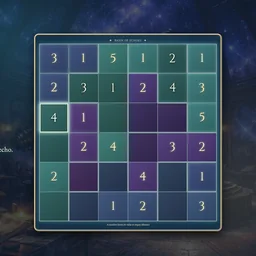
How to play
- Goal
- Fill each room with 1 through its size while keeping equal numbers in a row or column separated by at least that many other cells.
- How it ends
- A chart is complete when every cell is filled and both room and spacing rules hold; there is no loss.
- Record
- The fastest first solve of each chart is kept locally and on the public board.
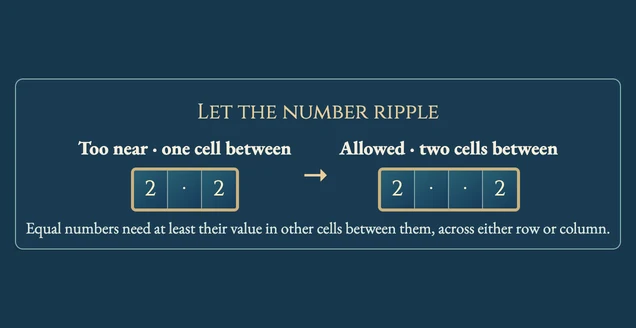
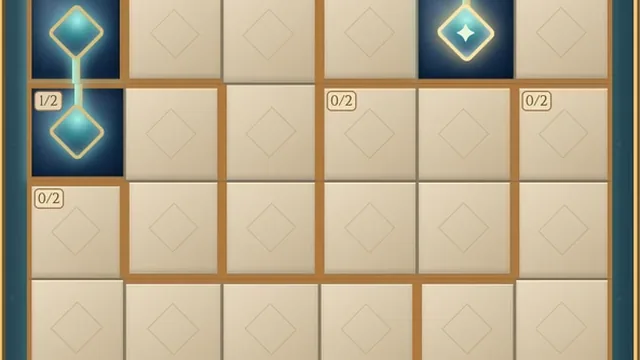
- Fill each outlined room with 1 through its number of cells, once each. Equal numbers in a row or column need at least their value in other cells between them. The worked picture shows why two 2s need two cells between them.
- Choose a number and tap a square, or focus a square and type 1–5. Given numbers are carved in place. A red number visibly breaks a room or spacing rule; change or erase it.
- Undo restores a mark. Restart clears your entries without resetting the first clock. Fill every cell so both rules agree to finish automatically. Replays are untimed practice and keep the original first time.
Controls
| Tap / click a square | Place the chosen number; tap it again to clear it |
|---|---|
| Number tools | Choose 1–5 or eraser before tapping a square |
| Right click | Erase the selected square |
| Undo / Z | Restore the previous entry |
| Restart | Clear entries without resetting the first clock |
| Arrow keys | Move focus between squares |
| 1–5 keys | Place that number in the focused square |
| Space / Enter | Place the chosen number in the focused square |
| Backspace / Delete | Erase the focused square |
| Escape | Close a panel or return to the atlas |
All 160 fixed charts have one independently verified answer and become ambiguous without the spacing rule. Private witnesses do not ship. First-solve progress uses morass.ripple-effect.v1; sound follows the shared site setting. No ads or analytics run inside the game.
About Ripple Effect
At a moonlit observatory, number the carved water basins. Each outlined room holds every number from 1 through its size.
Matching numbers send ripples down rows and columns: two equal values need at least that many other cells between them.
Explore 160 fixed charts whose answers are independently proved. The first completion time for each chart can claim a named public best.