About Kanjo
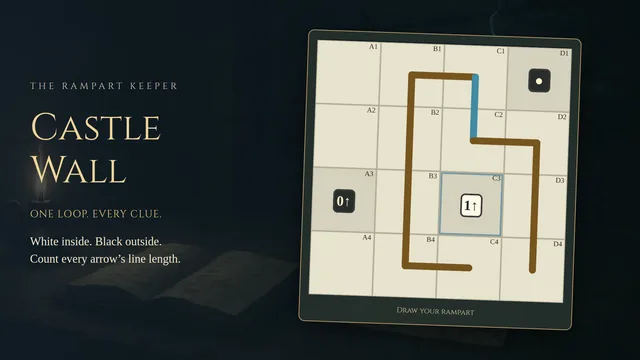
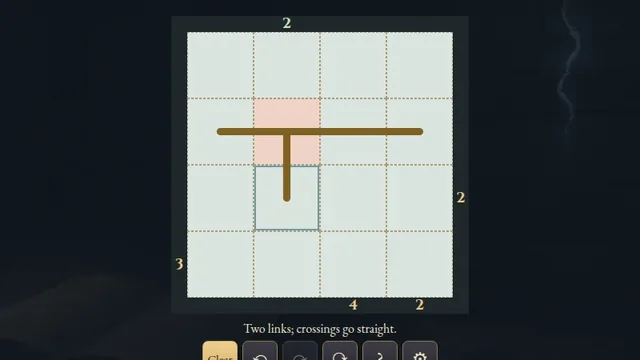
Join neighbouring cell centres into numbered rings across the whole grid. Four links make a crossing: top continues to bottom and left continues to right, so the lanes never join or turn into one another.
All 96 original charts are open: eight 4×4, sixteen 5×4, twenty-four 5×5 and forty-eight 6×6. Each complete edge ending is checked, with no repeated ending shape under rotation or reflection.
How to play
- Goal
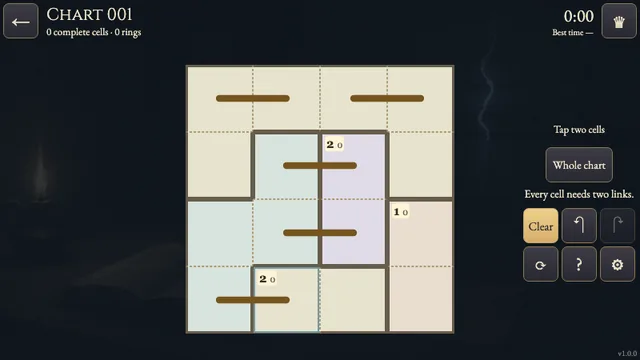
- Draw closed rings through every cell; matching numbers share one ring and different numbers use different rings.
- How it ends
- A chart is won when every cell is covered by closed rings, every ring has a number and all fixed pieces are respected; there is no loss.
- Record
- Your first unassisted solve of each chart earns one fastest-time record; replays are practice.
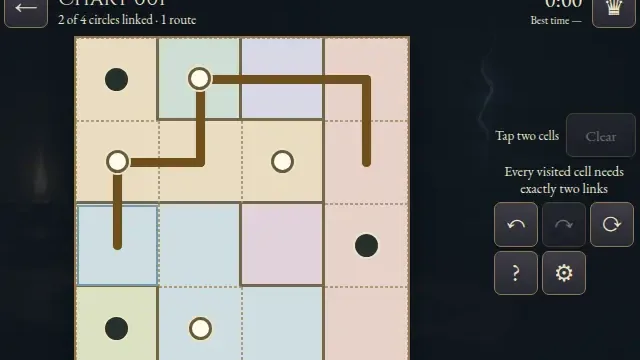
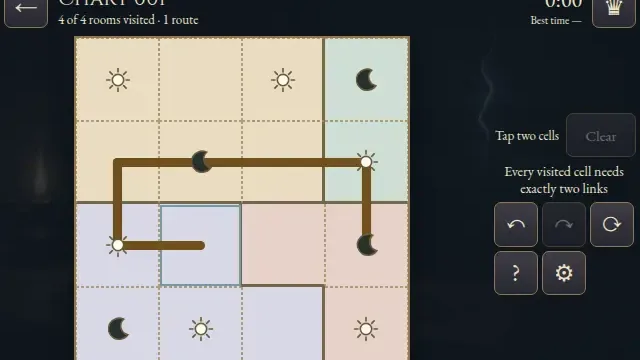
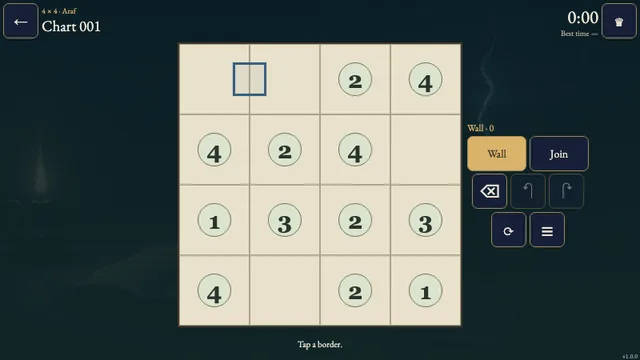
- Every cell needs two links, or four links forming a straight-through crossing. Routes must close into rings without branches or loose ends.
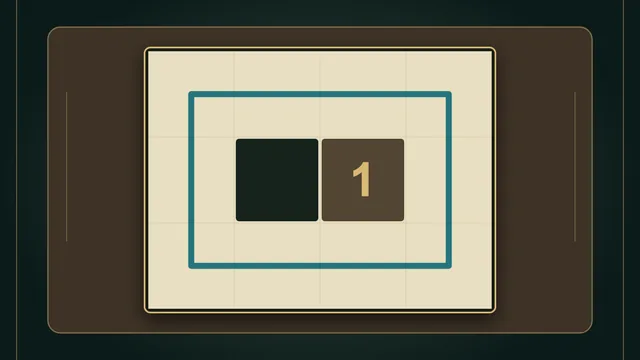
- Matching numbers belong to the same ring; different numbers belong to different rings. Numbers are identities, not ring lengths. Every ring needs a number, and a numbered cell cannot be a crossing.
- Tap two neighbouring cells to toggle their link, or drag through neighbouring cells and release to add one stroke. Clear removes editable links at the chosen cell. Printed pieces, including their missing links, cannot change.
- Undo and Redo correct edits. Restart preserves printed pieces and the first clock. The clock starts when a chart is dealt and keeps running through menus and atlas returns.
Controls
| Input | Action |
|---|---|
| Mouse / touch | Tap two neighbouring cells; drag to add a stroke |
| Arrows + Enter / Space | Move between cells and select or connect |
| Delete | Clear editable links at the chosen cell |
| Z / Y / R | Undo / Redo / Restart confirmation |
| Escape | Cancel a selection, close a dialog or return to the atlas |
| Gamepad | D-pad moves; A connects; X clears; shoulders Undo/Redo; B clears a selection or steps back; Start opens Settings. |
Tips
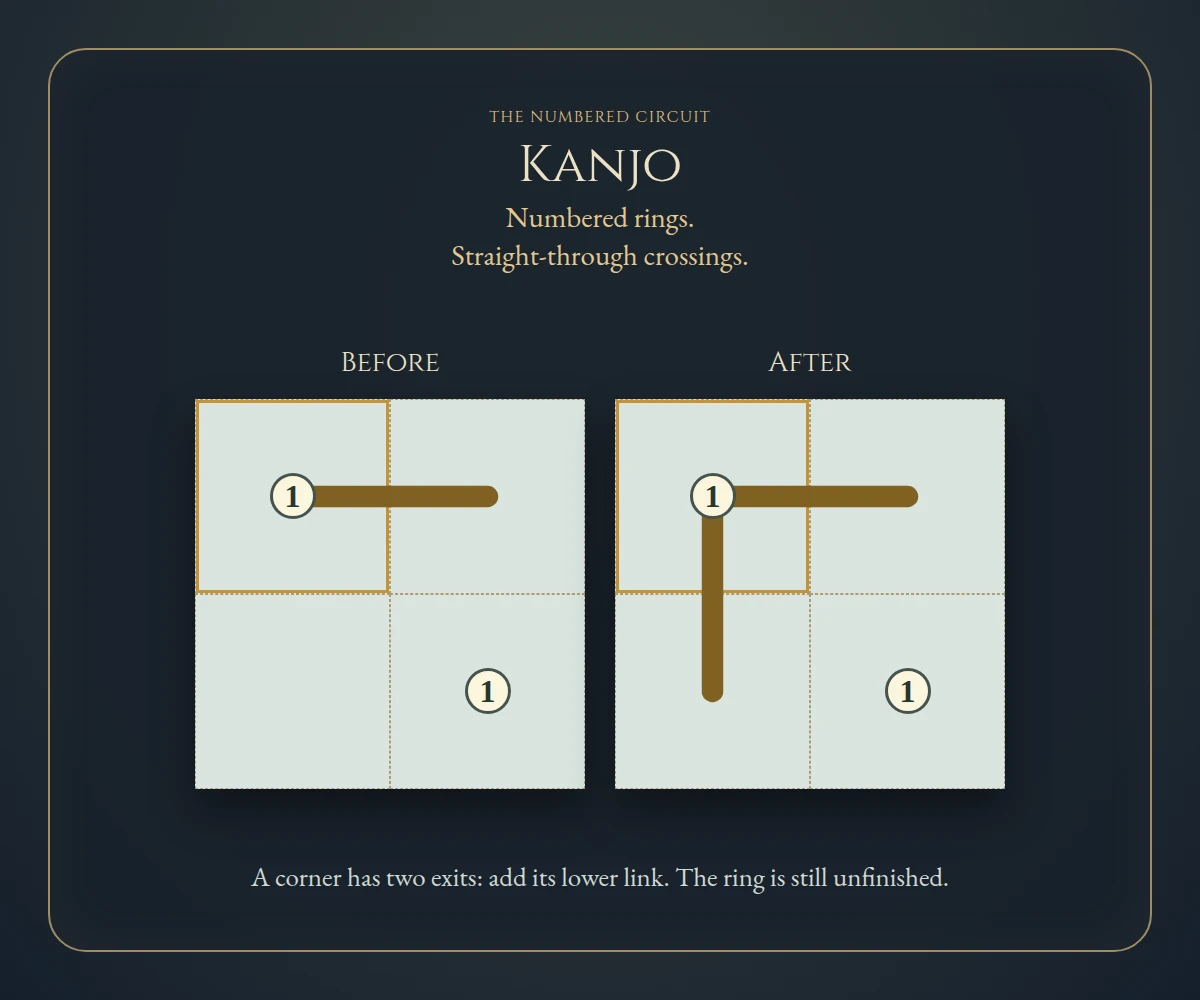
- Start at corners A corner has exactly two available exits. Both links are forced.
- Track number identities A route may not bring different numbers together. A closed ring cannot leave matching numbers on another route.
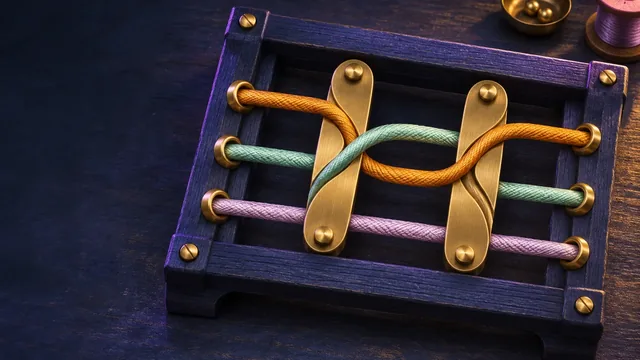
- Keep crossing lanes separate At four links, follow opposite sides. A crossing is never a junction.
- Respect printed pieces A fixed cell keeps its entire shape. Correct mistakes in editable neighbouring links.
Good to know
These charts and examples are original. Reload keeps links and Undo; reloaded first solves stay local. Shelf labels describe dimensions, not difficulty.
Watch how to play
Questions
Must I use every cell?
Yes. Each cell has two links or a legal straight-through crossing.
Do numbers show lengths?
No. A number identifies its ring. All equal numbers share that ring.
Can two rings cross?
Yes. Their lanes remain separate; a ring can also cross itself.
Can I add a link to a printed piece?
No. The whole printed cell shape is fixed, including absent links.
Can Replay replace my first time?
No. Replay is Practice and retains your first result.