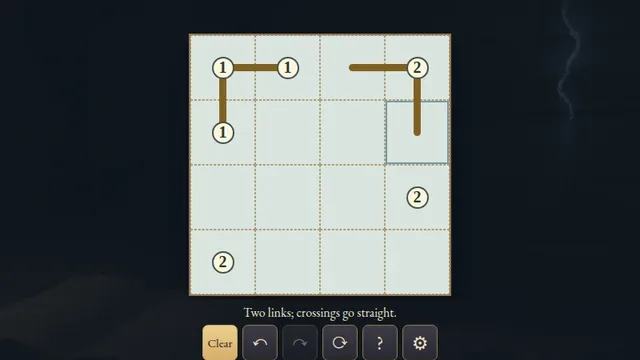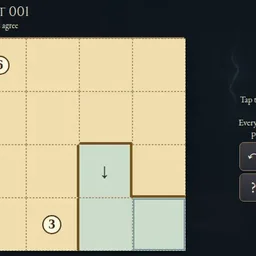
How to play
- Goal
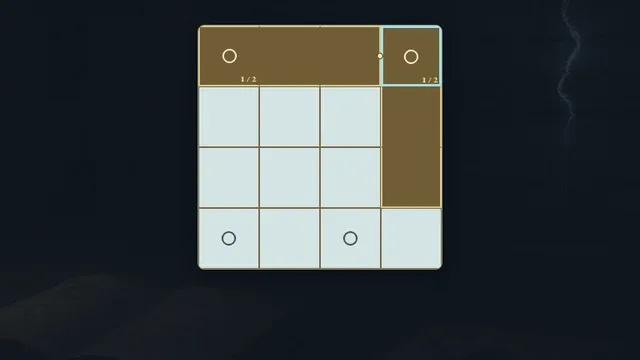
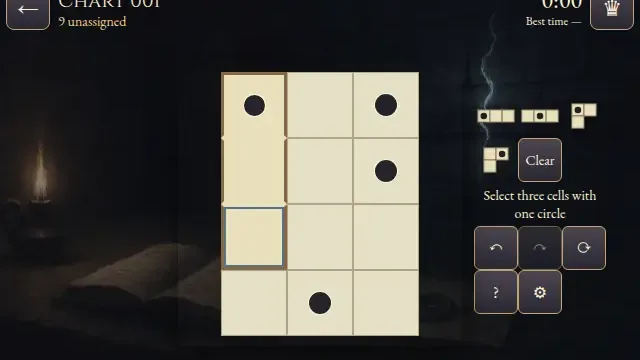
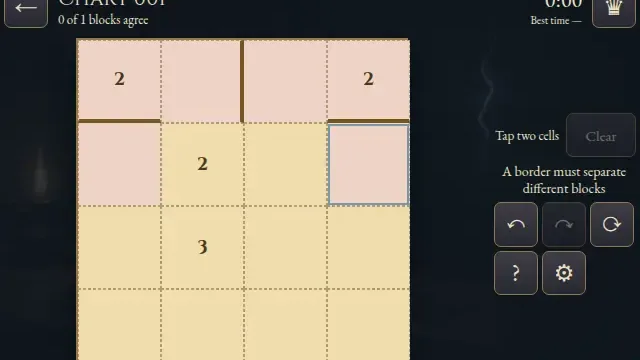
- Divide the whole grid into one-cell-wide L-shaped blocks, placing each circle at a bend, obeying its size when numbered, and making each arrow an endpoint pointing toward its bend.
- How it ends
- The chart finishes when every block and clue obeys the rules; borders can be changed before completion, so there is no loss state.
- Record
- Your first unaided solve time is recorded for each chart; Replay is Practice.
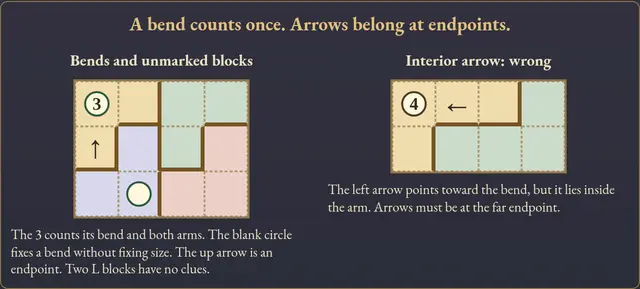
- Tap a cell and an orthogonal neighbour to toggle their shared border. Every cell must belong to one thin L with two perpendicular straight arms.
- A circle must be at the bend. A number counts all cells in its block, including the bend once. A blank circle gives no size.
- An arrow must be at the far endpoint of an arm and point toward its bend. It cannot sit inside the arm or at the bend. Blocks may have no clues.
- Borders separate different blocks. Do not reconnect around a drawn border. Undo, Redo and Restart remain available before completion.
Controls
| Mouse / touch | Tap two neighbouring cells to toggle their shared border |
|---|---|
| Arrows / Space or Enter | Move the cursor / select or complete a neighbouring pair |
| Delete / Escape | Clear selection / clear or return |
| Z / Y / R | Undo / Redo / Restart confirmation |
| Controller | D-pad moves; A selects; X clears; Y undoes; shoulders undo/redo; B clears then returns; Start opens settings. |
Tips for Sashigane
- Start at the edge A bend or endpoint near the grid edge restricts the available arms.
- Count the bend once A three-cell L has one extra cell on each arm.
- Allow unmarked blocks An L does not need a circle or arrow.
- Repair borders Tap the same pair again to remove a line, or use Undo. Restart keeps the original clock.
Questions about this game
Must every cell be used?
Yes. Every cell belongs to exactly one thin L.
Must the arms have equal lengths?
No. Each arm needs at least one cell beyond the bend; their lengths can differ.
Does an arrow only specify direction?
No. It must also be at the far endpoint of its arm.
What does a blank circle mean?
It fixes the bend without fixing the block’s area.
Can Replay replace my first time?
No. Replay is Practice; it retains your first result.
This edition follows Nikoli’s Sashigane rules. All charts and examples were made for this edition; no published boards were copied. Reload keeps borders and Undo; resumed first solves stay local.
Watch how to play
About Sashigane
Divide the grid into one-cell-wide L blocks. Circles mark bends, numbers count cells and arrows sit at endpoints pointing toward their bends.
All 96 original charts are open: twelve 4×4, twenty-four 5×5 and sixty 6×6. Each has exactly one independently verified partition.