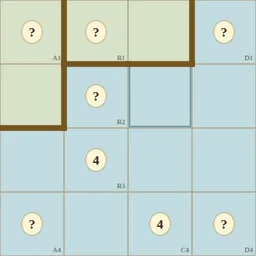
How to play
- Goal
- Divide every cell into equally sized connected provinces, each containing one clue, so every number matches its province's distinct edge neighbours.
- How it ends
- The chart finishes when every province has the required area and one clue, and every numbered neighbour count matches; there is no loss state.
- Record
- Each chart keeps your first solve time, and an uninterrupted first solve can claim the named fastest time.
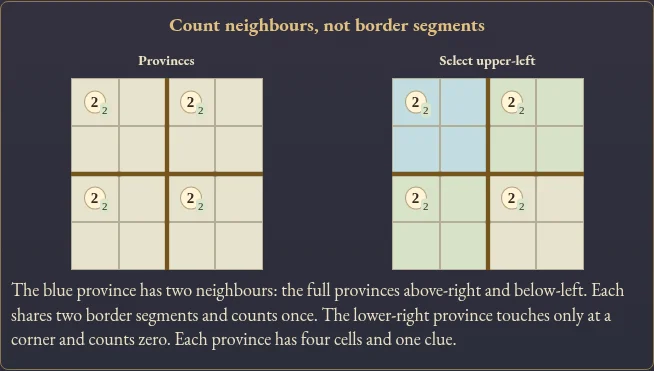
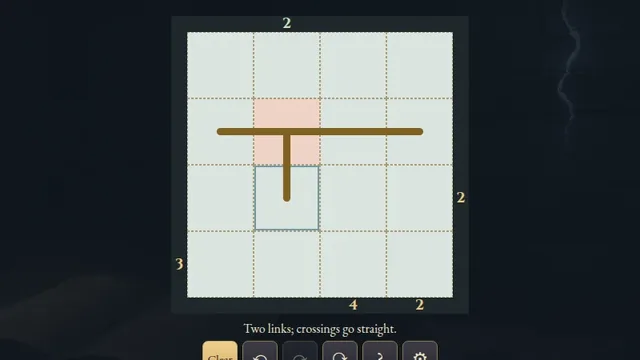
- Draw borders between neighbouring cells to divide every cell into connected provinces of the same area. Each province must contain exactly one printed number or question mark.
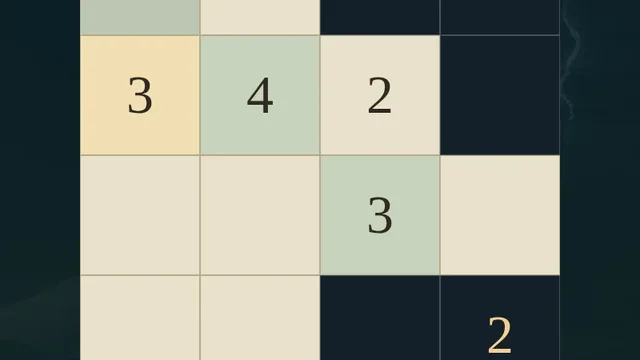
- A number counts different provinces sharing a cell side. Two or more shared border segments with the same province still count once.
- Corner-only contact and the outside of the map count zero. A question mark anchors a province but has no neighbour quota.
- Select a cell to inspect its entire current province in blue and its neighbouring provinces in green. These are counts of your own borders, rather than deductions. Province shapes may be irregular.
Controls
| Mouse / touch | Tap two neighbouring cells to toggle their shared border; drag consecutive cells to draw one undoable stroke |
|---|---|
| Arrows + Enter / Space | Move cell focus and select neighbouring cells |
| Delete / Clear | Remove borders touching the selected cell |
| Z / Y / N | Undo / Redo / open Restart confirmation |
| Whole chart / Show rows or columns | Read-only overview / pan a clipped chart |
| Escape | Close a dialog, cancel a stroke, clear selection or return to the atlas |
| Controller | D-pad move; A select; X clear; shoulders Undo/Redo; B cancel or back; Start settings |
Tips for Neighbours
- Find the common area Divide the total cells by the number of printed clues; every question mark counts as a clue.
- Count whole provinces Follow each touching connected province before adding a neighbour. Repeated side contact contributes only one.
- Check the anchors Every completed province needs exactly one clue, including question marks.
Questions about this game
Must provinces be rectangles?
No. Any orthogonally connected shape is allowed if its area, anchor and neighbour count obey the rules.
Do question marks count as clues?
Yes. A question mark is the sole anchor of its province, with no neighbour quota.
When do red clue counts appear?
When the grid already forms equal-area provinces with one clue each; incomplete components remain neutral.
Are shelves difficulty levels?
The four shelves describe chart size and province area: eight 4×4 area-two charts, eight 4×4 area-four charts, twenty-four 6×4 area-three charts and fifty-six 6×6 area-three charts. No difficulty ranking is promised.
Does Restart reset the clock?
No. It clears borders and keeps the original first-solve clock. Undo restores the cleared borders.
What happens when I replay?
Replay is untimed Practice and preserves your first finish. Reloaded unfinished attempts stay local while borders and Undo are retained.
Charts and the worked example are original. Borders and Undo save in this browser. The first clock starts when a chart is selected. Reloaded attempts and detected clock or browser-suspension discontinuities stay local. Unsafe or unavailable storage is reported in-game. This is an independent implementation of the classic Neighbours puzzle rules.
Watch how to play
About Neighbours
D
i
v
i
d
e
a
m
a
p
i
n
t
o
e
q
u
a
l
l
y
s
i
z
e
d
c
o
n
n
e
c
t
e
d
p
r
o
v
i
n
c
e
s
.
E
a
c
h
p
r
i
n
t
e
d
n
u
m
b
e
r
c
o
u
n
t
s
d
i
s
t
i
n
c
t
n
e
i
g
h
b
o
u
r
i
n
g
p
r
o
v
i
n
c
e
s
a
c
r
o
s
s
9
6
o
r
i
g
i
n
a
l
c
h
a
r
t
s
w
i
t
h
c
e
r
t
i
f
i
e
d
u
n
i
q
u
e
e
n
d
i
n
g
s
.