About Latin Arena
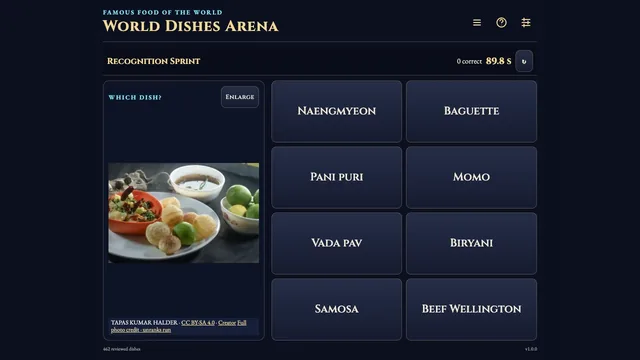
Fifteen competitions on Latin alone. Name the author of a Latin line from eight, type the author’s name, pick its work, its author’s century or its English meaning, fill a famous line’s missing word, match lines to authors, or uncover a hidden Latin line letter by letter.
Quotations come from sourced sections of English Wikiquote pages of 146 Latin authors, Plautus and Cicero to Erasmus and Spinoza, each with its translation. Phrases come from Wikipedia’s lists of Latin phrases, mottos from its national, state, university, military and family motto lists. Sources as of 2025.
How to play
- Goal
- Know Latin: who wrote its lines, in which work and century, and what its phrases and mottos mean.
- How it ends
- Finish ten questions, eight pairs, three hidden quotations or five hidden phrases or names, exhaust the sprint clock, or make one sprint mistake.
- Record
- Most correct answers, fewest wrong letters or fastest matching finish, with time and the player’s name.
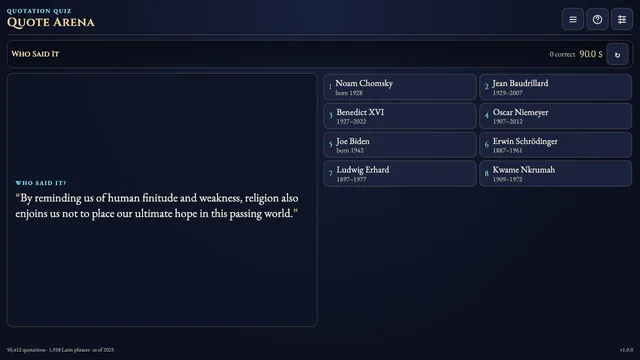
- Who Wrote It: a Latin line and eight authors; 90 seconds from the first question; one wrong answer ends the run. Most correct answers wins; time breaks ties.
- Author Search: ten Latin lines; type any part of the author’s name, ignoring accents and small slips, and choose from the list.
- Source Work and Century: ten lines each; pick the work out of eight, or the century in which the author died.
- Meaning: ten Latin lines; pick the English translation from eight. Finish the Line: a famous line with one word blanked; pick the Latin word from eight.
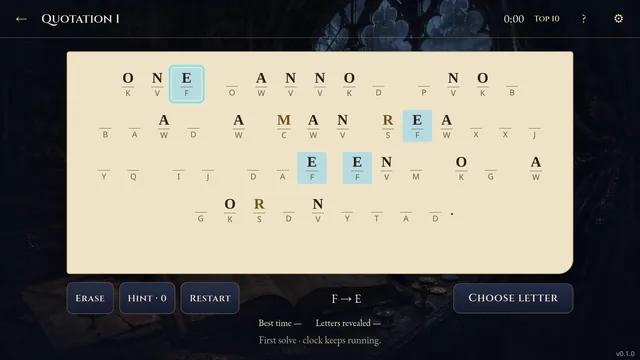
- Latin Hangman: three hidden Latin lines, author and translation shown. Right letters are free and fill every place they occur; fewest wrong letters wins, time breaks ties. Letter Hunt does the same with five hidden author names.
- Matching: pair eight Latin lines with their authors; each wrong pair adds three seconds.
- Phrases: Phrase Sprint (Latin to English, 90 seconds, one mistake ends), English to Latin, Phrase Hangman and Phrase Matching.
- Mottos: Whose Motto (pick the country, state, school, regiment or family that bears it) and Motto Meaning.
Controls
| Input | Action |
|---|---|
| Tap / click | Choose answers and matching pairs; double-click or double-tap an answer to confirm it at once |
| Drag | Drag either side of the Matching table onto its partner |
| Type a name | Filter authors in Author Search; Enter chooses a unique result |
| Letters | Guess letters in the Hangmen and Letter Hunt |
| 1–8 | Choose an answer |
| Enter / Space | Continue from a reveal |
| Standard controller | D-pad navigates controls, left and right jump between initials in the author list; A selects, B goes back, Y opens Rules, Start opens Settings |
Tips
- Read the voice Comedy, epigram, oratory and scripture sound different in Latin too; the eight authors share a trade and an age, so style decides.
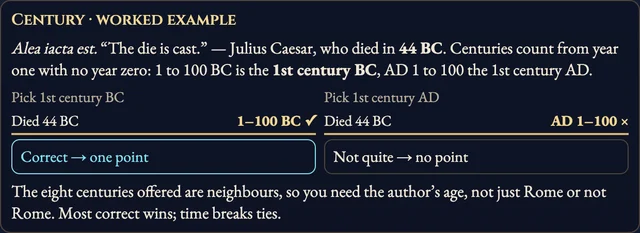
- Count the centuries Centuries before Christ count down: Caesar died in 44 BC, the 1st century BC; Cicero a year later, the same century.
- Vowels first In Latin Hangman E, I, A, U and the endings -US, -UM and -IS fill the most places.
Good to know
Every reveal links the author’s Wikiquote page or the Wikipedia list it came from. Source links are free to open once a question is answered; leaving the tab or restoring an unfinished run makes that attempt practice. Sources as of 2025.
Watch how to play
Questions
Where do the quotations come from?
English Wikiquote pages of authors who wrote in Latin, sourced sections only: a line needs a citation or a work heading and an English translation. Disputed, misattributed and unsourced lines are left out.
Why not Latin Wikiquote?
It gives the Latin without English translations, so its lines could not be played for meaning or explained in the reveal.
Which quotations are famous?
Those Wikiquote shows in bold or as a page’s image caption, and lines that also appear in Wikipedia’s lists of Latin phrases.