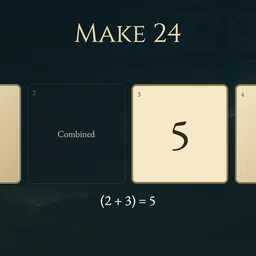
About Make 24
Combine four numbered cards with addition, subtraction, multiplication and division to make exactly 24. Choose two cards at a time; their exact result becomes a card you can use in the next combination. Every valid expression counts.
Explore every solvable four-card set from numbers 1–13: 1,362 deals across Single digits, Larger cards and Fraction steps. Undo a route, try another grouping, and keep your first solve time for each deal.
How to play
- Goal
- Use all four cards once with addition, subtraction, multiplication and division to make 24.
- How it ends
- A deal is complete when one card remains with the exact value 24; there is no loss.
- Record
- Your first solve time is kept per deal, alongside the fastest verified first solve and its holder.
- Choose a deal to reveal its four cards and start its first clock. Each original card must be used exactly once, including equal-valued cards.
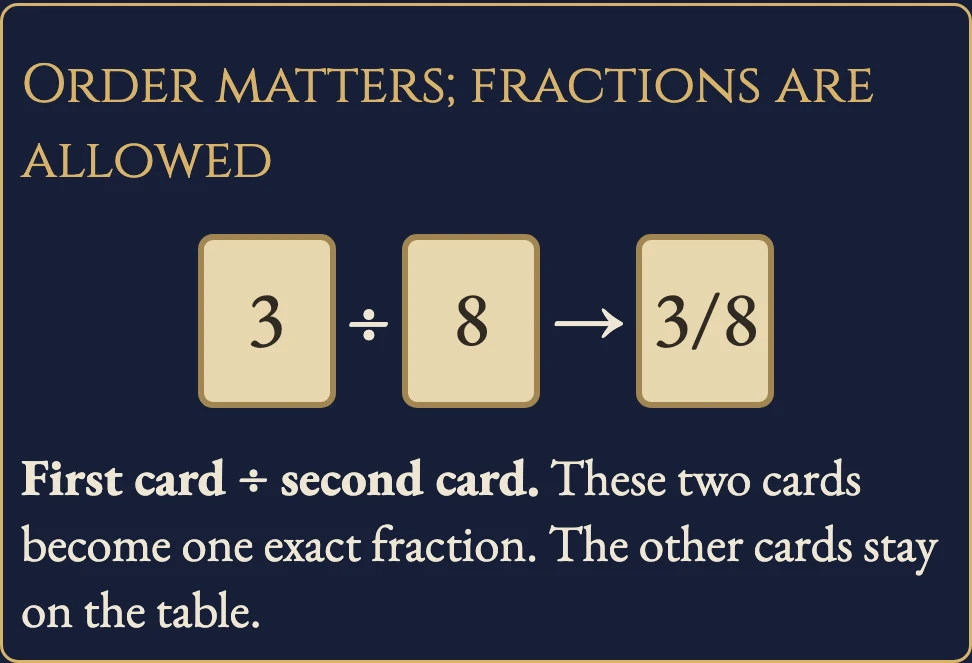
- Select a card, choose +, −, × or ÷, then select another card. Their result replaces those two cards. The first card is the left operand, so order matters for subtraction and division.
- Fractions, zero and negative intermediate values are allowed. Division by zero is refused. Do not concatenate cards or add roots, exponents or extra numbers.
- Combine three times to leave exactly 24. Any valid expression wins; a different final value can be undone.
- Single digits and Larger cards have a route with whole-number intermediate values. Fraction steps deals require fractions. These shelves describe arithmetic properties, rather than difficulty ratings.
- Undo and Redo restore your own combinations. Restart clears combinations but keeps the first clock running; later replays are Practice.
Controls
| Input | Action |
|---|---|
| Tap card → operation → card | Combine two current cards |
| 1–4 | Select an occupied card slot |
| +, -, *, / | Choose an operation |
| Z or Backspace / Y | Undo / Redo |
| R | Request Restart |
| Escape | Cancel a selection or close a panel |
Tips
- Work back from 24 Look for useful pairs such as 6 × 4, 8 × 3 or 12 × 2, then see whether your cards can make them.
- Keep fractions exact A fraction can be useful later. The cards retain exact values, so no rounding is needed.
- Try a different grouping Undo returns the cards from a combination. A different order may make a useful intermediate result.
Good to know
Your progress stays in this browser when storage is available. The first clock keeps running through menus, Restart and visits to the chooser. Reloaded unfinished attempts stay local. Practice preserves your first finish. No account is needed.
Watch how to play
Questions
Must I use every card?
Yes. Use each of the four original cards exactly once, even when some have the same number.
Are fractions or negative values allowed?
Yes. Fractional, zero and negative intermediate results are allowed; division by zero is refused.
Does every deal have just one expression?
No. Many deals have several valid expressions, and every exact expression using all four cards is accepted.
Can a deal be impossible?
Every published deal has at least one solution under these rules. An unhelpful route can still end at another value; Undo or Restart lets you try again.
What do the shelves mean?
Single digits and Larger cards have a whole-number route; Fraction steps has no whole-number-only route. They are properties of the cards, not promised difficulty levels.
Can Practice replace my first time?
No. Your first finish is kept; later completions are Practice.